Types of Donuts
Donuts fall into two core types: yeast-raised donuts, which are light and airy, and cake donuts, which are dense and crumbly. Popular styles include glazed, jelly-filled, Boston cream, old-fashioned, crullers, and fritters, plus international varieties like churros and mochi donuts. This guide helps foodservice operators choose, price, and package each type.
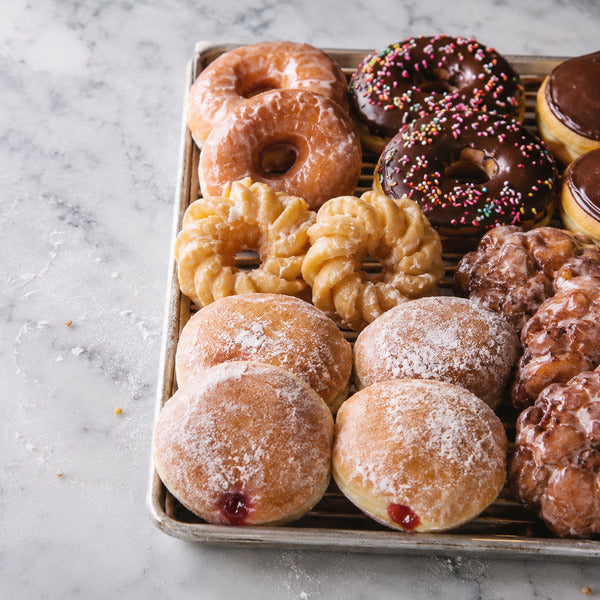
Every donut on a bakery menu starts as one of two doughs, and knowing the difference is the fastest way to understand all the types of donuts you can make, buy, or sell. At Restaurantware, we have spent 15+ years supplying 40,000+ foodservice operations — including bakeries, donut shops, cafés, and hotel breakfast programs — so this guide covers every major donut type from the operator's side of the counter: what each one is, how it is made, and how to price, package, and display it profitably. The donut business is worth defending: IBISWorld values the U.S. donut shop industry at $9.6 billion in 2026, spread across more than 14,000 shops.
TL;DR — Types of Donuts at a Glance
- Two core categories: yeast-raised (light, airy, fried after proofing) and cake (dense, tender, chemically leavened).
- Classic American styles: original glazed, chocolate frosted, jelly-filled, Boston cream, old-fashioned, French cruller, apple fritter, long john, donut holes, powdered sugar.
- International styles: churros (Mexico/Spain), beignets (New Orleans), malasadas (Portugal/Hawaii), paczki (Poland), sufganiyot (Israel), mochi donuts (Japan/Hawaii).
- Spelling: "doughnut" is the original spelling; "donut" is the accepted American shorthand. Both are correct.
- Pricing: most U.S. shops charge roughly $12–$20 per dozen for standard donuts; specialty and gourmet dozens run $24–$40.
Donut Type Comparison Table
| Donut Type | Base Dough | Texture | Signature Example | Best Packaging |
|---|---|---|---|---|
| Yeast-raised | Proofed yeast dough | Light, airy, chewy | Original glazed | Windowed bakery box (glaze needs airflow) |
| Cake | Batter with baking powder | Dense, tender crumb | Old-fashioned | Bakery box or paper bag |
| Filled | Yeast dough, no hole | Soft shell, creamy or fruity center | Boston cream, jelly | Single-layer box — never stack fillings |
| Cruller | Pâte à choux (egg-rich) | Crisp outside, custardy inside | French cruller | Bakery tissue + windowed box |
| Fritter | Yeast dough + fruit | Craggy, caramelized | Apple fritter | Grease-resistant paper bag |
| International | Varies (choux, rice flour, enriched) | Varies by style | Churro, beignet, mochi donut | Style-specific — see below |
What Are the Two Main Types of Donuts?
The two main types of donuts are yeast-raised donuts and cake donuts. Every classic style on this list — from the original glazed to the old-fashioned — is built on one of these two doughs, so the yeast-versus-cake split is the foundation of every donut menu.
Yeast-Raised Donuts
A yeast-raised donut is made from a proofed, enriched yeast dough that is rolled, cut, allowed to rise, and fried at roughly 350–375°F. Fermentation creates the airy, pillowy interior and the slight chew that defines styles like the original glazed, jelly-filled, Boston cream, and long john. Yeast donuts are taller and lighter than cake donuts and absorb less oil, but they are also more time-sensitive: proofing takes hours, and the finished donut stales faster. In our experience supplying donut shops, yeast-raised styles are the volume drivers — they dominate the dozen-box business.
Cake Donuts
A cake donut is made from a sweet batter leavened with baking powder instead of yeast, deposited directly into the fryer through a dropper. The result is a dense, tender, crumbly interior with a crisp exterior — closer to a muffin than to bread. Old-fashioneds, sour cream donuts, powdered sugar donuts, and most seasonal flavors (pumpkin spice, apple cider) are cake donuts. Cake batter also adapts well to baked formats: many cafés without fryers bake cake donuts in molds such as our Pastry Tek 6-compartment silicone ridged donut mold, which lets a kitchen add donuts to the menu with nothing but an oven.
Cake vs. Yeast Donuts: How Do You Tell Them Apart?
Cake donuts are dense, crumbly, and flat-topped; yeast donuts are tall, light, and airy. Pick the donut up: a yeast donut feels almost weightless for its size, while a cake donut has real heft. Bite texture settles any doubt — cake donuts crumble, yeast donuts tear. For operators, the practical difference is workflow: cake batter goes from mixer to fryer in minutes, while yeast dough demands proofing time and planning.
What Are the Most Popular Glazed, Filled, and Topped Donut Styles?
The most popular donut styles in the United States are the original glazed, chocolate frosted, jelly-filled, Boston cream, old-fashioned, French cruller, apple fritter, long john, powdered sugar donut, and donut holes. Here is what defines each one.
1. Original Glazed
The original glazed is a yeast-raised ring dipped in a thin sugar glaze while still warm, creating the translucent shell that cracks delicately when bitten. It is the best-selling donut type in America and the benchmark by which customers judge a shop. Krispy Kreme built an entire brand on this single style, selling its Original Glazed since 1937.
2. Chocolate Frosted & Sprinkled
A chocolate frosted donut is a yeast ring topped with a thick chocolate icing, often finished with rainbow sprinkles. It is the donut of birthday boxes and kids' menus — and in our customers' display cases, the color contrast of a sprinkled row consistently pulls impulse buys.
3. Jelly-Filled
A jelly-filled donut is a holeless yeast donut injected with fruit jam — traditionally raspberry or strawberry — and rolled in granulated sugar. The style descends from the German Berliner and the Israeli sufganiyah, both covered in the international section below.
4. Boston Cream
A Boston cream donut is a yeast shell filled with vanilla pastry cream and topped with chocolate glaze — a handheld version of Boston cream pie. It is the official state donut of Massachusetts and a permanent top-five seller in most East Coast shops.
5. Old-Fashioned
An old-fashioned is a cake donut, usually made with sour cream, fried at a slightly lower temperature so its edges crack into crisp, craggy ridges. Those ridges hold glaze better than any other donut surface, which is why glazed old-fashioneds have such a devoted following. Its sturdy crumb also makes it the best donut for dunking in coffee.
6. French Cruller
A French cruller is piped from pâte à choux — the same egg-rich dough used for éclairs — into a fluted ring, then fried and glazed. The result is the lightest donut in the case: crisp and ridged outside, nearly hollow and custardy inside. Crullers are fragile, so they belong in their own box layer with bakery tissue between rows.
7. Apple Fritter
An apple fritter is an irregular, hand-formed mass of yeast dough folded with chopped apples and cinnamon, fried until deeply caramelized, and glazed. Fritters are the heavyweight of the case — often twice the size of a ring donut — which justifies premium single-unit pricing.
8. Long John (Bar Donut)
A long john is a bar-shaped yeast donut, typically frosted with chocolate or maple icing and sometimes filled with custard or cream. In the Midwest, the maple long john topped with bacon has become a signature indulgence item.
9. Powdered Sugar & Cinnamon Sugar
Powdered sugar donuts and cinnamon sugar donuts are cake donuts tumbled in their coating immediately after frying. They are inexpensive to produce and travel well, making them staples of grocery and grab-and-go programs — though powdered styles demand tight packaging, because loose sugar dusts everything it touches.
10. Donut Holes
Donut holes are the fried centers cut from ring donuts — or purpose-made small rounds — sold by the dozen in glazed, powdered, and chocolate varieties. They turn what was once waste into one of the highest-margin items in the case, and they are ideal for catering trays and sampler boxes. Dunkin' branded them "Munchkins" and Tim Hortons calls them "Timbits" — proof that a byproduct can become a product line of its own.
What Are the Best International Donuts?
The most popular international donuts are churros, beignets, malasadas, paczki, sufganiyot, and mochi donuts. Each brings a distinct dough, texture, and tradition — and each gives an American menu a differentiated item competitors cannot match with another glazed ring.
Churros (Mexico & Spain)
A churro is a ridged stick of choux-style dough piped through a star tip, fried, and rolled in cinnamon sugar. Churros are the answer to the common question "what is a Mexican donut called," and they are frequently served with chocolate or dulce de leche dipping sauce. Their stick shape makes them the easiest donut type to serve in cones and paper sleeves for walk-away snacking.
Beignets (France & New Orleans)
A beignet is a square of fried yeast dough buried under powdered sugar, served hot in orders of three. It is the signature donut of New Orleans, inseparable from café au lait and best sold as a plated, made-to-order item rather than a case donut.
Malasadas (Portugal & Hawaii)
A malasada is a Portuguese fried dough ball — eggy, holeless, and rolled in granulated sugar — brought to Hawaii by Portuguese plantation workers in the late 1800s. Modern Hawaiian shops fill them with haupia (coconut), guava, and lilikoi custards.
Paczki (Poland)
A paczek (plural: paczki) is a rich Polish donut made from an egg- and butter-heavy dough, filled with rose hip jam, plum butter, or custard. Paczki are a Fat Thursday and Fat Tuesday tradition, and bakeries in Polish-American cities take pre-orders by the hundreds of dozens in the week before Lent — a seasonal spike worth planning packaging inventory around.
Sufganiyot (Israel)
A sufganiyah is a round jelly donut fried in oil and eaten during Hanukkah, when fried foods commemorate the miracle of the oil. Classic versions hold strawberry jam under powdered sugar; modern Israeli bakeries pipe them high with pistachio cream, halva, and chocolate ganache.
Mochi Donuts (Japan & Hawaii)
A mochi donut is made with glutinous rice flour, giving it a signature chewy-bouncy texture, and is most recognizable in the pon de ring shape — a ring of eight connected dough balls that pull apart cleanly. Mochi donuts are the fastest-growing donut trend in U.S. metros, and their Instagram-friendly pull-apart format rewards windowed packaging that shows off the shape.
What Are the Most Popular Donut Flavors?
The most popular donut flavors are glazed, chocolate, maple, vanilla frosted, strawberry, blueberry, apple cinnamon, and lemon, with seasonal flavors like pumpkin spice and peppermint rotating through fall and winter menus. Flavor is a separate decision from donut type: the same yeast ring can carry a dozen different glazes, icings, and toppings, which is how a shop with two base doughs can present a case of thirty distinct donuts.
- Classic flavors: plain glazed, chocolate frosted, vanilla frosted, powdered sugar, and cinnamon sugar remain the top sellers in nearly every U.S. market.
- Fruit flavors: strawberry, blueberry, raspberry, lemon, and apple appear as fillings, glazes, and mix-ins — blueberry cake donuts are a West Coast staple.
- Premium flavors: maple (especially maple bacon), matcha, ube, salted caramel, and dulce de leche anchor specialty menus and support premium pricing.
- Seasonal flavors: pumpkin spice cake donuts drive fall traffic, while peppermint, eggnog, and gingerbread carry the holidays. Tastewise trend data shows chocolate, berry, and cinnamon leading donut pairings year-round.
For operators, the rule we share with our bakery customers is simple: keep 60–70% of the case in classic flavors that guarantee turnover, and use the remaining slots for premium and seasonal flavors that create return visits and social posts.
Is It Donuts or Doughnuts?
Both spellings are correct: "doughnut" is the original spelling, and "donut" is the accepted American variant. "Doughnut" appears in print by the early 1800s — Washington Irving described "dough-nuts" in 1809 — and it remains the preferred spelling in most dictionaries and in British English. "Donut" is a 20th-century American simplification popularized by Dunkin' Donuts after 1950, and it now dominates U.S. shop signage and search behavior. Use whichever your audience uses; in the United States, that is increasingly "donut."
How Much Should a Dozen Donuts Cost?
A dozen standard donuts costs roughly $12–$20 at most U.S. donut shops in 2026, while specialty and gourmet dozens run $24–$40. Grocery-store dozens sit lower, at about $6–$10. Where an individual shop should price within those ranges depends on four factors:
- Dough type: yeast and cake rings are the low-cost anchors; filled donuts, fritters, and mochi donuts carry 25–75% premiums for labor and ingredients.
- Market: urban specialty shops command nearly double the price of rural and suburban legacy shops.
- Format: the dozen box should always be priced below 12 single donuts — the discount drives the higher-ticket sale.
- Presentation: our foodservice customers consistently tell us that windowed bakery boxes and branded packaging are what make a $24 specialty dozen look worth $24. Customers judge value with their eyes before they taste anything.
Industry economics support premium pricing done well: IBISWorld reports the U.S. donut shop industry grew at a 5.8% annualized rate from 2020 to 2025, and donuts hold a durable place on menus — Tastewise menu data shows about 14% of U.S. restaurants now offer donuts, well beyond dedicated donut shops.
Outfitting a donut program? Browse our full collection of bakery boxes and cake boxes — including windowed dozen and half-dozen formats that protect glazes and sell the contents on sight.
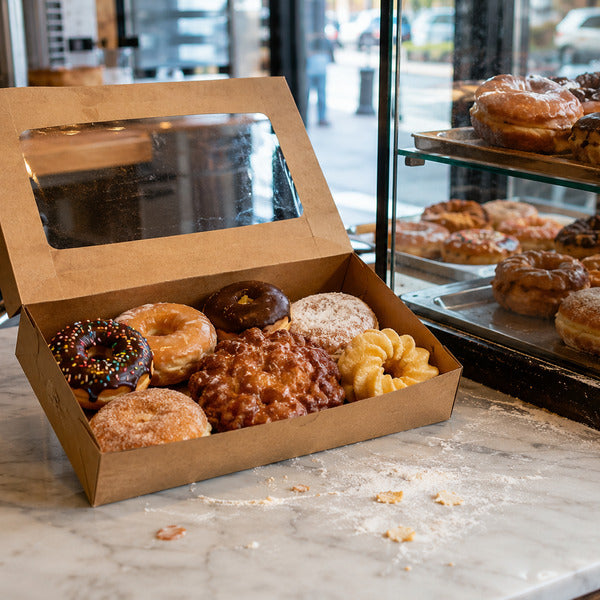
How Should Foodservice Operators Serve, Package, and Display Donuts?
Match the packaging to the donut type: airflow for glazed, single layers for filled, grease-resistance for fritters, and visibility for everything. In 15+ years supplying 40,000+ foodservice operations, we've seen more donut programs lose margin to smeared glaze and crushed fillings than to any recipe problem. The donut survives the fryer; it gets ruined in transit. The stakes are bigger than a single box, too — the National Restaurant Association projects U.S. restaurant industry sales of $1.55 trillion in 2026, and grab-and-go bakery is fighting for its share of every morning daypart dollar.
Boxes: Sell the Donuts Through the Lid
Windowed bakery boxes do two jobs: they protect the product and they merchandise it. A Pastry Tek pink-and-white stripe window box reads as classic donut-shop nostalgia, while a kraft paper window box signals artisan quality for specialty and mochi programs. Keep filled donuts — Boston creams, jellies, paczki — in a single layer; stacked fillings blow out.
Bags: Own the Single-Donut Sale
Most donut transactions are one or two units, not a dozen. Grease-resistant paper bags in signature patterns — like our Bag Tek yellow polka dot bags or pink zig zag bags — turn a $3 impulse buy into a walking advertisement. Browse the full bakery bags collection for colors that match your brand.
Display: Height and Color Move Product
Display each donut type at an angle, grouped by color contrast, with the highest-margin styles at eye level. Tiered stands and risers from our food display and merchandising collection add the vertical drama that flat trays cannot, and our bakery customers report that a well-lit, color-blocked donut case measurably lifts impulse attachment on coffee orders.
Frequently Asked Questions About Types of Donuts
Is it spelled donuts or doughnuts?
Both spellings are correct. "Doughnut" is the original, dictionary-preferred spelling; "donut" is the standard American shorthand popularized by Dunkin' Donuts in the mid-20th century. U.S. shops, menus, and searches now favor "donut," while British English retains "doughnut."
What is a Mexican donut called?
A Mexican donut is called a churro — a ridged stick of fried dough rolled in cinnamon sugar, often served with chocolate or dulce de leche for dipping. Mexico also has the dona, a ring-style glazed donut sold in panaderías.
How much should 12 donuts cost?
Twelve donuts should cost about $12–$20 at a standard U.S. donut shop, $6–$10 at a grocery store, and $24–$40 at a specialty or gourmet shop. Filled donuts, fritters, and trend styles like mochi donuts justify the higher end of each range.
Which company makes the best donuts?
No single company makes the objectively best donuts — it depends on style. Krispy Kreme is famous for its Original Glazed, sold since 1937; Dunkin' operates the largest U.S. donut-serving chain with the broadest variety; and independent shops typically win on freshness, fritters, and specialty types like mochi donuts.
Why do Americans spell it donut?
Americans spell it "donut" because the simplified spelling is shorter, phonetic, and was cemented in popular culture when Dunkin' Donuts adopted it in 1950. Signage and advertising favored the compact form, and over decades it became the dominant American spelling.
Which country eats the most donuts?
The United States consumes the most donuts by total volume, supporting a donut shop industry that IBISWorld values at $9.6 billion in 2026. Canada, however, is widely reported to have the most donut shops per capita of any country, driven largely by the Tim Hortons chain.
What are the two types of doughnuts?
The two types of doughnuts are yeast-raised doughnuts and cake doughnuts. Yeast doughnuts use fermented, proofed dough for a light, airy texture (glazed, filled, long johns); cake doughnuts use chemically leavened batter for a dense, tender crumb (old-fashioneds, sour cream, powdered sugar).
Final Thoughts: Build a Donut Menu That Sells
Understanding the types of donuts — yeast versus cake at the foundation, the ten classic American styles, and the six international varieties reshaping menus — is what separates a deliberate donut program from a case of assorted rings. Start with flawless glazed and old-fashioned anchors, add one filled and one fritter for ticket size, and test an international style like mochi donuts or churros to differentiate. Then protect every unit you fry: the right box, bag, and display turn quality product into repeat revenue.
Restaurantware has spent 15+ years helping 40,000+ foodservice operations present bakery products at their best. Shop our bakery boxes collection to find the windowed dozen boxes, single-serve bags, and display pieces your donut program deserves.