Cake Frostings
Cake frostings are sweet, spreadable coatings made from butter, sugar, eggs, cream, or chocolate that cover, fill, and decorate cakes. The 12 core types are American, Swiss meringue, Italian meringue, French, German, and ermine buttercreams, cream cheese frosting, whipped cream, ganache, fondant, royal icing, and glaze. This guide also covers piping tips, scrapers, and toppers.
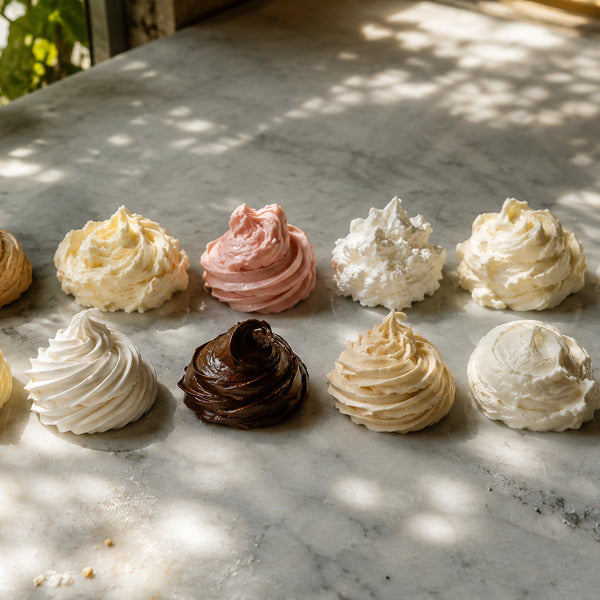
Choosing among cake frostings is the single highest-leverage decision in cake production. It determines sweetness, pipe-ability, heat tolerance, display life, and whether a finished cake survives a delivery van in July. At Restaurantware, we have spent 15+ years supplying 40,000+ foodservice operations, and we have watched the same pattern repeat in bakeries of every size: the frosting choice, not the cake recipe, is what separates a pastry case that sells out from one that slumps by noon. This consolidated guide covers all 12 major cake frostings, then the tools that finish them — piping tips, cake scrapers and icing combs, cake toppers, and the trending frosting board.
TL;DR — Cake Frostings at a Glance
- Fastest and sweetest: American buttercream — the workhorse of U.S. bakeries and the most popular cake frosting nationwide.
- Silkiest for wedding cakes: Swiss and Italian meringue buttercreams — less sweet, glass-smooth, heat-stable enough for tiered work.
- Best for chocolate cakes: ganache — a two-ingredient chocolate-and-cream frosting that pours, whips, or sets firm.
- Best for carrot cake and red velvet: cream cheese frosting — tangy, soft, and a time/temperature-controlled (TCS) food under the FDA Food Code.
- Best for sculpted showpieces: rolled fondant over a buttercream or ganache base.
- Tools matter as much as recipes: piping tips, metal cake scrapers, icing combs, and a weighted turntable produce the finish customers pay for.
| Frosting | Base | Sweetness | Stability | Best For | Skill Level |
|---|---|---|---|---|---|
| American buttercream | Butter + powdered sugar | Very high | High (crusts, holds at room temp) | Sheet cakes, piped flowers, cupcakes | Beginner |
| Swiss meringue buttercream | Heated egg whites + sugar + butter | Medium | Medium-high | Wedding cakes, smooth finishes | Intermediate |
| Italian meringue buttercream | Hot sugar syrup + egg whites + butter | Medium | High (most heat-stable buttercream) | Tiered and summer event cakes | Advanced |
| French buttercream | Egg yolks + hot syrup + butter | Medium | Low (soft, heat-sensitive) | Fillings, tortes, plated desserts | Advanced |
| German buttercream | Pastry cream + butter | Medium-low | Low (refrigerate) | Fillings, European-style tortes | Intermediate |
| Ermine (flour) buttercream | Cooked flour-milk roux + butter | Low-medium | Medium | Red velvet, less-sweet menus | Intermediate |
| Cream cheese frosting | Cream cheese + butter + sugar | Medium | Low (TCS — keep at 41°F/5°C or below) | Carrot cake, red velvet, cinnamon rolls | Beginner |
| Whipped cream (Chantilly) | Heavy cream + sugar | Low | Very low (refrigerate, short display life) | Fresh fruit cakes, light desserts | Beginner |
| Ganache | Chocolate + cream | Medium (depends on chocolate) | High when set | Chocolate cakes, drip cakes, under fondant | Beginner-intermediate |
| Fondant | Rolled sugar paste | Very high | Very high | Sculpted wedding and celebration cakes | Advanced |
| Royal icing | Egg whites/meringue powder + sugar | Very high | Dries hard | Cookies, string work, gingerbread | Intermediate |
| Glaze / mirror glaze | Sugar + liquid (or gelatin + chocolate) | High | Medium | Bundts, entremets, doughnuts | Beginner-advanced |
What Are Cake Frostings, and How Does the Category Break Down?
Cake frostings are defined as sweetened coatings and fillings — built on fat, sugar, eggs, dairy, or chocolate — that finish a cake's surface and interior. The category breaks down into four families: buttercreams (American, Swiss, Italian, French, German, ermine), dairy-based frostings (cream cheese, whipped cream), chocolate-based frostings (ganache), and sugar-paste finishes (fondant, royal icing, glazes).
Frosting and icing are often used interchangeably, but in professional kitchens the distinction is texture: frosting is thick, fluffy, and spreadable; icing is thinner and dries to a firmer, often glossy finish. Buttercream is a frosting; royal icing and glazes are icings; fondant is a rolled paste in its own class. This is not an academic distinction — the four families behave differently at every stage, from mixer to pastry case. The U.S. commercial baking industry employs almost 800,000 workers and generates an overall economic impact of more than $186 billion, according to the American Bakers Association, and a meaningful share of that output is decorated product where the frosting choice drives both labor cost and sell-through.
What Are the 12 Types of Cake Frosting?
The 12 types of cake frosting are American buttercream, Swiss meringue buttercream, Italian meringue buttercream, French buttercream, German buttercream, ermine buttercream, cream cheese frosting, whipped cream frosting, ganache, fondant, royal icing, and glaze. Each is defined below with its best use in a working bakery.
1. American Buttercream
American buttercream is a fast frosting of softened butter (or part shortening) beaten with powdered sugar, milk, and vanilla. It is the sweetest and most forgiving of all cake frostings, it crusts lightly for clean stacking, and it holds piped detail — flowers, borders, rosettes — better than any other buttercream. It is also the most room-temperature-stable buttercream, which is why it dominates American pastry cases, grocery bakeries, and cupcake programs. If a menu lists "easy cake frostings," this is the answer: four ingredients, one mixer, no thermometer.
2. Swiss Meringue Buttercream
Swiss meringue buttercream is made by heating egg whites and sugar to about 160°F over a water bath, whipping the mixture to a glossy meringue, then beating in butter. The result is silky, light, and roughly half as sweet as American buttercream. It takes color beautifully and smooths to a near-porcelain finish under a metal scraper, which makes it a leading choice among wedding cake frostings.
3. Italian Meringue Buttercream
Italian meringue buttercream is built by streaming 240°F sugar syrup into whipping egg whites before adding butter. The cooked syrup produces the most stable meringue of the three, so Italian meringue buttercream tolerates warm venues and long display windows better than Swiss or French versions. For tiered event cakes delivered in summer, it is the professional default.
4. French Buttercream
French buttercream is an egg-yolk buttercream: hot sugar syrup is whipped into yolks (a pâte à bombe), then butter is added. Yolks make it the richest and most custard-like of the buttercreams — and the softest. It shines as a torte filling or plated-dessert component, but it slumps in heat and is a poor choice for exterior work on display cakes.
5. German Buttercream
German buttercream is pastry cream (a cooked custard of milk, yolks, sugar, and starch) beaten with softened butter. It is lush, notably less sweet, and popular in European-style tortes and filled celebration cakes. Because it is custard-based, it is a perishable frosting that belongs under refrigeration between service windows.
6. Ermine (Flour) Buttercream
Ermine buttercream — also called flour buttercream or boiled-milk frosting — starts with a cooked roux of flour, milk, and sugar that is cooled and whipped into butter. It is the traditional partner for red velvet cake, with a texture close to whipped cream and a restrained sweetness that reads "homemade." Ermine is trending again as customers push back on ultra-sweet finishes.
7. Cream Cheese Frosting
Cream cheese frosting is cream cheese and butter beaten with powdered sugar and vanilla. Its tang is the classic counterpoint for carrot cake, red velvet, and spice cakes — when customers search for carrot cake frostings, this is the one they mean. Operationally, it is soft, over-beats easily, and is a time/temperature control for safety (TCS) food: under the FDA Food Code, it must be cold-held at 41°F (5°C) or below, and ready-to-eat TCS items held longer than 24 hours must be date-marked and used within 7 days.
8. Whipped Cream Frosting (Chantilly)
Whipped cream frosting is heavy cream whipped with sugar and vanilla, often stabilized with gelatin, mascarpone, or cream cheese for display work. It is the lightest of all cake frostings and pairs with fresh fruit, sponge cakes, and lemon cakes where a rich buttercream would overwhelm. It has the shortest display life in this guide: refrigerated storage is mandatory and same-day service is the rule.
9. Ganache
Ganache is a two-ingredient frosting of chocolate melted into hot cream. Ratio controls texture: 1:1 chocolate to cream spreads like frosting, 2:1 sets firm for truffle coats and sharp-edged finishes, and a thinned pour makes the drip on drip cakes. Among chocolate cake frostings, ganache is the professional benchmark — deep chocolate flavor, no grit, and a firm set that makes it the standard undercoat for fondant.
10. Fondant
Rolled fondant is a pliable sugar paste — sugar, glucose, and glycerin, sometimes with gelatin or marshmallow — draped over a crumb-coated cake for a flawless matte surface. It is the medium for sculpted wedding cakes, sharp modern tiers, and printed or embossed designs. Fondant is almost always applied over a thin base of American buttercream or ganache, which is why "buttercream vs. fondant" is a false choice: showpiece cakes usually use both.
11. Royal Icing
Royal icing is egg whites (or meringue powder) whipped with powdered sugar into an icing that dries rock-hard. It is the tool for decorated sugar cookies, string work, run-outs, and gingerbread construction — not for coating soft cake layers. In cake work its role is detail: piped lace, monograms, and structural decorations made ahead.
12. Glazes and Mirror Glaze
A glaze is a thin icing of powdered sugar and liquid — citrus juice, coffee, or milk — poured over Bundts, loaf cakes, and doughnuts. Mirror glaze is its high-gloss cousin: gelatin, sugar, condensed milk, and chocolate poured at ~90°F over a frozen entremet for a reflective finish. Glazes deliver maximum visual return for minimum labor, which is why they anchor grab-and-go bakery programs.
Which Frosting Goes With Which Cake?
Match the frosting to the cake's density and flavor: chocolate cake takes ganache or a chocolate American buttercream; carrot cake takes cream cheese frosting; lemon cake takes lemon cream cheese frosting, whipped cream, or a citrus glaze; red velvet takes ermine or cream cheese; wedding cakes take Swiss or Italian meringue buttercream, or fondant over ganache. When in doubt, lighter cakes get lighter frostings.
Outfitting a decorating station? Browse Restaurantware's piping tips, pastry bags, and accessories and baking and icing spatulas — wholesale pricing, stocked for foodservice volume.
Which Piping Tips Do You Need for Cake Frosting?
Piping tips are shaped metal nozzles that turn frosting into decoration, and five families cover 95% of cake work: round, open star, closed star, petal, and leaf. Understanding the different piping tips and what they do is faster than memorizing catalog numbers — every design on a bakery cake comes from one of these profiles plus pressure control.
- Round tips pipe dots, pearls, lettering, and macaron shells. Small rounds (#1–#5) handle writing; large rounds fill cupcakes and pipe smooth "rope" borders.
- Open star tips (like the classic 1M profile) pipe rosettes, shells, and the swirl on nearly every American cupcake. The open teeth create deep, defined ridges.
- Closed star tips curve inward for tighter, more ruffled stars and drop flowers with more petal texture than an open star produces.
- French star tips carry fine, numerous teeth for delicate ridged shells and Saint-Honoré-style work.
- Petal tips have a teardrop opening that pipes roses, ruffles, and fabric-like draping — the foundation of piped-flower work.
- Leaf tips (the V-shaped opening) pipe foliage with a natural center vein to finish floral arrangements.
- Specialty tips cover basketweave (one flat ridged side), grass/fur multi-opening tips, and ball tips for modern dot cakes.
- Russian piping tips are oversized nozzles with an internal die that extrudes a complete flower in a single squeeze — a genuine labor saver for high-volume decorated cupcakes. A stainless steel option like the Pastry Tek stainless steel #57 Russian piping tip requires a stiff American buttercream to hold the petal definition.
Two practical rules govern piping tip designs. First, match tip size to bag size: large tips (1M-class and Russian tips) drop directly into an 18-inch bag such as a Pastry Tek 18" biodegradable piping bag, while standard tips pair with a coupler so you can swap designs without emptying the bag. Second, match the frosting to the tip: medium-stiff American buttercream holds the sharpest detail from different icing tips; meringue buttercreams pipe smooth, softer-edged designs at cool room temperature; whipped cream needs large tips and gentle pressure; ganache pipes best slightly whipped.
How Do Cake Scrapers and Icing Combs Create a Flawless Finish?
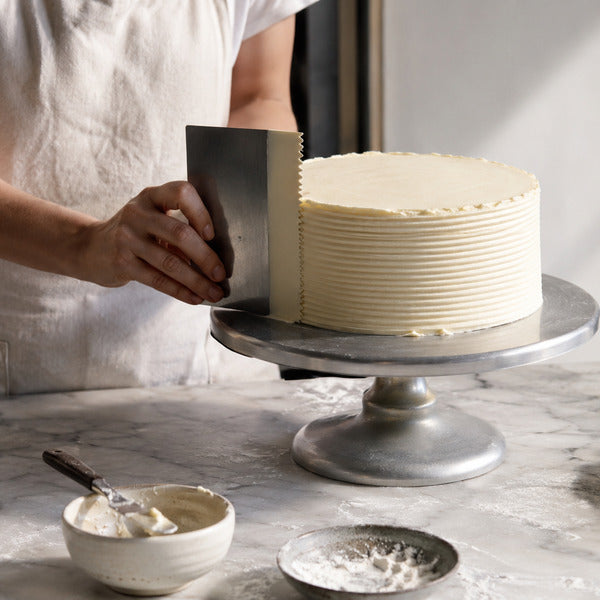
A cake scraper is a rigid flat blade held against a rotating cake to level the frosting; an icing comb is a scraper with a patterned edge that cuts decorative grooves in one pass. Together with a turntable, these baking combs are the difference between a homemade look and the sharp, seamless sides customers photograph.
The best cake scraper for buttercream is rigid stainless steel with a true 90° edge — flexible plastic bows under pressure and leaves waves in the finish. Metal combs also chill well, which matters because a cold blade cuts cleaner grooves in buttercream. Multi-pattern combs stretch one tool across several looks: the Pastry Tek 4-pattern metal cake scraper and icing comb (wave and wide tooth) and the Pastry Tek 3-pattern comb with pleated design edge each put multiple textures on a single blade, so a decorator can offer striped, pleated, and smooth finishes without re-tooling. Browse the full range of icing combs and smoothers for straight-edge, fine-tooth, and scalloped profiles.
The best cake decorating turntable is heavy enough not to walk across the bench, spins friction-free, and grips the cake board. A weighted 12-inch model with a non-slip base, like the Pastry Tek 12" revolving cake stand with non-slip base, is the standard footprint for 6- to 10-inch cakes. The professional sequence: crumb-coat with an 8-inch offset spatula, chill 20 minutes, apply the final coat generously, then hold the scraper steady at 90° and spin the turntable — the tool stays still, the cake moves. Chill again before combing a pattern.
What Is a Cake Topper, and Which Type Should You Choose?
A cake topper is a decorative piece — paper, acrylic, plastic, or edible — placed on top of a finished cake to communicate the occasion instantly. Toppers matter commercially because they convert a plain frosted cake into a birthday, anniversary, or holiday SKU without added decorating labor.
The main types of cake toppers are:
- Paper pick toppers — die-cut designs on food-safe picks; the lowest-cost way to theme a cake or cupcake set. Insert just before display so frosting moisture never wicks into the paper.
- Acrylic toppers — rigid, reusable-look script pieces ("Happy Birthday," names, ages). A mirrored gold acrylic topper like the Top Cake gold mirrored Happy Birthday topper photographs like metal at a disposable price point.
- Number toppers — a single "1" cake topper for first birthdays, paired digits for milestone anniversaries. An anniversary cake topper in script or numerals is the fastest personalization a counter program can offer.
- Novelty and plush-character toppers — trending keepsake pieces (plush animals in the style of Jellycat and similar brands) that customers supply or buy as add-ons. Plush and other non-food-safe items must sit on a barrier — a fondant disc, cake board circle, or food-safe pick — never directly in the frosting.
- Fresh flowers and edible toppers — florals need food-safe, pesticide-free stems wrapped or picked; edible toppers (chocolate plaques, printed wafer paper) are the only kind that can touch frosting with zero barrier.
Match the topper to the frosting: firm surfaces (American buttercream, ganache, fondant) support heavier acrylic and number toppers; soft frostings (whipped cream, cream cheese) need lightweight paper picks. Restaurantware's decorative cake toppers collection covers birthday, holiday, and themed programs by the case.
What Is a Frosting Board?
A frosting board — also called a buttercream board or frosting charcuterie board — is a serving board spread with a thick, swooped layer of frosting, finished with piped accents, sprinkles, and fruit, and served with dippables like cookies, pretzels, graham crackers, and cake cubes. It is the dessert answer to the butter board, and it has become a genuine catering upsell: interactive, photogenic, and built from ingredients a bakery already stocks.
To build one that wows guests: spread a base of American or Swiss meringue buttercream in overlapping swoops (an offset spatula makes the signature ridges), pipe contrasting rosettes with a star tip, then zone the board — chocolate ganache drizzle on one third, citrus curd on another, crushed cookies and sprinkles across the top. Serve with sturdy dippers and small spreaders. Two operational notes: portion roughly 1/3 cup of frosting per guest, and treat any board built on cream cheese frosting or whipped cream as a TCS item — keep it at 41°F or below until the moment of service, per the FDA Food Code. Boards intended for display longer than 2 hours should be built on American buttercream or ganache, which hold safely at room temperature.
How Do Professional Bakeries Choose and Handle Frostings?
Professional bakeries choose frostings on three criteria — pipe-ability, heat tolerance, and display life — and the winning frosting is the one that survives the pastry case, not just the taste test. In 15+ years supplying 40,000+ foodservice operations, we've seen high-volume shops standardize on American buttercream for decorated counter cakes precisely because it crusts, stacks, and holds at ambient temperature through a full retail day, while reserving Swiss meringue buttercream and ganache for pre-ordered event work where refrigerated staging is guaranteed.
The demand side rewards that discipline. In Datassential's consumer research, 57% of consumers say they are interested in nostalgic desserts — flavors like birthday cake, s'mores, and banana pudding — while only about two in five operators serve them, and 82% of consumers are at least somewhat interested in mini desserts (Datassential). Translation for a bakery program: classic frosted formats in smaller, grab-and-go portions are an underserved gap, and frosting finish quality is the merchandising.
Food safety draws the operational line between frosting families. American buttercream, ganache, fondant, royal icing, and glazes are shelf-stable enough for ambient display. Cream cheese frosting, whipped cream, German buttercream, and French buttercream are perishable: the FDA Food Code requires cold holding at 41°F (5°C) or below, with date marking and a 7-day maximum for ready-to-eat TCS foods held beyond 24 hours. Build your case layout around that split, and label finished cakes accordingly when they leave in cake boxes and bakery boxes.
Our foodservice customers consistently tell us the same thing about tools: upgrading from flexible plastic to rigid metal scrapers and from cut-corner zip bags to real piping bags changed their finish quality overnight — buttercream sides came out flat and photographable, and decorated-cake returns dropped. The equipment is cheap relative to the labor it saves; a full decorating station (turntable, offset spatulas, tips, bags, combs) costs less than one wedding cake order.
Frequently Asked Questions
What is the most popular cake frosting?
American buttercream is the most popular cake frosting in the United States. Its four-ingredient simplicity, sweet vanilla flavor, room-temperature stability, and ability to hold piped decoration make it the default in retail bakeries, grocery cake programs, and home kitchens alike. Cream cheese frosting and chocolate ganache are the most requested alternatives.
What are the types of cake frostings?
The 12 types of cake frostings are American buttercream, Swiss meringue buttercream, Italian meringue buttercream, French buttercream, German buttercream, ermine (flour) buttercream, cream cheese frosting, whipped cream frosting, ganache, fondant, royal icing, and glaze (including mirror glaze). They group into buttercreams, dairy-based frostings, chocolate-based frostings, and sugar-paste finishes.
What are the 7 types of icing?
The 7 types of icing taught in classic pastry curricula are buttercream, royal icing, fondant, ganache, whipped cream, glaze, and boiled (meringue-type) icing. Modern guides expand the list to 12 by splitting buttercream into its American, Swiss, Italian, French, German, and ermine styles, as this guide does.
What frosting do professionals use for cakes?
Professionals use Swiss or Italian meringue buttercream for smooth-finish wedding and event cakes, American buttercream for high-volume decorated and piped work, and ganache for chocolate cakes, drip cakes, and as the firm undercoat beneath fondant. The choice follows the job: heat tolerance and display life for events, speed and pipe-ability for daily production.
What is the tastiest frosting?
The tastiest frosting is subjective, but Swiss meringue buttercream wins the most professional votes for its silky texture and balanced sweetness, while cream cheese frosting wins on flavor contrast for spiced cakes. In consumer terms, familiar nostalgic flavors dominate — Datassential finds 57% of consumers are drawn to nostalgic dessert flavors like birthday cake, which keeps classic vanilla American buttercream at the top of actual sales.
Conclusion: Match the Frosting to the Job, Then Tool Up
Cake frostings are a system, not a single recipe: choose the family that fits the cake, the climate, and the display window — then let the tools deliver the finish. American buttercream runs the counter, meringue buttercreams and ganache win events, cream cheese and whipped cream demand cold-chain discipline, and fondant, royal icing, and glazes handle the showpieces and grab-and-go ends of the menu. The piping tips, scrapers, combs, turntables, and toppers covered above are what turn a correct frosting choice into a cake that sells.
Ready to build or upgrade your decorating program? Shop Restaurantware's piping tips and pastry bags, icing combs and smoothers, cake turntables, and cake toppers — professional-grade supplies, stocked in wholesale quantities for bakeries, cafés, and caterers.
….