Food Truck Vs Food Cart: What's The Difference?
A food truck is a self-contained motorized vehicle with an onboard kitchen for cooking full menus, while a food cart is a small non-motorized unit that is pushed or towed and typically serves pre-made or simple foods. Trucks cost more and face heavier licensing; carts are cheaper and easier to permit. Choose a truck for cooking capacity, a cart for low-cost entry.
By Jamil Bouchareb, CEO of Restaurantware
The food truck vs food cart decision is the first — and most financially consequential — choice every mobile food entrepreneur makes. One format can exceed $150,000 before you sell a single taco; the other can put you in business for less than the price of a used sedan. In 15+ years supplying more than 40,000 foodservice operations at Restaurantware, we've outfitted both trucks and carts, and we've watched the same pattern repeat: operators obsess over the vehicle and underestimate everything else, from permits to packaging.
TL;DR: Food trucks offer full onboard kitchens, bigger menus, and higher revenue ceilings, but they demand $50,000–$200,000 in startup capital and heavy permitting. Food carts start at roughly $5,000–$15,000, permit faster, and suit focused single-item menus. Food trailers sit in between: truck-level kitchen space without the engine, but you need a tow vehicle.
Food truck vs food cart at a glance
| Factor | Food Truck | Food Cart |
|---|---|---|
| What it is | Motorized vehicle with a built-in commercial kitchen | Compact non-motorized unit, pushed by hand or towed |
| Typical vehicle cost | $40,000–$150,000 (Square, 2025) | $4,299–$10,000 for a new professional cart (Willy Dogs) |
| Cooking capability | Full cooking line: grills, fryers, ranges, refrigeration | Limited: warming, grilling, or assembly of prepped food |
| Menu capacity | Broad, multi-item menus | Focused, 1–5 item menus |
| Mobility | Drives itself anywhere roads allow | Short-range; positioned in one spot per shift |
| Licensing burden | Heaviest: vehicle, health, fire, zoning, commissary | Lighter: vending permit, health permit, commissary |
| Staffing | 2–4 people per shift | Often a single operator |
| Revenue ceiling | High — full menu, catering, events | Lower — limited by menu and prep capacity |
What Is the Difference Between a Food Truck and a Food Cart?
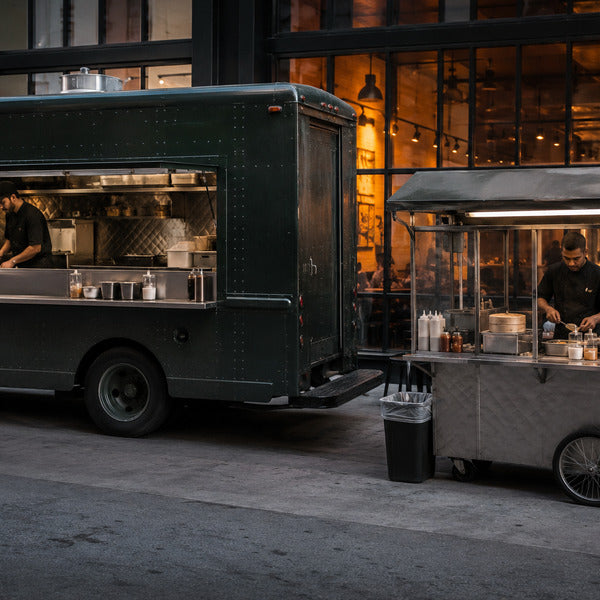
The difference between a food truck and a food cart comes down to three things: the vehicle, the kitchen, and the law. A food truck is a motorized vehicle — usually a step van or converted delivery truck — fitted with a complete commercial kitchen, including cooking equipment, refrigeration, ventilation, and water systems. A food cart is a compact, non-motorized unit that an operator pushes, pedals, or tows into position and works from the outside or from a small standing platform.
That structural difference cascades into everything else. Because a truck carries a real kitchen, health departments regulate it much like a restaurant on wheels: it needs cooking ventilation, a fire suppression system, potable water and wastewater tanks, and in most jurisdictions a commissary agreement for overnight servicing. A cart, with little or no onboard cooking, faces a shorter checklist — but it also cannot legally prepare most raw proteins on site, which restricts the menu to items like hot dogs, pretzels, coffee, ice cream, or foods prepped in advance at a licensed kitchen.
The mobile food category breaks down into three formats, not two. The food trailer — a towable kitchen without an engine — sits between the truck and the cart, and for many operators it is the smartest of the three options. We compare all three below, because the truck-vs-trailer question dominates real-world buying decisions just as much as food truck vs food cart.
Food Truck vs Food Cart vs Food Trailer: How Do the Three Formats Compare?
The three-way comparison matters because a food trailer offers most of a truck's kitchen capacity at a fraction of the cost, provided you own or lease a tow vehicle. Here is the full decision framework across the five factors that determine whether a mobile food business survives its first two years.
Food truck vs food cart vs food trailer: decision framework
| Factor | Food Truck | Food Trailer | Food Cart |
|---|---|---|---|
| Startup cost (vehicle) | $40,000–$150,000 new or converted (Square, 2025); used trucks run $30,000–$60,000 (StartCosts, 2026) | $15,000–$40,000 (StartCosts, 2026), plus a tow vehicle | $4,299–$10,000 new (Willy Dogs); used carts for less |
| Mobility | Fully self-propelled; can chase lunch crowds, events, and catering gigs in one day | Mobile only when hitched; slower to reposition; easier to leave on site at festivals | Short-range; one location per shift; can operate where trucks are banned (parks, plazas, indoor venues) |
| Licensing | Heaviest: commercial vehicle registration, health permit, fire inspection, zoning, commissary agreement | Similar health/fire requirements to a truck; trailer registration is cheaper than a commercial truck | Lightest: vending and health permits, commissary agreement; often no vehicle inspection at all |
| Menu capacity | Full cooking line — burgers, fried food, multi-course menus | Comparable to a truck; some trailers exceed trucks in interior square footage | 1–5 items, mostly pre-cooked, assembled, or held hot/cold |
| Revenue ceiling | Highest — full menus, private catering, multi-stop days | High — same menu power, but repositioning friction limits multi-stop days | Lowest — single-operator throughput and limited menu cap earnings |
Is It Cheaper to Have a Food Truck or a Food Trailer?
A food trailer is cheaper than a food truck — typically 50–70% less for comparable kitchen space, according to StartCosts' 2026 cost breakdown, which prices trailers at $15,000–$40,000 against $30,000–$150,000 for used-to-new trucks. The trailer also removes your biggest mechanical risk: when a truck's engine dies, your kitchen is stranded and revenue stops; when a tow vehicle dies, you rent or borrow another and keep serving. The trade-offs are hitching time, parking complexity, and the cost of the tow vehicle itself if you don't already own one.
What Does It Cost to Start a Food Truck vs a Food Cart?
A food truck startup costs roughly 5 to 15 times more than a food cart startup. Square's 2025 cost guide puts the truck alone at $40,000–$150,000, with licenses and permits ranging from $1,864 to $28,276 depending on the city, plus $2,000–$3,000 in opening inventory. By contrast, cart manufacturer Willy Dogs prices a new professional hot dog cart at $4,299–$10,000 including warranty and shipping — meaning a complete cart operation, permits and inventory included, frequently launches for under $15,000.
The industry those dollars buy into is substantial. IBISWorld projects US food truck industry revenue to reach $2.9 billion in 2026, with an annualized growth rate of 3.4% over the five years to 2026. That growth is real, but so is the compliance overhead: the US Chamber of Commerce Foundation's Food Truck Nation study found that starting and operating a food truck for one year requires an average of 45 separate government-mandated procedures over 37 business days, and $28,276 spent on permits, licenses, and ongoing legal compliance in the average large US city.
Budget lines new operators most often miss, in our experience outfitting both formats at Restaurantware:
- Commissary fees — most health departments require overnight servicing at a licensed commissary, typically a recurring monthly cost.
- Fire suppression — required for any truck or trailer with a cooking line.
- Insurance — commercial auto plus general liability for trucks; general liability for carts.
- Packaging and serveware — the packaging list, not the vehicle, is usually what new operators underestimate. Trays, cones, bags, napkins, and cutlery are a permanent cost of goods, and choosing the wrong formats slows your service line every single shift.
What Licenses and Permits Do Food Trucks and Food Carts Need?
Both food trucks and food carts need a business license, a health department permit, a food handler certification, and — in most jurisdictions — a commissary agreement. Trucks add commercial vehicle registration, fire inspection, and often zoning or parking permits on top.
The food-safety baseline for both formats comes from the FDA Food Code, which most states and counties adopt as the model for their retail food regulations. The Food Code's definition of a food establishment explicitly includes vehicles and mobile units, and it requires at least one handwashing sink in any food establishment (§ 5-203.11). The 2022 FDA Food Code update also revised the minimum hot water temperature at handwashing sinks to 85°F (29.4°C) — a practical win for carts and trucks, where maintaining 100°F water on a mobile unit was a persistent inspection failure point.
Requirements vary meaningfully by city and state, which is exactly why the Chamber's Food Truck Nation study found such a wide compliance-cost spread. Before buying anything, get your local health department's mobile food establishment checklist — it will tell you whether your concept is even legal on a cart in your jurisdiction, since many localities prohibit raw-protein cooking on carts entirely.
What Are the Main Types of Food Trucks?
Food trucks fall into five practical types, and knowing which type you're building determines your equipment list, permit path, and packaging needs:
- Full-kitchen cooking trucks — burgers, tacos, fried chicken, cheesesteaks. Complete cooking line with ventilation and fire suppression. The most expensive and most regulated type.
- Prep-and-finish trucks — food is largely prepped at a commissary and finished on the truck (assembly, warming, garnishing). Lower equipment cost, faster service.
- Cold-service trucks — ice cream, smoothies, cold-brew coffee, salads. Refrigeration-heavy, minimal cooking equipment, lighter fire-code requirements.
- Beverage trucks — coffee, tea, juice, and mobile bar (where legal). Compact equipment footprint; high margin per transaction.
- Specialty/dessert trucks — crepes, mini donuts, shaved ice. Narrow menus with theatrical, watch-it-made service.
Carts mirror several of these types in miniature — coffee carts, hot dog carts, pretzel carts, ice cream carts — but always with the same constraint: minimal or no raw cooking on board.
Is a Food Cart Business Right for You?
A food cart business is the right choice when your priorities are low startup cost, a single-operator model, and access to locations trucks can't reach. Carts operate legally in pedestrian plazas, parks, farmers markets, stadium concourses, and even indoor venues — places where a 16,000-pound truck is physically or legally impossible. A cart is also the cheapest real-world test of a food concept: if your menu item sells from a cart, it will sell from a truck, and you'll have revenue data before committing six figures.
The constraint is throughput. One operator, a focused menu, and limited holding capacity put a hard ceiling on daily sales. Successful cart operators lean into that constraint rather than fighting it: they pick one high-margin, handheld item, position in reliable foot traffic, and keep service under 60 seconds per customer.
Food Truck vs Food Cart: Pros and Cons
Food truck vs food cart pros and cons
| Pros | Cons | |
|---|---|---|
| Food truck | Full menu capability; self-propelled multi-stop days; catering and event revenue; strong branding canvas; highest revenue ceiling | $50,000–$200,000 all-in startup; heavy permitting (45 procedures on average per the Chamber's study); engine breakdowns stop revenue; 2–4 staff per shift |
| Food cart | Launches for under $15,000 in many cities; single-operator; lighter permits; access to truck-free locations; fastest concept test | Menu limited to simple/pre-made items; low throughput ceiling; weather-exposed; short-range mobility; smaller branding presence |
How Do You Run an Eco-Friendly Food Truck?
An eco-friendly food truck reduces its environmental footprint in four areas: power, water, sourcing, and packaging. Environmentally friendly trucks are no longer a niche pitch — sustainability sells at street level, where the customer literally watches you work, sees your generator, and holds your packaging in their hand. Here is how eco food truck operators cut waste without cutting margins:
- Power: Replace or supplement gas generators with lithium battery banks and roof-mounted solar. Quieter service also gets you into noise-restricted events that ban generators.
- Water: Low-flow spray valves and foot-pedal handwashing sinks stretch limited onboard tanks — a direct operational win, since refilling potable water mid-shift kills service time.
- Sourcing: Local and seasonal ingredients shrink cold-chain transport miles and give the menu a story customers repeat.
- Packaging: Switch to compostable or recyclable serveware — bamboo, palm leaf, kraft paper, and PLA-lined alternatives to plastic-coated disposables. If you serve both hot and iced drinks, pick lids and cups deliberately: our guide to hot cups vs cold cups explains why the two are not interchangeable and where eco-friendly cup materials fit each use.
- Waste: Run a visible sorting station (compost/recycle/landfill) at your service window. Cities and event organizers increasingly require it, and early adopters win event slots.
Everything above applies to carts, too — an eco-friendly cart with solar-powered holding equipment and compostable serveware is one of the cheapest genuinely green foodservice businesses you can start.
What Supplies Do Food Trucks and Food Carts Need?
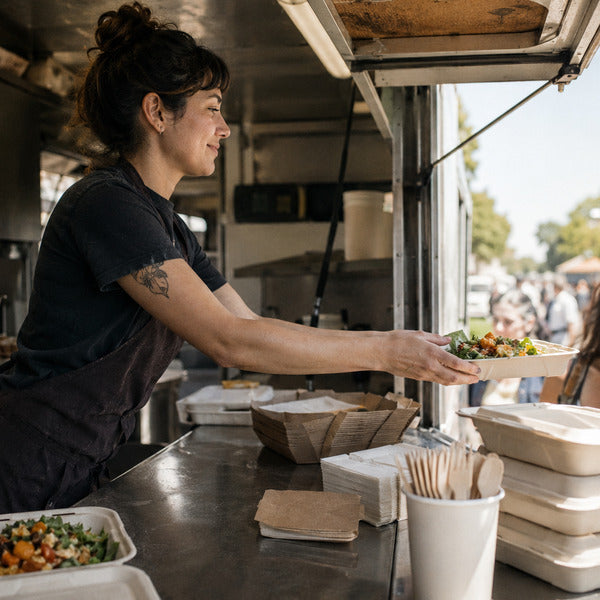
Trucks and carts need the same four supply categories — service packaging, handhelds, transport packaging, and back-of-window smallwares — but in different proportions. Our foodservice customers consistently tell us handheld-friendly serveware makes or breaks street service speed: if the customer can't hold it, walk with it, and eat it one-handed, the line slows and revenue drops.
- Service trays: Paper food trays are the default truck-window format — grease-resistant, stackable, and fast to load for fries, tacos, sliders, and loaded bowls.
- Handhelds for carts: Food cones shine in cart service, where customers stand and stroll: fries, popcorn chicken, churros, and desserts serve one-handed with zero table space required.
- Transport packaging: Grease-resistant to-go bags and take-out bags matter more for trucks with multi-item orders, where customers carry food back to offices or event seating.
Whichever format you choose, standardize your packaging sizes before opening day. Operators who buy one tray size, one cone size, and one bag size per menu section serve faster and carry less dead stock than operators who improvise. For more operational guides on the mobile food business, browse our food trucks & concessions resource hub.
Frequently Asked Questions
What is the difference between a food truck and a food cart?
A food truck is a motorized vehicle with a full onboard kitchen that can cook complete menus; a food cart is a small non-motorized unit that is pushed or towed and serves simple or pre-made foods. Trucks cost $50,000–$200,000 all-in and face heavy licensing; carts often launch for under $15,000 with lighter permits.
Is it cheaper to have a food truck or a food trailer?
A food trailer is cheaper — typically 50–70% less than a truck for comparable kitchen space, with trailers running $15,000–$40,000 versus $30,000–$150,000 for trucks (StartCosts, 2026). The trailer requires a tow vehicle, but it separates your kitchen from your engine, so a mechanical breakdown never strands your revenue.
What are the disadvantages of food trucks?
The main disadvantages of food trucks are high startup cost ($50,000–$200,000), heavy regulatory burden (an average of 45 government procedures and $28,276 in first-year compliance costs, per the US Chamber of Commerce Foundation), engine and equipment breakdowns that halt revenue, weather-dependent sales, cramped working conditions, and daily commissary servicing requirements.
Is a food cart profitable?
Yes — a food cart can be profitable precisely because its costs are so low. With startup investment frequently under $15,000, no fuel-hungry engine, and a single-operator labor model, a well-located cart selling a high-margin item (coffee, hot dogs, pretzels) can recover its entire startup cost within months. The constraint is scale: one operator and a short menu cap daily revenue.
How much does it cost to start a food cart?
A new professional food cart costs $4,299–$10,000 including warranty and shipping (Willy Dogs pricing), and a complete cart launch — cart, permits, initial inventory, and smallwares — commonly lands between $5,000 and $15,000 depending on the city. Permits and licenses typically add several hundred to a few thousand dollars depending on local requirements.
Do food carts need permits?
Yes. Food carts need a business license, a local health department permit, food handler certification, and in most jurisdictions a commissary agreement for cleaning, servicing, and food storage. The FDA Food Code — the model most state and local codes adopt — treats mobile units as food establishments, including the requirement for handwashing capability (§ 5-203.11). Exact requirements vary by city, so start with your local health department's mobile vending checklist.
Why do so many food trucks fail?
Food trucks fail most often from undercapitalization, not bad food. Operators budget for the truck but not for the $28,276 in average first-year compliance costs (US Chamber of Commerce Foundation), commissary fees, insurance, repairs, and slow seasons. Other common causes: weak location strategy, menus too large for the kitchen to serve quickly, and engine breakdowns with no cash reserve.
Do food carts make money?
Food carts make money when three things align: a high-margin handheld product, consistent foot traffic, and service speed under a minute per customer. Because overhead is minimal — no engine, no crew, low permit costs — a cart's break-even point is far lower than a truck's, and profitable carts routinely become the seed capital for a first truck or trailer.
Which Should You Choose: Food Truck or Food Cart?
Choose a food truck when you need real cooking capacity, a multi-item menu, and catering revenue — and you can fund $50,000–$200,000 without draining your operating reserve. Choose a food cart when you want the lowest-cost entry into mobile food, a single-operator business, or a live market test before scaling up. Choose a food trailer when you want truck-level kitchen space at half the price and already have a vehicle that can tow it. If you’d rather test a concept without wheels at all, see our guide on how to start a pop-up restaurant.
Whichever format wins your business plan, your service speed will live or die on the supplies at your window. Explore our paper food trays for truck-window service, food cones for cart-friendly handhelds, and grease-resistant to-go bags for orders that travel — everything a mobile kitchen needs to serve fast from day one.