Restaurant Kitchen Cleaning Checklist: What To Clean Daily, Weekly & Monthly
A restaurant kitchen cleaning checklist is a written schedule of daily, weekly, and monthly cleaning tasks for every surface, appliance, and station in a commercial kitchen. To stay FDA Food Code compliant, clean and sanitize food-contact surfaces after each use and at least every four hours during continuous use.
A restaurant kitchen cleaning checklist turns food safety from a hope into a habit. This guide gives you complete daily, weekly, and monthly checklists for a commercial kitchen, plus the FDA Food Code rules behind each task, how to prevent cross-contamination, how to clean wooden cutting boards the right way, and a full restroom cleaning routine. Post it, print it, and assign every line to a name and a shift.
📄 Printable version: Download the free printable PDF of this kitchen cleaning checklist (daily, weekly, and monthly tables) and post it at your dish station and manager's office. [Attach PDF asset at publish.]
TL;DR: The Kitchen Cleaning Checklist At A Glance
- Daily: Clean and sanitize all food-contact surfaces, prep tables, cutting boards, and small equipment; wipe down lines and hoods' grease trays; sweep and mop floors; empty trash; run and drain the dish machine.
- Weekly: Deep clean ovens, delime sinks and faucets, empty and sanitize reach-in coolers, clean floor drains, and wash walls behind cooking lines.
- Monthly: Degrease hoods and vents, pull equipment to clean behind and beneath it, empty and sanitize the ice machine, clean freezers, calibrate thermometers, and wash ceilings and light fixtures.
- The compliance anchor: FDA Food Code §4-602.11 requires food-contact surfaces used with time/temperature control for safety (TCS) foods to be cleaned at least every 4 hours during continuous use.
| Frequency | Focus | Who Owns It | Time Required |
|---|---|---|---|
| Daily | Food-contact surfaces, floors, trash, dish area, restrooms | Every station, every shift | Built into opening/closing |
| Weekly | Equipment interiors, coolers, drains, walls | Assigned by rotation | 1–3 hours |
| Monthly | Hoods, behind equipment, ice machine, ceilings, pest check | Manager-led deep clean | Half day or overnight |
Why does this matter? The CDC estimates that 48 million people get sick, 128,000 are hospitalized, and 3,000 die from foodborne illness in the United States each year (CDC, Facts About Food Poisoning). And the FDA's Retail Food Risk Factor Study names contaminated food surfaces and equipment as one of the three foodborne illness risk factors still most in need of improvement in restaurants, alongside poor personal hygiene and improper holding of food (FDA Retail Food Risk Factor Study). A posted, assigned kitchen cleaning checklist is the single cheapest defense against both a failed inspection and a sick guest.
In 15+ years supplying 40,000+ foodservice operations, we've seen a consistent pattern at Restaurantware: kitchens that standardize on labeled janitorial supplies and post a signed-off cleaning checklist pass health inspections more consistently than kitchens that rely on "everyone knows what to do." The checklist is not paperwork — it is the system.
What Should Be On A Restaurant Kitchen Cleaning Checklist?
A restaurant kitchen cleaning checklist should cover every food-contact surface, every piece of equipment, and every floor, wall, and drain — organized by frequency. At minimum, include:
- Clean and sanitize prep tables, cutting boards, and utensils after each task
- Wipe down cooking line equipment and change sanitizer buckets every 4 hours
- Empty trash, then sweep and mop floors every shift
- Run, drain, and wipe out the dish machine nightly
- Clean grill, flattop, and fryer areas nightly; filter fryer oil
- Deep clean ovens, coolers, and floor drains weekly
- Delime sinks, faucets, and the dish machine weekly
- Degrease hoods, vents, and walls monthly
- Empty and sanitize the ice machine monthly
- Pull equipment to clean behind and beneath it monthly
Daily Kitchen Cleaning Checklist
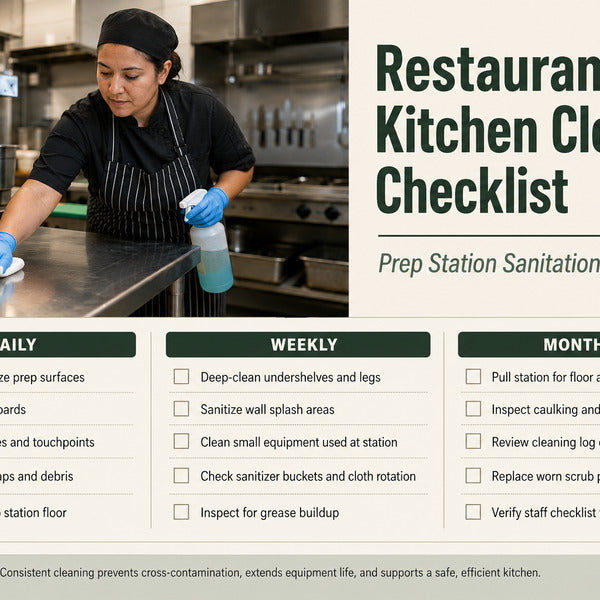
Daily tasks are the backbone of any kitchen cleaning schedule, and most of them map directly to FDA Food Code requirements. The non-negotiable rule: food-contact surfaces must be cleaned and sanitized after each use, any time you switch between raw animal foods and ready-to-eat foods, and at least every 4 hours during continuous use with TCS foods (FDA Food Code §4-602.11). Build your daily checklist in three blocks — during service, opening, and closing. Squeeze bottles and other food-safe containers need the right chemistry too — see our guide to choosing the right cleaning solutions for food-safe bottles.
During Every Shift
| Task | Frequency |
|---|---|
| Clean and sanitize cutting boards, knives, and prep surfaces | After each use / between tasks |
| Change sanitizer buckets and test concentration with test strips | Every 4 hours minimum |
| Swap wiping cloths into fresh sanitizer solution | Every 4 hours minimum |
| Wipe spills on floors immediately; post wet floor signs | As they happen |
| Clear and wipe the pass and expo station | Continuously |
| Wash hands and change gloves between tasks | Per FDA Food Code |
Opening Tasks
| Task | Station |
|---|---|
| Sanitize all prep tables and cutting boards before first use | Prep |
| Set up three-compartment sink: wash (≥110°F), rinse, sanitize | Dish |
| Mix and test sanitizer buckets for every station | All |
| Check cooler and freezer temperatures; log them | Walk-in / reach-in |
| Verify handwashing sinks are stocked with soap and paper towels | All |
| Restock gloves, wipes, and towels at each station | All |
Closing Tasks
| Task | Station |
|---|---|
| Clean and sanitize all food-contact surfaces, prep tables, and shelving | Prep / line |
| Brush and scrape the grill; empty and wipe grease trays | Hot line |
| Filter fryer oil; wipe fryer exteriors | Hot line |
| Wipe down equipment exteriors: ranges, salamanders, microwaves, slicers | Line |
| Break down, wash, rinse, and sanitize the slicer and small equipment | Prep |
| Run final dish cycles; drain, rinse, and wipe out the dish machine | Dish |
| Wash, rinse, sanitize, and air-dry all utensils and smallwares | Dish |
| Empty all trash cans; replace liners; clean can lids | All |
| Sweep and mop all floors, including under prep tables and behind the line | All |
| Wrap, date, and store all food; check FIFO rotation | Walk-in |
| Launder or bag soiled aprons, towels, and wiping cloths | All |
| Clean and restock restrooms (see restroom section below) | FOH/BOH |
Weekly Kitchen Cleaning Checklist
Weekly tasks target the buildup daily cleaning can't reach — the difference between a kitchen that looks clean and one that passes a surprise inspection. Assign each weekly task to a specific day and a specific person so nothing waits for "someone."
| Task | Notes |
|---|---|
| Deep clean ovens (interiors, racks, doors) | Follow manufacturer's degreaser guidance |
| Empty, wash, and sanitize reach-in coolers | Check door gaskets for mold |
| Delime sinks, faucets, and the dish machine | Hard-water scale harbors soil |
| Clean and flush floor drains | Use an enzymatic or approved drain cleaner |
| Wash walls and backsplashes behind cooking lines | Grease film builds fast here |
| Boil out fryers and replace oil | Frequency depends on volume |
| Clean shelving in walk-ins; rotate and consolidate stock | FIFO check |
| Wash floor mats and scrub underneath them | Front and back of house |
| Clean coffee machines, tea urns, and beverage nozzles | Soda gun nozzles daily where required |
| Sharpen knives and inspect cutting boards for deep grooves | Replace scarred boards |
Monthly Kitchen Deep Clean Checklist
How often should a commercial kitchen be deep cleaned? Schedule a manager-led deep clean at least monthly, with high-volume operations deep cleaning high-grease zones (hoods, fryer surrounds) more often. Many operators run this overnight or on the slowest day of the month.
| Task | Notes |
|---|---|
| Degrease exhaust hoods, filters, and vents | Hood filters often need weekly attention in high-volume kitchens; full duct cleaning is a certified-professional job on a schedule set by your fire code |
| Pull equipment away from walls; clean behind and beneath | Grease + crumbs behind the line attract pests |
| Empty, clean, and sanitize the ice machine | Follow manufacturer instructions; ice is a food |
| Empty and deep clean freezers | Defrost if ice has built up |
| Wash ceilings, light fixtures, and ceiling tiles | Replace stained tiles |
| Clean refrigeration coils and condenser units | Extends equipment life |
| Calibrate thermometers | Ice-point method: 32°F |
| Wash and sanitize storage bins, dunnage racks, and dry-storage shelving | Label everything |
| Inspect for pest activity: droppings, gnaw marks, entry gaps | Log findings; call your pest partner |
| Deep clean grease traps (or verify service schedule) | Local code may set frequency |
| Restock and audit janitorial inventory | Reorder before you run out |
Map your supplies to the schedule: keep restaurant janitorial disposables — gloves, liners, and wiping cloths — stocked at every station for the daily list, and stage heavier-duty degreasers and brushes from a dedicated janitorial supplies cart for weekly and monthly tasks.
How Do You Prevent Cross-Contamination In A Commercial Kitchen?
To prevent cross-contamination, you should separate raw and ready-to-eat foods, clean and sanitize food-contact surfaces between tasks, and practice strict hand hygiene. Cross-contamination — pathogens transferring from raw foods, hands, or dirty equipment onto ready-to-eat food — is the failure mode your entire kitchen cleaning checklist exists to stop.
3 Ways To Prevent Cross-Contamination
- Separate. Store raw meat, poultry, and seafood below and away from ready-to-eat foods, and use dedicated color-coded cutting boards and utensils for each food type: red for raw meat, yellow for raw poultry, blue for seafood, green for produce, white for dairy and bread.
- Clean and sanitize. Wash, rinse, and sanitize every food-contact surface after working with raw animal foods and before switching to any other food — cleaning removes soil, sanitizing kills the pathogens that remain. The FDA Food Code requires this after each use and at least every 4 hours during continuous use (§4-602.11).
- Control hands and tools. Wash hands and change gloves between raw and ready-to-eat tasks, keep wiping cloths in sanitizer solution between uses, and never reuse a utensil that touched raw protein without a full wash-rinse-sanitize cycle.
Beyond the big three: receive and inspect deliveries away from prep areas, store chemicals below and away from food, and keep allergen prep segregated with its own labeled tools. Our foodservice customers consistently tell us that stocking dedicated hand cleaning sanitizing wipes & dispensers at each station turns the between-task sanitizing step from a chore into a reflex — when the wipe is within arm's reach, it actually gets used.
How Do You Clean A Wooden Cutting Board?
To clean a wooden cutting board, wash it by hand with hot, soapy water immediately after each use, rinse with clean water, and stand it on edge to air dry. To sanitize, USDA guidance is to flood the surface with a solution of 1 tablespoon of unscented liquid chlorine bleach per gallon of water, let it stand for several minutes, then rinse and air dry (USDA FSIS, Cutting Boards). Season wood boards regularly with food-grade mineral oil to prevent drying and cracking.
What Is A Common Mistake When Cleaning A Wooden Cutting Board?
The most common mistake is soaking a wooden cutting board in water or running it through the dish machine. Wood is porous: prolonged soaking and high dishwasher heat make the board absorb water, then warp, crack, and split — and those cracks harbor bacteria that no wipe-down can reach. Other frequent errors: leaving the board flat to dry (trapping moisture underneath), skipping the sanitizing step after raw protein, using scented bleach or harsh chemicals that leach into the wood, and never oiling the board. Wash by hand, sanitize, dry upright, oil regularly — and retire any board with deep grooves.
Are Plastic Cutting Boards Bad For You?
Plastic cutting boards are not inherently bad, but they have a real weakness: knife scarring. USDA FSIS notes that nonporous surfaces like plastic are easier to clean than wood, and both wood and plastic boards are acceptable when properly washed and sanitized. The catch is that once a plastic board is deeply scored by knife work, the grooves become difficult to clean and the board should be replaced — USDA advises discarding any cutting board with hard-to-clean grooves. Research has also raised the separate question of microplastic particles shed from heavily scarred boards, one more reason to replace worn plastic rather than scrub it forever. In a commercial kitchen, the practical answer is: use color-coded plastic boards for raw proteins (they can be sanitized aggressively and replaced cheaply) and replace them on a schedule, not when they look destroyed.
Is Acacia Wood Good For Cutting Boards?
Acacia is a dense, naturally water-resistant hardwood, which makes it a durable choice for cutting and serving boards. Its tight grain absorbs less moisture than softer woods, so it resists warping and bacterial penetration when maintained properly. Care is the same as any wood board: hand wash, sanitize with the bleach solution above, dry upright, and oil with food-grade mineral oil. Many operators use acacia boards front-of-house for serving and charcuterie, where their rich grain doubles as presentation, and keep color-coded boards in the back for raw prep.
How Do You Clean Restaurant Restrooms?
Restaurant restrooms are cleaned top to bottom, from cleanest to dirtiest: high surfaces and mirrors first, then sinks and counters, then toilets and urinals, then floors last. Guests judge your kitchen by your restroom — surveys consistently show a dirty restroom sends diners straight to the conclusion that the kitchen is dirty too. Restrooms belong on the same checklist as the line, with hourly checks during service.
Restroom Cleaning Routine (Daily, Plus Hourly Checks)
- Prep and protect. Post a closed/cleaning sign, put on gloves, and ventilate.
- High-touch first pass. Wipe door handles, locks, light switches, and dispenser levers with disinfectant — these carry the heaviest hand traffic.
- Mirrors and counters. Glass cleaner on mirrors; disinfect counters and sink basins; polish faucets.
- Toilets and urinals. Apply bowl cleaner, let it dwell per the label, scrub under the rim, then disinfect seats, lids, flush handles, and stall latches.
- Restock. Soap, paper towels, toilet paper, seat covers, and toilet seat liners where provided. An empty soap dispenser is a health-code problem, not just a guest complaint.
- Floors last. Sweep, then mop from the far corner toward the door with disinfectant solution. Let dry before reopening.
- Log it. Sign the posted restroom checklist with time and initials — the same accountability loop as the kitchen list.
Use separate, clearly labeled tools for restrooms — a dedicated mop, bucket, and caddy that never enter the kitchen. This is cross-contamination prevention applied outside the kitchen, and inspectors look for it.
Stocking Your Cleaning Stations: What Each Checklist Section Needs
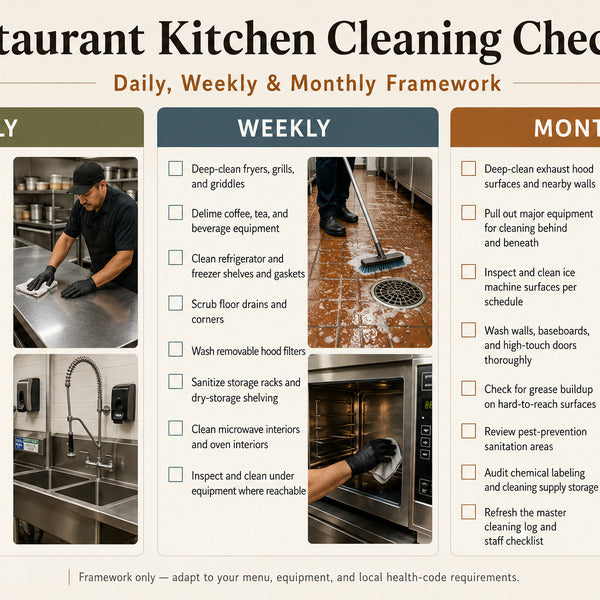
A checklist fails when the supplies aren't where the task happens. Here's how we map products to the schedule for the operations we supply:
- Daily / every station: Sanitizer buckets with test strips, color-coded wiping cloths, nitrile gloves, and hand cleaning sanitizing wipes & dispensers mounted at prep, line, and dish stations.
- Daily / dish and floors: Trash liners, brooms, mops, and floor signs from a stocked restaurant janitorial disposables shelf.
- Weekly / monthly deep cleans: Degreasers, delimers, drain treatment, and scrub tools staged on a rolling cart — our RW Clean line covers the professional-grade cleaners and tools for these rotations.
Browse the full janitorial supplies collection to build a station-by-station kit that matches every line on this checklist.
Frequently Asked Questions
What are the 7 steps of cleaning a kitchen?
The seven steps are: (1) scrape or remove food debris, (2) pre-rinse surfaces, (3) wash with hot water and detergent, (4) rinse with clean water, (5) sanitize with an approved sanitizer at the correct concentration, (6) air dry — never towel dry sanitized surfaces, and (7) verify and log the task on your kitchen cleaning checklist. Steps 3–6 mirror the FDA Food Code's wash-rinse-sanitize-air dry sequence for food-contact surfaces.
What is the 30/3 rule for cleaning?
The 30/3 rule is a quick-reset habit: spend 3 minutes tidying visible mess so a space passes a 30-second glance. In a restaurant it translates to micro-cleans — every team member resets their station for 3 minutes at set intervals so the kitchen never drifts more than a few minutes from inspection-ready. It supplements, but never replaces, the scheduled daily, weekly, and monthly checklist tasks.
In what order should you clean a kitchen?
Clean from high to low, from clean to dirty, and finish with floors. Start with hoods, shelves, and high surfaces so debris falls before floors are cleaned; then equipment and food-contact surfaces (wash, rinse, sanitize); then non-food-contact surfaces like handles and switches; then trash; and floors last — sweep, then mop from the far corner toward the exit.
What is the daily 6 cleaning list?
The "daily 6" is a shorthand for the six tasks that must happen every single day in any kitchen: (1) clean and sanitize food-contact surfaces, (2) wash all dishes and utensils, (3) wipe down equipment exteriors, (4) empty trash, (5) sweep and mop floors, and (6) restock cleaning and handwashing supplies. Use it as the minimum floor for slow days — the full daily checklist above is the standard.
How often should a commercial kitchen be deep cleaned?
A commercial kitchen should be deep cleaned at least monthly, covering hoods, behind and beneath equipment, ice machines, freezers, coils, and ceilings. High-volume and heavy-fry operations should deep clean grease-prone zones weekly or biweekly, and hood-and-duct systems must be professionally cleaned on the schedule your local fire code sets (commonly quarterly to annually based on cooking volume).
What are the FDA requirements for kitchen cleaning?
The FDA Food Code requires food-contact surfaces to be cleaned and sanitized after each use, when switching between raw animal foods and ready-to-eat foods, and at least every 4 hours during continuous use with TCS foods (§4-602.11). Approved sanitizing methods include chemical sanitizing — for example, chlorine at 50–100 ppm (§4-501.114) — and hot-water sanitizing, such as immersion at 171°F for at least 30 seconds in manual operations (§4-703.11). Non-food-contact surfaces must be cleaned often enough to prevent soil buildup. See the FDA Food Code for the full text; your state or local health code (usually a Food Code adoption) is the enforceable version.
Put Your Kitchen Cleaning Checklist To Work
A restaurant kitchen cleaning checklist only works when it's printed, posted, assigned, and signed. Break this guide into three documents — daily, weekly, monthly — put a name and a shift next to every line, and have a manager initial each completed list. Within a few weeks, cleaning stops being a nightly argument and becomes the way your kitchen simply runs — and your next health inspection becomes a formality instead of a fire drill. Water quality belongs on the schedule too — here’s why foodservice operations should regularly test their drinking water.
Ready to stock every station? Shop janitorial supplies at Restaurantware — from sanitizing wipes and disposables to the RW Clean professional line — and give your team the tools the checklist calls for.