Food Safe Sanitizer: Choosing The Right Cleaning Solutions For Food-Safe Bottles
A food safe sanitizer is a chemical solution approved under the FDA Food Code for use on food-contact surfaces at no-rinse concentrations. The three main types are chlorine (50–100 ppm), quaternary ammonium (per the EPA-registered label, commonly 150–400 ppm), and iodine (12.5–25 ppm). Always verify concentration with a sanitizer test strip before use.
Choosing a food safe sanitizer for your squeeze bottles, juice bottles, and dispensers is one of the highest-leverage food safety decisions an operator makes — and one of the most commonly botched. The CDC estimates 48 million Americans get sick from foodborne illness every year, with 128,000 hospitalizations and 3,000 deaths (current as of July 2026). Reusable bottles are a quiet contributor to that risk: they hold moist, protein- and sugar-rich products, they have narrow necks and valve tips that trap residue, and they get refilled far more often than they get broken down and sanitized.
This guide covers exactly which sanitizers are legal on food-contact surfaces, the concentrations the FDA Food Code requires, and a step-by-step workflow for bottles and containers specifically — the part general surface-sanitizer guides skip.

TL;DR — Food Safe Sanitizer at a Glance
- Legal definition: A food safe sanitizer must be EPA-registered for food-contact surfaces and used per FDA Food Code §4-501.114 — concentration, temperature, and pH all matter.
- The big three: chlorine (hypochlorite), quaternary ammonium ("quat"), and iodine. Each is no-rinse at labeled food-contact concentrations.
- Concentrations: chlorine 50–100 ppm, quat per manufacturer label (commonly 150–400 ppm), iodine 12.5–25 ppm.
- Contact time: at least 10 seconds for chlorine, at least 30 seconds for other chemical sanitizers (FDA Food Code §4-703.11).
- Verification: test strips are not optional — the Food Code requires a test kit to confirm concentration (§4-501.116).
- Bottles are different: full disassembly (cap, tip, valve), wash at 110°F+, rinse, immersion sanitize, and air-dry upside down. Never towel-dry.
What Is a Food Safe Sanitizer?
A food safe sanitizer is defined as a chemical agent that reduces bacteria on food-contact surfaces to safe levels and is approved to remain on those surfaces without a final rinse. Two federal rules govern that approval: 21 CFR 178.1010 lists the sanitizing solution formulations FDA permits on food-processing equipment and utensils, and 40 CFR 180.940 sets the EPA tolerance exemptions that make no-rinse use legal at specified end-use concentrations. In practice, this means one thing for operators: the product must carry an EPA registration number and say "food-contact surface sanitizer" on the label. A disinfectant, bleach with additives, or an all-purpose "food safe cleaning products" spray does not qualify.
Sanitizing is also the second step of a two-step process. Cleaning removes visible soil with detergent; sanitizing kills what cleaning leaves behind. A food grade sanitizer applied over sauce residue is largely wasted — organic matter deactivates chlorine especially fast.
What Are the Three Main Types of Food Safe Sanitizer?
The FDA Food Code recognizes three primary chemical sanitizer families for manual warewashing, each defined in §4-501.114 of the FDA Food Code 2022:
| Sanitizer Type | Concentration | Minimum Temperature | Contact Time | Best For Bottles? |
|---|---|---|---|---|
| Chlorine (hypochlorite) | 50–100 ppm (25–49 ppm allowed only at 120°F) | 75°F at pH ≤8; 100°F at pH ≤10 (50–99 ppm) | ≥10 seconds | Yes — cheap, fast, no residue taste at proper ppm; degrades quickly in solution |
| Quaternary ammonium (quat) | Per EPA-registered label (commonly 150–400 ppm) | 75°F; water hardness ≤500 ppm | ≥30 seconds | Yes — stable all shift, non-corrosive to plastic; needs correct water hardness |
| Iodine | 12.5–25 ppm | 68°F; pH ≤5.0 | ≥30 seconds | Situational — can stain plastics and silicone valves amber |
Source: FDA Food Code 2022, §§4-501.114 and 4-703.11 (current as of July 2026). These numbers are law in most jurisdictions — the Food Code has been adopted in some form by nearly every U.S. state.
What Concentration Should Food-Safe Sanitizer Be?
Food safe sanitizer concentration must land inside the Food Code window: 50–100 ppm for chlorine, 12.5–25 ppm for iodine, and the exact range printed on the EPA-registered label for quats. Too weak and bacteria survive; too strong and you have a chemical residue problem on a surface that touches food — both are code violations.
Three details operators routinely miss:
- Temperature and pH change the chlorine rules. A 50–99 ppm chlorine solution needs 75°F minimum water at pH 8 or less, but 100°F if pH runs up to 10. At 100 ppm, 55°F water is acceptable (Food Code §4-501.114(A)).
- Quat concentration is a label number, not a rule of thumb. The Food Code defers to the manufacturer's EPA-registered directions, and it caps water hardness at 500 ppm unless the label allows more. Hard water quietly neutralizes quats — the most common reason a "correctly mixed" solution tests out of range.
- Test strips are mandatory. Food Code §4-501.116 requires concentration to be "accurately determined by using a test kit or other device." Use chlorine strips for chlorine, quat strips for quats — they are not interchangeable.
In 15+ years supplying 40,000+ foodservice operations, the pattern we hear from customers is consistent: their no-rinse quat solution tests out of range not because the product failed, but because it was mixed by eye instead of dosed per the label. That is why we pair reusable bottle SKUs with test-strip and chemical-dispenser recommendations — a $10 pack of strips is the cheapest inspection insurance in the building.
How Do You Choose the Right Cleaning Solutions for Food-Safe Bottles?
Bottles and dispensers punish sanitizer choices that work fine on flat prep surfaces. Use these criteria when sourcing:
1. Confirm It Is No-Rinse at Food-Contact Concentration
A no rinse food safe sanitizer lets you sanitize a bottle interior and air-dry it without a final potable-water rinse — essential for narrow-neck bottles you cannot effectively re-rinse. Look for "no rinse required on food-contact surfaces" plus the 40 CFR 180.940 concentration on the label. If the label directs a rinse after use, it is a disinfectant, not a food-contact sanitizer.
2. Match the Chemistry to the Bottle Material
- LDPE/HDPE squeeze bottles: chlorine or quat both work; iodine can stain over repeated soaks.
- Polycarbonate and PET juice bottles: quat is gentlest for daily immersion; high-temp chlorine cycles accelerate crazing.
- Glass milk and juice bottles: any of the three; glass tolerates hot-water sanitizing (171°F immersion) if you prefer a chemical-free line.
- Silicone valves and gaskets: avoid iodine; quat at label strength is the safest daily choice.
3. Pick a Format That Matches the Job
Concentrates dosed through a wall dispenser are the cheapest per gallon for three-compartment sink sanitizing. Sanitizer tablets remove mixing error — one tablet per labeled volume of water — and store compactly. A food safe sanitizer spray is the right format for the outside of bottles, dispenser nozzles between uses, and bar-top touchpoints, but spraying into a bottle is not a substitute for full immersion: the interior needs total surface contact for the full contact time.
4. Separate Your Cleaning and Sanitizing Products
Food safe cleaning products (degreasers, dish detergents, bottle brushes) handle step one; the sanitizer handles step two. The only exception the Food Code allows is a true detergent-sanitizer used in both steps per its label (§4-501.115). If you run manual warewashing, stock both — our manual dish washing and sanitizing chemicals collection is organized around that two-step split.
How Do You Sanitize Squeeze Bottles Step by Step?
Here is how to clean squeeze bottles the way a health inspector expects — a full five-step breakdown, not a rinse-and-refill:
- Empty and disassemble completely. Cap, precision tip, and any silicone valve come off. Residue hides in the tip threads and under valve flaps — the two spots swabs fail most often.
- Wash at 110°F or hotter. The Food Code sets 110°F (43°C) as the minimum wash-solution temperature for manual warewashing (§4-501.19). Use a bottle brush for the interior and a tip brush for the nozzle; detergent cannot reach what bristles do not touch.
- Rinse in clean, warm water. Detergent carryover deactivates sanitizer — especially quats, which bind to anionic detergent residue.
- Immerse in sanitizer for the full contact time. Submerge bottle, cap, and tip so no air pockets remain: at least 10 seconds in 50–100 ppm chlorine or at least 30 seconds in labeled-strength quat or 12.5–25 ppm iodine. Verify the bath with a test strip before the first rack and every few hours after — chlorine especially degrades as soil load builds.
- Air-dry upside down on a drying rack. Food Code §4-901.11 requires air-drying after sanitizing — towel-drying recontaminates the surface you just sanitized. Reassemble only when bone dry; trapped moisture inside a capped bottle is a bacteria incubator.
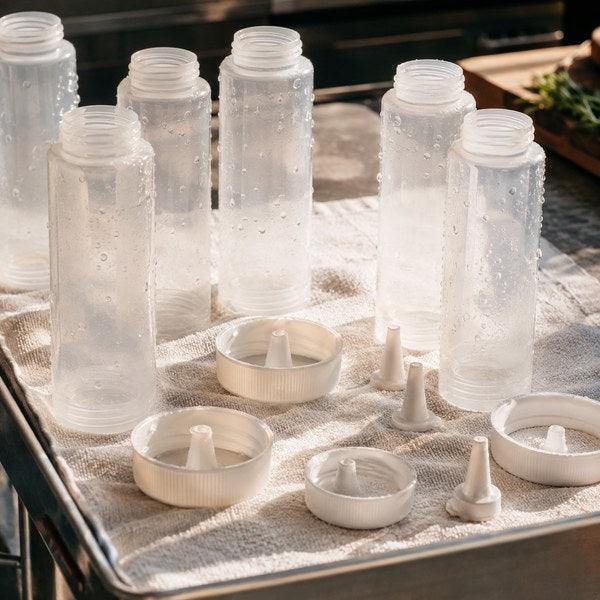
The same five steps apply to pour spouts, condiment dispensers, pumps, and reusable juice bottles — anything with a restricted opening gets disassembled, immersed, and air-dried. For pump dispensers, draw sanitizer solution up through the pump mechanism itself, then purge with air.
How Often Should Food-Safe Bottles Be Sanitized?
Frequency depends on what the bottle holds. Under FDA Food Code §4-602.11, food-contact surfaces used with time/temperature control for safety (TCS) foods — garlic-in-oil sauces, dairy-based dressings, mayo-based aiolis, milk bottles — must be cleaned and sanitized at least every 4 hours during continuous room-temperature use. Non-TCS contents (vinegar-based hot sauce, simple syrup) still require cleaning on a schedule that prevents soil buildup, and consumer self-service dispensers must be cleaned before each restock.
In our 15+ years supplying foodservice operations, squeeze bottles and dispensers are the most-skipped items in the sanitizing rotation we see: prep surfaces get wiped hourly while the same sauce bottles are topped off for days without a full breakdown, soak, and no-rinse sanitize cycle. Topping off also resets nothing — the oldest product film stays on the interior wall the entire time. Build bottles into your written cleaning schedule as line items with assigned owners; our published restaurant kitchen cleaning checklist covers the full daily, weekly, and monthly rotation for every station, so this guide stays focused on the bottle-specific workflow.
When Should You Replace the Sanitizer Bath?
A sanitizer bath is only compliant while it tests in range. Chlorine loses strength fastest: every bottle that enters the bath carries organic soil that consumes free chlorine, and warm water accelerates dissipation. Plan to test the third compartment with a strip at setup, then re-test every couple of hours or after any visibly soiled batch, and remix the moment it reads below 50 ppm or the water turns cloudy. Quat solutions are more stable across a shift but are not immortal — detergent carryover from a lazy rinse step neutralizes them silently, which strips will catch and eyes will not.
Biofilm is the other reason frequency matters for bottles specifically. Bacteria that survive a skipped cycle anchor to interior plastic walls and secrete a protective film within hours; once established, biofilm can shrug off correctly mixed sanitizer because the chemical never reaches the cells underneath. The fix is mechanical, not chemical: a bottle brush during the wash step physically disrupts the film before the sanitizer soak. If a bottle smells sour after washing, has visible clouding, or its interior feels slick after a full cycle, retire it — replacement squeeze bottles cost less than a failed inspection line item.
Which Bottles and Supplies Make Sanitizing Easier?
Sanitizer chemistry is half the equation; the other half is stocking bottles that are actually designed to be broken down and sanitized daily. What we recommend from our own catalog, based on what holds up in real kitchens:
- Squeeze bottles with wide mouths and removable precision tips — wide openings fit a bottle brush and drain fully during air-drying.
- Squeeze bottle parts and accessories — spare caps, tips, and valves let you run a "clean set on the line, dirty set in the soak" rotation instead of racing one set through the sink mid-service.
- Reusable milk and juice bottles in glass or heavy-wall PET — smooth interiors without molded-in corners that trap dairy soil, rated for repeated hot-wash cycles on prep-line turnover.
- Juice bottles with leak-proof caps that fully disassemble — the cap gasket is a biofilm hotspot on any bottle that cannot be taken apart.
- Hand cleaning sanitizing wipes and dispensers for front-of-house contact points around self-service dispenser stations — hand sanitation and surface sanitation fail together.
Pair whichever bottles you run with a stocked test-strip caddy at the three-compartment sink. And remember material choice touches your whole smallwares program — the same sanitizing logic applies to boards, which our cutting boards buying guide covers in depth.
Frequently Asked Questions
What sanitizers are food safe?
Food safe sanitizers are chlorine (hypochlorite) at 50–100 ppm, quaternary ammonium compounds at EPA-registered label strength, and iodine at 12.5–25 ppm, per FDA Food Code §4-501.114. Other chemistries (peroxyacetic acid, lactic acid blends) are also food safe when EPA-registered for food-contact surfaces and used per label.
What is a food safe sanitizer?
A food safe sanitizer is an EPA-registered chemical solution that reduces bacteria on food-contact surfaces to safe levels and may legally remain on the surface without rinsing, at the no-rinse concentrations set by 40 CFR 180.940 and the FDA Food Code.
Where can I buy food-grade sanitizer?
Food grade sanitizer is sold through foodservice suppliers — Restaurantware stocks sanitizing chemicals alongside the bottles, wipes, and dispensers they maintain. Whatever the source, confirm the EPA registration number and the words "food-contact surface sanitizer" on the label before buying.
What do restaurants use to disinfect?
Restaurants sanitize food-contact surfaces (bottles, utensils, prep tables) with chlorine, quat, or iodine solutions, and disinfect non-food-contact surfaces (door handles, restrooms) with stronger EPA-registered disinfectants. The two are not interchangeable — disinfectants generally require a rinse before food contact.
How do you sanitize squeeze bottles?
Disassemble the bottle, cap, and tip; wash in 110°F+ detergent water with a bottle brush; rinse; fully immerse in food safe sanitizer (10+ seconds in 50–100 ppm chlorine, or 30+ seconds in labeled-strength quat); then air-dry upside down before reassembling.
What concentration should food-safe sanitizer be?
Chlorine: 50–100 ppm. Iodine: 12.5–25 ppm. Quaternary ammonium: the concentration on the manufacturer's EPA-registered label, commonly 150–400 ppm. Verify with a test strip — the FDA Food Code requires a test kit (§4-501.116).
What are the approved sanitizers for food service?
The FDA Food Code approves chlorine, iodine, and quaternary ammonium solutions at the concentrations above, plus any other chemical sanitizer applied per its EPA-registered label instructions (§4-501.114(E)). Approved formulations are listed federally in 21 CFR 178.1010.
Conclusion: Sanitize the Bottles, Not Just the Surfaces
The right food safe sanitizer for bottles is the one your team will use correctly every shift: an EPA-registered, no-rinse chlorine or quat solution mixed to Food Code concentration, verified with test strips, and applied to fully disassembled bottles that air-dry before reassembly. Get those five steps into the routine and your most-skipped sanitizing item becomes one of your most defensible.
Ready to upgrade the bottles themselves? Shop squeeze bottles and reusable milk and juice bottles built for daily breakdown and sanitizing — in stock and ready to ship.