Ways & Places To Use Bamboo Food Cones and Display Stands
Bamboo food cones are compostable, cone-shaped serving vessels used to present appetizers, fries, sushi, and desserts at catering events, buffets, and cafés. Paired with bamboo cone stands and holders, they create upright grab-and-go food displays that are sturdier and more sustainable than plastic alternatives.
Walk the appetizer line at a well-run catered event and you will almost always spot the same presentation trick: a row of bamboo food cones standing upright in a wooden stand, each one filled with a single perfect portion. It is one of the simplest upgrades in food presentation — and one of the most effective. In 15+ years supplying 40,000+ foodservice operations, we've watched bamboo cones and cone stands move from a niche catering flourish to a staple of buffets, café counters, food trucks, and hotel banquet programs. This guide covers every way and place to use bamboo food cones, cone stands, cone holders, and their close cousin, the bamboo canoe serving boat — plus the practical details (fill weights, food pairings, compostability, cost) that product pages never explain.
TL;DR — Bamboo Food Cone Displays at a Glance
- What they are: Cone-shaped serving vessels made from natural bamboo sheath or bamboo leaf, designed for single-portion food service.
- What holds them up: Bamboo cone stands and cone holders — flat or tiered blocks with drilled ports that keep each cone upright and grab-ready.
- Best foods: Fries, tempura, fried chicken bites, sushi rolls, ceviche, charcuterie, fruit, popcorn, mini desserts.
- Best places: Catering passes, buffet stations, café and bakery counters, food trucks, weddings, hotel receptions, stadium suites.
- Why bamboo: Certain bamboo species grow up to 91 cm (35 in) per day — the fastest-growing plant on record — and culms mature in 3–5 years, so bamboo serviceware is rapidly renewable and compostable.
- Companion piece: Bamboo canoes (boat-shaped mini trays) cover the dishes a cone can't — saucy, layered, or flat-plated bites.
What Are Bamboo Food Cones, and How Does the Category Break Down?
Bamboo food cones are disposable serving cones rolled from natural bamboo sheath or bamboo leaf, used to present single portions of food upright. Unlike paper cones, bamboo food cones are rigid enough to stand in a holder without collapsing, naturally grease-resistant, and sturdy under warm fried foods. The category has four working parts, and understanding each one is the difference between a display that works for a two-minute photo and one that survives a four-hour event:
| Piece | What it is | What it does |
|---|---|---|
| Bamboo food cone | Cone rolled from bamboo sheath/leaf, typically 3–8 oz capacity | Holds one portion; guests take cone and all — no plate, no fork required for finger foods |
| Bamboo cone stand | Flat or tiered bamboo block with drilled ports | Keeps 4–24 cones upright and evenly spaced on a table or pass tray |
| Bamboo cone holder | Single- or few-port holder, often weighted | Presents one to three cones per table setting or per pass; also used for plated service |
| Bamboo canoe / serving boat | Boat-shaped shallow mini tray with flat base | Handles saucy, layered, or flat items that would leak or crush in a cone |
Everything else in this guide — the display ideas, the venue playbook, the food pairings — builds on those four pieces. You can browse the full range of sizes and shapes in our food cones collection.
How Do Bamboo Cone Stands Create the Ultimate Food Display?
Bamboo cone stands create the ultimate food display by turning a pile of individual portions into an organized, vertical, self-serve presentation. A cone lying on a platter looks like leftovers; the same cone standing upright in a bamboo stand looks intentional. Here is what a stand actually does for your display, and how to choose one:
Why a bamboo cone stand beats a flat platter
- Verticality. Upright cones add height to a buffet or pass, which draws the eye from across the room. Food displays are read at a glance, and height is the first thing guests register.
- Portion control. Each port holds exactly one cone, and each cone holds exactly one portion. Caterers quoting per-piece pricing can count portions at a glance and refill in full rows.
- Speed of service. Guests lift a cone in one motion — no tongs, no serving spoon, no plate shuffle. On a passed-appetizer tray, a small cone holder means servers never touch the food.
- Stability. A filled cone is top-heavy. A drilled bamboo stand keeps it from tipping when the table gets bumped — which, at a full-length event, it will.
How to choose a bamboo cone stand or cone holder
Match the stand to the service style, not the other way around:
- Buffet and station service: multi-port flat stands (8–24 ports) refill fast and keep lines moving. Place them at the front edge of the table so guests don't reach over other food.
- Passed appetizers: small 3–6 port holders sized to a server's tray. Weight matters here — a holder that slides ruins the pass.
- Plated and tasting-menu service: single-port cone holders present one cone per cover, which is how many hotel banquet teams serve amuse-bouche courses.
- Counter merchandising: tiered stands and display risers & display stands lift cones to eye level in a café or bakery case, where they double as impulse-buy merchandising.
One practical note from our catering customers: buy more stand capacity than you think you need. A stand that is only half full reads as "picked over," while a full stand reads as abundant — the fastest fix is simply having a second stand staged and filled behind the line.
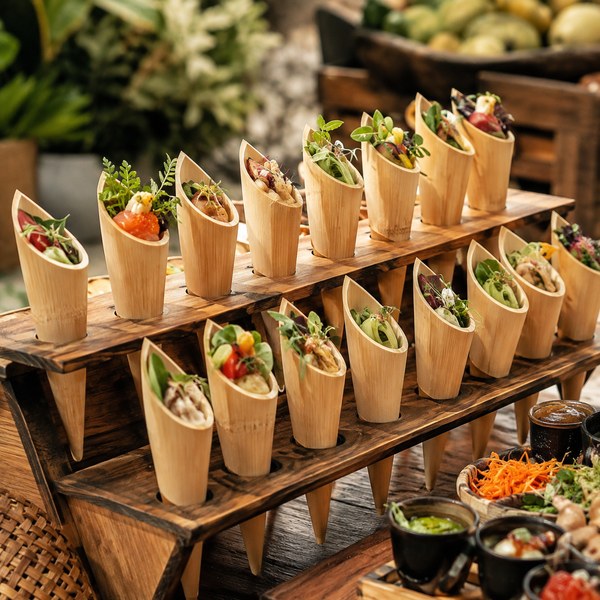
How Do You Create the Ultimate Food Display Using Bamboo Cones and Stands? (Step by Step)
Creating a food display with bamboo cones and stands takes five steps: choose the cone size for the food, line the cone if needed, fill just before service, stage cones in the stand in full rows, and layer in height and garnish. Here is the working sequence our foodservice customers use:
- Match cone size to the food. Use 3–4 oz cones for one-bite items (ceviche spoonful, three shrimp, a mini dessert) and 6–8 oz cones for fries, popcorn chicken, or churros. Oversized cones with small portions look empty; undersized cones overflow and tip.
- Line when the food demands it. Bamboo is naturally grease-resistant, but for heavily sauced or very oily items, drop in a food-safe liner or a small paper insert. For dry snacks — spiced nuts, popcorn, fruit — fill directly.
- Fill as close to service as possible. Fried foods steam inside any vessel. Fill in waves during service rather than loading fifty cones an hour ahead; assign one staffer to refill rows as they empty.
- Stage in full rows, front to back. Fill the front row of the stand completely before starting the next. Guests take from the front; a display refilled in rows always looks full.
- Add height, color, and a sauce station. Set the cone stand on a riser, garnish cones with a visible element (herb sprig, lemon wheel, edible flower), and place dips beside — not inside — the display. A tidy line of ramekins in condiment stands & displays keeps sauces from cross-contaminating the cones and gives the station a finished look.
Food cone ideas: what to serve in bamboo cones
These are the fillings we see most often across 40,000+ foodservice operations — grouped by course so you can build a full menu around cones:
- Fried & hot: french fries, sweet potato fries, tempura vegetables, popcorn chicken, calamari, fish-and-chips bites, arancini, churros, mini corn dogs.
- Fresh & cold: shrimp ceviche, poke, tuna tartare with wonton chips, caprese skewers, melon-prosciutto, crudité with dip at the cone's base.
- Charcuterie cones: salami ribbons, cheese batons, olives, breadsticks — the single most photographed cone format at weddings, because each guest gets a personal charcuterie "board."
- Sushi & hand rolls: temaki-style hand rolls sit naturally in a cone stand; the cone keeps the nori crisp and off the table.
- Sweets: mini doughnuts, cookies, chocolate-dipped fruit, macarons, cotton candy, dessert "fries" (churro sticks with chocolate dip).
- Snack service: popcorn, spiced nuts, trail mix, granola — a self-serve cone wall works for open-house events and hotel lobbies.
How Do Bamboo Canoes Bring Food Displays to Life?
Bamboo canoes are boat-shaped serving vessels that bring food displays to life by giving saucy, layered, and flat-plated bites the same single-portion, grab-and-go treatment that cones give handheld foods. A bamboo canoe (also called a bamboo serving boat) is a shallow, elongated mini tray pressed from bamboo sheath, with a flat base that sits directly on the table — no stand required. Where a cone works with gravity, a canoe works like a miniature plate.
When to use a bamboo canoe instead of a cone
- Sauced items: glazed meatballs, braised short-rib bites, curry spoonfuls — anything that would soak or leak through a cone's point.
- Layered builds: deconstructed tacos, mini nacho stacks, bruschetta, sliders — items that need a flat footprint to hold their architecture.
- Sushi and sashimi: nigiri and sashimi slices present beautifully in a canoe's hull; it is the classic izakaya look, portioned per guest.
- Dessert plating: a slice of tart, a panna cotta with garnish, or a two-bite brownie with sauce dots — the canoe becomes a disposable dessert plate.
The strongest displays mix both formats: cones in stands for the vertical, handheld items and rows of bamboo canoes flanking them for the sauced and plated bites. The materials match, so the whole station reads as one cohesive, natural-textured presentation — this is bamboo tableware doing real work in food service, not just decoration. You'll find bamboo canoes and serving boats alongside other natural-material trays in our eco-friendly food trays collection.
Bamboo canoe display patterns that work
- The regatta line: canoes in a single long row down a grazing table, alternating two menu items — high visual rhythm, easy restocking.
- The chevron: canoes angled in a herringbone pattern on a riser-lifted board; fills a wide buffet footprint with fewer pieces.
- Tiered flotilla: canoes on ascending display risers, tallest tier at the back — the go-to for narrow café counters where table depth is limited.
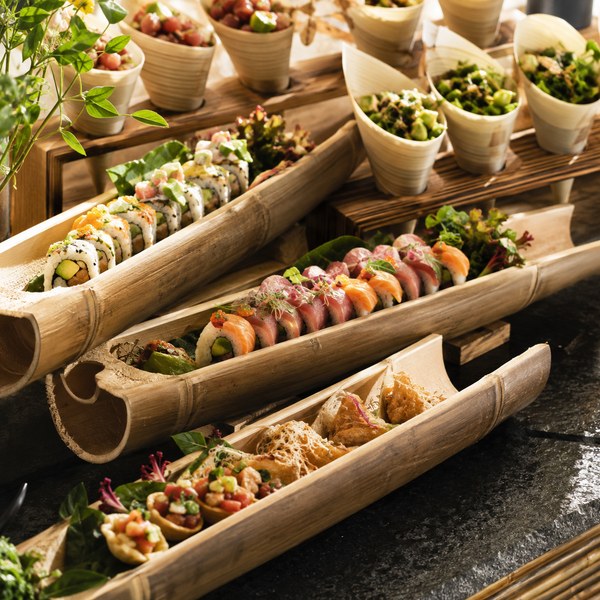
Where Should You Use Bamboo Food Cones and Stands? (The Venue Playbook)
Bamboo food cones and stands work anywhere single portions need to look intentional and move fast: catering events, buffets, cafés and bakeries, food trucks, weddings, hotels, and stadium hospitality. Here is how each venue actually uses them:
Catering events and passed appetizers
This is the format's home turf. Small cone holders ride on servers' trays for passed hors d'oeuvres — guests take the entire cone, so there is no half-eaten skewer coming back on the tray. At stations, multi-port stands anchor the display. Our foodservice customers consistently tell us that bamboo cone displays photograph well for social media and hold up through full-length catering events better than plastic alternatives — the material doesn't fog, crack, or look wilted at hour three.
Buffets and grazing tables
On a buffet, cones solve the serving-utensil problem: every portion is pre-measured and self-contained, so lines move faster and there is no tong bottleneck. Grazing tables use cone stands as height anchors between flat boards of charcuterie and canoes of plated bites.
Cafés, bakeries, and coffee shops
Counter service operations use cone stands as merchandising: a tiered stand of filled cones next to the register sells snacks that would sit unnoticed in a basket. Bakeries run cones of mini pastries, cookie assortments, and chocolate-dipped items; the natural bamboo texture flatters baked goods the way kraft paper does, but stands upright.
Food trucks and concession stands
A cone is a one-handed vessel — which is exactly what a customer standing on a sidewalk needs. Fries, fried chicken, churros, and popcorn all serve faster in a cone than in a clamshell, and a small counter-mounted cone holder turns the pass-through window into a display.
Weddings and private events
Charcuterie cones, dessert cones, and late-night fry cones are three of the most requested wedding food trends we supply. Cone walls — vertical boards drilled with cone ports — double as décor and service piece. Because bamboo reads as natural and premium, it fits rustic, garden, and modern-minimal wedding aesthetics without looking like concession equipment.
Hotels, banquets, and stadium suites
Banquet teams use single-cone holders for amuse-bouche courses and receptions; premium stadium and arena suites use cone stands for self-serve snack programs. In both cases the operational win is the same: portions are controlled, service is utensil-free, and cleanup is a compost bin rather than a dish pit.
Which Restaurantware Products Build a Complete Bamboo Cone Display?
A complete bamboo food cone display uses four product groups, each doing a specific job. This is the checklist we walk catering and hotel customers through:
- Food cones — the vessels themselves, in bamboo and natural-fiber options across 3–8 oz sizes. Start here and size to your menu.
- Display risers & display stands — the height layer. Risers lift cone stands and canoe rows to eye level and create the front-to-back tiers that make a station read as abundant.
- Condiment stands & displays — the sauce station. Organized ramekin and pump stands keep dips beside the cones and off the display.
- Eco display pieces — natural-material display accessories that match bamboo's texture so the whole station looks designed, not assembled.
Mix in bamboo canoes from the eco-friendly food trays collection for the sauced and plated items, and one order covers an entire event's presentation program.
Are Bamboo Food Cones Actually Sustainable? (The Numbers)
Yes — bamboo food cones are among the most defensible sustainability choices in disposable serviceware, and the numbers hold up at the source. Current as of August 2026:
- Bamboo is the fastest-growing plant on record. Certain bamboo species grow up to 91 cm (35 in) per day, according to Guinness World Records.
- It regenerates without replanting. Bamboo matures in 3–5 years and can then be harvested annually for about 20 years from the same living root system, per the International Bamboo and Rattan Organisation (INBAR) — hardwood timber, by contrast, takes decades per harvest.
- Customers notice. In the National Restaurant Association's 2022 State of the Restaurant Industry research, sustainable, reusable, and recyclable packaging ranked first among the year's Top 10 food and menu trends, 30% of adults said they'd likely choose a restaurant offering food produced in an environmentally friendly way, and 70% of millennials and 72% of Gen Z adults said they'd pay extra for upgraded to-go packaging (National Restaurant Association).
- Regulation is moving the same direction. Eight states — California, Connecticut, Delaware, Hawaii, Maine, New York, Oregon, and Vermont — have banned single-use plastic bags, per the National Conference of State Legislatures, and states including Maine, New York, and Maryland have banned polystyrene foam foodservice ware outright, per the Maine Department of Environmental Protection. Operators switching displays to bamboo now are getting ahead of rules that keep tightening.
For foodservice operators, the practical translation: a bamboo cone display is a visible, guest-facing sustainability statement — the rare eco upgrade customers can actually see on the table.
Frequently Asked Questions
What are bamboo cones used for?
In foodservice, bamboo cones are used to serve single portions of appetizers, fried foods, sushi, snacks, and desserts at catering events, buffets, cafés, food trucks, and weddings. Set upright in bamboo cone stands, they create grab-and-go food displays where each guest takes one filled cone — no plates or serving utensils needed.
How do you display food in bamboo cones?
Display food in bamboo cones by filling each cone with one portion just before service, then standing the cones upright in a drilled bamboo cone stand or holder. Refill in full front-to-back rows, add height with display risers, garnish each cone visibly, and station dips in condiment holders beside the stand.
Are bamboo food cones compostable?
Yes. Bamboo food cones are made from natural bamboo sheath or leaf and are compostable, typically in commercial composting programs. Bamboo itself is rapidly renewable — it matures in 3–5 years and regrows from the same root system after harvest, per INBAR — making cones a lower-impact alternative to plastic serviceware.
What foods work best in serving cones?
Handheld, low-sauce foods work best in serving cones: french fries, popcorn chicken, tempura, churros, charcuterie ribbons, fruit, spiced nuts, sushi hand rolls, and mini desserts. Save heavily sauced, layered, or flat-plated items — glazed meatballs, sliders, nigiri — for bamboo canoe serving boats instead.
How do bamboo cone stands and holders work?
Bamboo cone stands and holders are solid bamboo blocks with drilled ports sized to grip a cone's tip. Drop a filled cone into a port and it stands upright, spaced from its neighbors. Multi-port stands (8–24 cones) serve buffets and stations; small weighted holders (1–6 cones) work for passed trays and plated courses.
Are bamboo cones better than paper cones for food?
For displays, yes. Bamboo food cones are rigid, so they stand in a holder without crumpling, and they resist grease and moisture longer than uncoated paper. Paper cones cost less and suit quick hand-offs like fry service, but they slump in stands and soften under hot, oily food during long events.
Conclusion: Build the Display Guests Remember
Bamboo food cones and stands earn their place in a foodservice program because they solve three problems at once: presentation (vertical, cohesive, photogenic displays), operations (portion control and utensil-free service), and sustainability (a renewable, compostable material guests can see and appreciate). Start with the cones, add stands and risers for height, canoes for the sauced bites, and condiment displays for the finishing touch — and your next event station will look like it was designed, not just set out.
Ready to build yours? Shop the full food cones collection at Restaurantware — sized for everything from one-bite tastings to loaded fry cones, in stock and ready to ship.