Food Plating & Presentation: A Foodservice Guide
Food plating presentation is the art of arranging food on a plate to enhance visual appeal, using techniques like the clock method, rule of thirds, height, and negative space. Effective plating combines balance, color, texture, and portioning with garnish and the right dinnerware to elevate perceived quality and guest experience.
Food plating presentation is the fastest lever a kitchen can pull to raise the perceived value of a dish — before a guest tastes anything, they have already judged it with their eyes. Research published in the journal Flavour found that diners rated the same salad as significantly tastier, and were willing to pay more for it, when it was plated artistically rather than tossed together — both before and after eating it (Michel et al., Flavour, University of Oxford Crossmodal Research Laboratory; current as of July 2026). In this guide, we break down the core plating techniques, the five elements every plate should balance, how to choose plating tools and dinnerware, and how to make it all work at commercial volume — not just for one photogenic plate, but for every cover on a Saturday night.
TL;DR: Food Plating & Presentation at a Glance
- The 5 elements of plating are the plate itself, placement/framing, color and texture balance, height, and garnish — every technique below is a way of organizing these five.
- Classic (clock) plating places protein at 6 o'clock, starch at 10, and vegetables at 2 — the fastest method for high-volume plating of food.
- Free-form and landscape plating arrange components asymmetrically for a modern look; minimalist plating uses negative space and oversized plates for fine dining.
- Tools that matter most: plating tweezers, offset spatulas, squeeze bottles, ring molds, and the right plate — white porcelain is the default canvas for a reason.
- Rule of thumb: the food should cover roughly two-thirds of the plate; the remaining negative space frames the dish.
| Plating Style | Best For | Speed at Volume | Signature Move |
|---|---|---|---|
| Classic / clock method | Diners, hotels, banquets, casual dining | Fast | Protein at 6 o'clock |
| Free-form | Contemporary bistros, tasting menus | Moderate | Asymmetric, "scattered with intent" |
| Landscape | Chef-driven concepts, small plates | Moderate | Low, linear arrangement across the plate |
| Minimalist / fine dining | Fine dining, prix fixe, tasting menus | Slow | Negative space on an oversized plate |
| Family style | Shared-plate concepts, catering | Fast | Abundance on large serving pieces |
What Is Food Plating Presentation?
Food plating and presentation is the practice of composing a dish visually — deciding where each component sits, how much of the plate stays empty, what colors and heights appear, and which vessel carries it all. Plating refers to the physical arrangement of food on the plate; presentation is the broader impression, including the dinnerware, garnish, sauce work, and even how the plate is set in front of the guest. The two work together: great plating of food on the wrong plate still reads as a mediocre dish.
Why does it matter commercially? The National Restaurant Association projects total restaurant and foodservice sales of $1.55 trillion in 2026, with more than 7 in 10 consumers saying they would use restaurants more often if they had more disposable income (National Restaurant Association, 2026 State of the Restaurant Industry; current as of July 2026). In a market that competitive, presentation is one of the few differentiators that costs almost nothing per plate. A dish that photographs well gets shared, and a dish that looks deliberate justifies its menu price.
In 15+ years supplying 40,000+ foodservice operations, we've seen the same pattern hold from food trucks to Michelin-starred kitchens: operators who standardize their plating — with plating diagrams, portion specs, and consistent food presentation tools — get more consistent reviews, faster ticket times, and better food-cost control than kitchens that improvise plate by plate.
What Are the Main Food Plating Techniques?
The main food plating techniques are classic (clock-method) plating, free-form plating, landscape plating, and minimalist fine-dining plating — all built on the same five elements. Master the elements first; the styles are just different ways of arranging them.
What Are the 5 Elements of Plating?
The 5 elements of plating are the plate, placement, color and texture, height, and garnish. Every plating food presentation decision falls into one of these five:
- 1. The plate. The canvas comes first. Size, shape, and color set the frame — a coupe bowl says something different than a rimmed round or a slate board. White plates make colors pop; dark plates flatter pale proteins and creams.
- 2. Placement. Where components sit relative to each other and to the rim. Use the rule of thirds (place the focal point off-center, roughly a third of the way across the plate) and keep food off the rim — the rim is the frame, not the canvas.
- 3. Color & texture. Aim for at least three colors and a contrast of textures — something creamy against something crisp, a purée under a seared crust. Monochrome plates read as flat, no matter how good they taste.
- 4. Height. Building vertically — stacking, leaning, or shingling components — creates dimension and makes portions look generous. Anchor tall elements against something stable so the plate survives the pass and the walk to the table.
- 5. Garnish. Every garnish must be edible, intentional, and flavor-relevant. A rogue parsley sprig is decoration; a charred lemon half is a garnish. For technique-level detail, see our guide on how to garnish dishes and cocktails like a pro.
One food-safety note that applies to all five: under the FDA Food Code, food employees may not touch exposed ready-to-eat food with bare hands — plating and garnishing must be done with suitable utensils such as tongs, deli tissue, single-use gloves, or plating tweezers (FDA Food Code 2022, §3-301.11; current as of July 2026). Tweezers aren't just for looks — they keep your health inspection clean.
Classic Plating: How Does the Clock Method Work?
The clock method works by treating the plate as a clock face: protein at 6 o'clock (closest to the guest), starch at 10 o'clock, and vegetables at 2 o'clock. Sauce is either plated under the protein or drawn across the plate before the components go down.
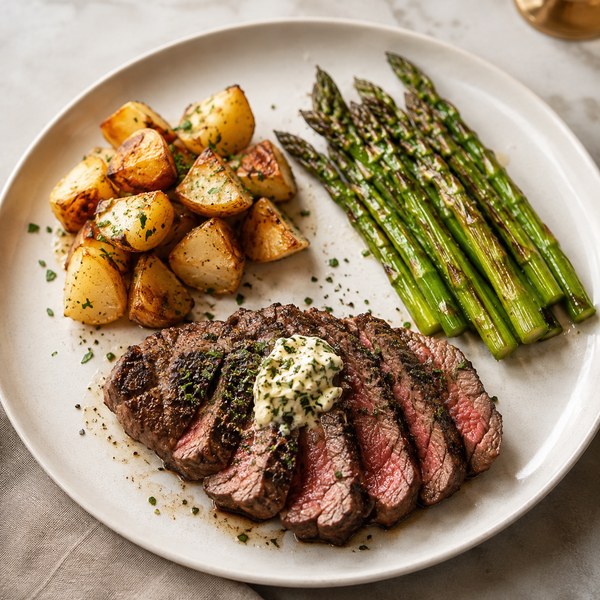
The clock method survives because it is fast, teachable, and repeatable. A line cook can learn it in one shift, and an expo can spot a mis-plated dish at a glance. That's why it remains the default for hotels, banquets, diners, and any operation plating the food for hundreds of covers a night. Its weakness is familiarity — it can look dated if the plate, garnish, and sauce work don't do any lifting. Modernize it with a better canvas (a wide-rimmed or organically shaped plate), a deliberate sauce swoosh, and one element of height.
Free-Form & Landscape Plating: When Should You Use Them?
Use free-form and landscape plating when you want a contemporary, chef-driven look and your ticket times can absorb an extra 30–60 seconds per plate. Free-form plating arranges components asymmetrically — dots of purée, torn herbs, scattered crumbles — composed like an abstract painting rather than a clock face. Landscape plating arranges elements in a low, linear band across the plate, inspired by garden and horizon lines, and it's especially strong for small plates and shareable appetizers.
Two rules keep these styles from becoming a mess. First, "scattered" must still be deliberate: odd numbers of elements (three dots, five points of garnish) read as intentional; even numbers read as accidental. Second, build a plating spec anyway — photograph the approved plate and post it at the pass. Free-form plating and food presentation without a reference photo drifts within a week, and by Friday every cook is plating a different dish.
Minimalist & Fine-Dining Plating: What Makes It Work?
Minimalist fine-dining plating works through negative space: a small, precise composition on an oversized plate, which signals confidence and focuses the eye on craftsmanship. The food typically covers a third or less of the visible surface, portions are tasting-menu scale, and every element earns its place — micro herbs placed with tweezers, a single quenelle, one perfect sauce gesture. Amuse-bouche courses are the purest test of the style — our easy amuse-bouche recipes for beginners are a good place to practice single-bite composition.
This style demands the most from both the cook and the dinnerware. Flaws have nowhere to hide on a nearly empty plate, so component quality and knife work must be immaculate. It also lives or dies on plate selection — oversized coupes, wide-rimmed rounds, and textured stoneware are the standard canvases. If your concept leans this direction, presentation extends beyond the plate: our table setting guide for formal and casual dining covers the tablescape around the plate, and our fine dining etiquette tips for servers cover how the plate should be delivered — both are the natural companions to what happens on the plate itself.
How Do You Choose Plating Tools & Dinnerware?
Choose plating tools and dinnerware by working backward from your menu and your volume: the plate defines the canvas, and the tools determine how precisely — and how quickly — your team can execute the same composition hundreds of times.
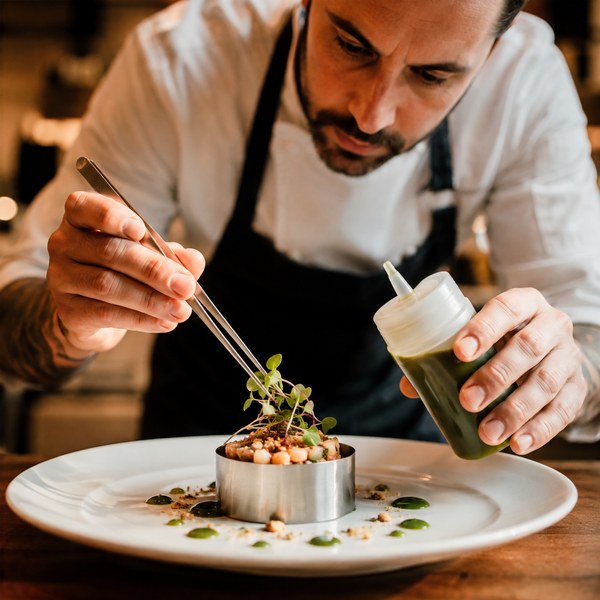
The core plating toolkit for a commercial kitchen:
- Plating tweezers (offset and straight). For placing micro greens, garnishes, and delicate components with precision — and for staying compliant with the FDA's no-bare-hand-contact rule on ready-to-eat food.
- Squeeze bottles. The workhorse for dots, lines, and controlled sauce portioning. Fine-tip squeeze bottles give line cooks pastry-level control at line-cook speed, and they standardize sauce cost per plate.
- Offset spatulas and plating spoons. For swooshes, smears, and quenelles. A deep-welled plating spoon produces a cleaner sauce pull than the back of any regular spoon.
- Ring molds and presentation frames. For stacked and molded components — tartares, timbales, layered starches — that create height with structural integrity.
- Brushes and misters. For glazes, oil sheens, and finishing touches that make components look freshly finished under dining-room light.
On the dinnerware side, the decision tree is simpler than most operators expect:
- White porcelain is the default for a reason. It maximizes color contrast, matches everything, and replaces cheaply when (not if) plates break. Build your core program on porcelain plates and add statement pieces per course rather than per concept.
- Match plate size to portion. A portion that fills two-thirds of the plate looks generous; the same portion on a plate two inches wider looks stingy, and on a plate two inches smaller looks sloppy. Buy the plate for the dish, not the other way around.
- Vary shape by course, not randomly. Coupes for saucy and composed dishes, rimmed rounds for classics, rectangles and boards for shareables. A coherent dinnerware program with two or three shapes beats a cabinet of one-off plates.
- Think about the room, not just the plate. Dark stoneware under warm light flatters rustic concepts; bright white under daylight suits cafés and brunch. Test your finalists under your actual dining-room lighting before committing to a case quantity.
Ready to build your kit? Shop our full range of food presentation tools — tweezers, molds, squeeze bottles, and finishing tools stocked for commercial volume.
How Does Plating Work in a Real Commercial Kitchen?
In a real commercial kitchen, plating works as a system, not an art project: a documented plate spec, a stocked plating station, and tools that let the slowest cook on the line match the chef's composition. This is the part most plating guides skip, and it's where the difference between a photogenic test plate and a consistent 200-cover service actually lives.
Our foodservice customers consistently tell us the same thing: the plating upgrades that stick are the ones that add zero seconds to ticket times. That's why squeeze bottles beat spoon-drizzling for sauce work, why ring molds beat free-hand stacking for layered items, and why pre-portioned garnish containers at the pass beat sending a cook to the walk-in mid-service. Speed and beauty aren't in tension if the mise en place is designed for both.
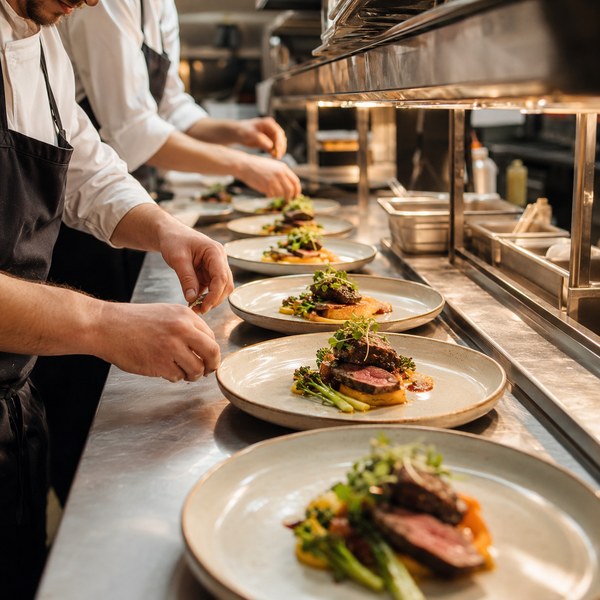
A practical rollout we've watched work across thousands of operations:
- Photograph the approved plate for every menu item and post it at the pass. The photo is the spec; the expo enforces it. For shots that travel beyond the pass — menus, social, delivery apps — see our must-have photography props for food bloggers.
- Standardize the vessel per dish. One dish, one plate. Substituting plates mid-service quietly destroys portion perception and food-cost math.
- Put plating tools on the line, not in a drawer. A bain of plating spoons, tweezers at every garnish station, labeled squeeze bottles in a rail. If a tool takes ten seconds to find, it won't be used on plate 150.
- Audit weekly. Pull one plate per station per week and compare it to the reference photo. Drift is normal; unmeasured drift is a brand problem.
- Design for the guest's first look. Presentation drives repeat business and social sharing — we cover the guest-experience side in depth in enhancing guest experience with creative presentation.
One more real-world note: plating rules flex by menu type. Plant-forward dishes, for example, lean harder on color contrast and height because they often lack a large seared protein as a focal point — our guide to serving plant-based dishes: presentation tips and tools covers that scenario specifically. For more technique deep-dives, browse the full food presentation section of our blog.
Frequently Asked Questions
What are the 5 rules of plating?
The 5 rules of plating are: build around a focal point, keep food off the rim, use odd numbers of components, create height and color contrast, and garnish only with edible elements that belong to the dish. Follow all five and even a simple dish reads as intentional and professional.
What is the rule of 3 in plating?
The rule of 3 in plating means composing dishes in odd-numbered groupings — three scallops, three dots of purée, three points of garnish — because odd numbers create visual movement and look deliberate. It overlaps with the rule of thirds: placing the focal point off-center, about a third of the way across the plate, rather than dead center.
What are the 5 basic elements of plating?
The 5 basic elements of plating are the plate (size, shape, color), placement (arrangement and framing), color and texture contrast, height (vertical dimension), and garnish (edible, intentional finishing touches). Every plating style — classic, free-form, landscape, or minimalist — is a different way of balancing these same five elements.
What is the difference between food plating and food presentation?
Food plating is the physical arrangement of food on the plate; food presentation is the total visual impression, which includes the plating plus the dinnerware, garnish, sauce work, table setting, and how the dish is served. Plating is one component of presentation — a well-plated dish on the wrong vessel, or delivered carelessly, still fails as presentation.
How do you plate food for presentation?
To plate food for presentation: start with the right-sized plate, sauce first, place the main component off-center using the rule of thirds, add sides with color and height contrast, wipe the rim, and finish with an edible garnish placed with tweezers. Work from a reference photo so every plate leaving the pass matches the approved composition.
What are some common food plating mistakes?
The most common food plating mistakes are overcrowding the plate, plating on the rim, using inedible or irrelevant garnishes, serving hot food on cold plates, ignoring height and color contrast, and letting sauce run uncontrolled. The fix for nearly all of them is the same: a documented plate spec, the right tools at the pass, and a two-thirds coverage rule that protects negative space.
Conclusion: Plate Like It's Part of the Recipe
Food plating presentation isn't decoration — it's the last step of cooking and the first step of the guest experience. The kitchens that win treat the plate spec with the same discipline as the recipe: the five elements balanced, one clear technique per dish, tools staged on the line, and a reference photo enforcing it all at the pass. The science says guests will rate the food as tastier and pay more for it; the operations math says it costs seconds, not dollars.
Start with the canvas and the toolkit: shop food presentation and plating tools at Restaurantware — plating tweezers, squeeze bottles, ring molds, and finishing tools stocked in commercial quantities and ready to ship today.