Sushi Rolls
Sushi rolls are cylinders of vinegared short-grain rice, nori seaweed, and fillings like raw fish, cooked seafood, or vegetables, sliced into bite-size pieces. Top sushi rolls include the California roll, spicy tuna roll, shrimp tempura roll, and dragon roll. This guide also covers sushi etiquette, rice, and traditional versus modern technique.
Sushi rolls have moved from specialty menus to the center of American dining. The NFI Sushi Council's 2026 U.S. Sushi Industry Report, conducted by Spheric Research, values the U.S. sushi industry at approximately $22 billion, with $16 billion generated through restaurant sales alone. Whether you run a dedicated sushi bar, a grocery grab-and-go program, or a hotel kitchen adding a sushi station, knowing the popular sushi rolls — their names, fillings, and how to present them — is foundational menu knowledge.
At Restaurantware, we've spent 15+ years supplying 40,000+ foodservice operations, including thousands of sushi bars, ghost kitchens, and supermarket sushi programs. This consolidated guide covers everything we used to spread across four separate articles: the most popular sushi rolls, how to eat sushi properly, what makes authentic sushi rice, and how traditional and modern sushi techniques differ.
TL;DR — Popular Sushi Rolls at a Glance
- The California roll is the most ordered sushi roll in the United States — a cooked, beginner-friendly uramaki.
- Sushi rolls break down into five structural types: hosomaki (thin), futomaki (thick), uramaki (inside-out), temaki (hand rolls), and gunkan (battleship).
- Authentic sushi rice is short-grain Japonica rice seasoned with rice vinegar, sugar, and salt — about 200 grams per cup uncooked.
- The FDA Food Code requires fish served raw to be frozen for parasite destruction — at -4°F for 7 days or -31°F for 15 hours.
- Presentation sells: rolls plated on quality trays and packed in fitted sushi containers command higher perceived value in dine-in and takeout alike.
| Roll | Style | Key Fillings | Raw or Cooked | Best For |
|---|---|---|---|---|
| California roll | Uramaki | Imitation crab, avocado, cucumber | Cooked | Beginners, grab-and-go |
| Spicy tuna roll | Uramaki/hosomaki | Minced tuna, spicy mayo | Raw | Heat seekers |
| Shrimp tempura roll | Uramaki | Fried shrimp, avocado, cucumber | Cooked | Crunch lovers |
| Philadelphia roll | Uramaki | Smoked salmon, cream cheese | Cured | Rich, creamy flavor |
| Dragon roll | Specialty uramaki | Eel or shrimp tempura, avocado top | Cooked | Showpiece plating |
| Rainbow roll | Specialty uramaki | California base, assorted sashimi top | Raw | Sampler appeal |
| Tekka maki (tuna roll) | Hosomaki | Raw tuna only | Raw | Purists |
| Kappa maki (cucumber roll) | Hosomaki | Cucumber only | Vegetarian | Palate cleanser, vegans |

What Are Sushi Rolls and How Does the Category Break Down?
Sushi rolls, called makizushi in Japanese, are a category of sushi made by rolling vinegared rice and fillings inside nori (dried seaweed) using a bamboo mat, then slicing the roll into pieces. The category breaks down into five structural types:
- Hosomaki (thin rolls): Nori outside, rice and a single filling inside. About one inch in diameter, cut into six pieces. Examples: tekka maki, kappa maki.
- Futomaki (thick rolls): Large-format rolls, two inches or more across, packed with multiple fillings — often four or five vegetables, egg, and fish.
- Uramaki (inside-out rolls): Rice on the outside, nori and fillings inside, often finished with sesame seeds or tobiko. This American innovation includes the California roll and most specialty rolls.
- Temaki (sushi hand rolls): Cone-shaped rolls wrapped by hand rather than rolled with a mat. Sushi hand rolls are eaten with the hands immediately after assembly, while the nori is still crisp.
- Gunkan (battleship sushi): An oval of rice wrapped with a nori collar to hold loose toppings like ikura (salmon roe) or uni (sea urchin).
Rolls are one branch of the wider sushi family. An assorted sushi platter typically combines maki rolls with nigiri and sashimi — the differences are covered in the comparison section below.
What Are the Most Popular Sushi Rolls?
The most popular sushi rolls in the U.S. are the California roll, spicy tuna roll, shrimp tempura roll, Philadelphia roll, and dragon roll — a list dominated by cooked or approachable uramaki styles. Here are 25 popular sushi rolls every operator, server, and sushi lover should know.
1. California Roll
The California roll is the best-known of all California sushi rolls and the most ordered roll in America. It combines imitation crab (kani), avocado, and cucumber in an inside-out roll, usually topped with sesame seeds or tobiko. Because it contains no raw fish, it is the classic gateway roll — and the anchor of nearly every grocery grab-and-go sushi program we supply.
2. Spicy Tuna Roll
Minced raw tuna is mixed with spicy mayonnaise and sriracha, then rolled with cucumber. It is a top-three seller at almost every sushi bar and a template for spicy salmon and spicy yellowtail variants.
3. Shrimp Tempura Roll
Crispy battered shrimp, avocado, and cucumber rolled inside-out and often drizzled with eel sauce. Fully cooked, crunchy, and one of the highest-margin rolls on most menus.
4. Philadelphia Roll
Smoked salmon, cream cheese, and cucumber — named for Philadelphia-brand cream cheese, not the city's sushi scene. A distinctly American creation that remains a perennial best seller.
5. Dragon Roll
A specialty roll typically built on shrimp tempura or eel and cucumber, then layered with thin avocado slices arranged like dragon scales. Its dramatic look makes it a social-media favorite and a premium-price anchor.
6. Rainbow Roll
A California roll base draped with alternating slices of tuna, salmon, yellowtail, and avocado. It functions as a sashimi sampler in roll form.
7. Spider Roll
Fried soft-shell crab, cucumber, avocado, and spicy mayo, with crab legs extending from the ends of the roll like spider legs. A futomaki-scale specialty roll.
8. Caterpillar Roll
Barbecued eel (unagi) and cucumber inside, with overlapping avocado slices covering the top to resemble a caterpillar. Sweet, smoky, and fully cooked.
9. Boston Roll
Poached shrimp, lettuce, cucumber, and mayonnaise — an entirely cooked, chilled roll popular with diners easing into sushi.
10. Alaska Roll
Fresh salmon, avocado, and cucumber, served either inside-out or with salmon layered on top. Clean, rich, and a strong seller wherever quality salmon is available.
11. Volcano Roll
A California-style base topped with a baked, creamy seafood mixture — often scallops or crab in spicy mayo — that erupts over the roll. Served warm.
12. Tiger Roll
Shrimp tempura inside with avocado and shrimp striped across the top, mimicking tiger markings. A visual centerpiece for assorted platters.
13. Tekka Maki (Tuna Roll)
A traditional hosomaki of raw tuna and rice in nori. Its simplicity showcases fish quality, which is why it remains a benchmark roll in Edomae-style sushi bars.
14. Kappa Maki (Cucumber Roll)
Crisp cucumber in a thin roll — named after the cucumber-loving kappa of Japanese folklore. It doubles as a palate cleanser and a reliable vegan option.
15. Sake Maki (Salmon Roll)
The salmon counterpart to tekka maki: raw salmon and rice in a thin nori roll. A minimalist staple across both traditional and modern menus.
16. Unagi Roll (Eel Roll)
Grilled freshwater eel glazed with sweet kabayaki sauce, usually paired with cucumber or avocado. Fully cooked with a caramelized, savory-sweet profile.
17. Negitoro Roll
Minced fatty tuna (toro) with scallion in a thin roll. A Japanese izakaya classic prized for its buttery texture.
18. Futomaki
The traditional thick roll, stuffed with tamago (sweet egg), pickled vegetables, mushrooms, and sometimes fish. Common in Japanese home cooking and festival bento.
19. Salmon Skin Roll
Crispy grilled salmon skin, cucumber, and sweet sauce. It converts a trim byproduct into a textural, high-margin menu item — smart economics for any sushi program.
20. Vegetable Roll
A mixed-vegetable roll — typically avocado, cucumber, carrot, and pickled radish (oshinko). The workhorse vegetarian option for catering trays.
21. Avocado Roll
Just avocado and rice: creamy, inexpensive, and one of the most ordered vegetarian rolls in American takeout.
22. Crunchy Roll (Firecracker Roll)
Usually shrimp tempura or spicy crab topped with crunchy tempura flakes and drizzled with spicy mayo and eel sauce. Texture is the selling point.
23. Hawaiian Roll
Fresh ahi tuna with tropical accents — mango, pineapple, or macadamia — reflecting Hawaii's poke tradition in rolled form.
24. Surf and Turf Roll
Seared beef paired with shrimp or crab and avocado. A crossover roll that pulls steakhouse diners into the sushi section.
25. Chicken Katsu Roll
Panko-fried chicken cutlet with cucumber and tonkatsu sauce. No seafood at all — a practical inclusion for mixed groups and kids' menus.
Building a sushi menu or grab-and-go program? Browse our full range of sushi containers and takeout trays designed to keep every one of these rolls looking as good at pickup as it does behind the glass.
What's the Difference Between Maki, Nigiri, Sashimi, and Hand Rolls?
Maki are rolled sushi cut into pieces; nigiri is a hand-pressed pillow of rice topped with a slice of fish; sashimi is sliced raw fish served without rice; and temaki are hand-rolled nori cones eaten whole. Only maki and temaki are technically "sushi rolls."
- Nigiri — Rice pressed by hand, topped with fish (tuna, salmon, shrimp, eel) and often a whisper of wasabi between rice and fish. Eaten in one bite, fish side down in soy sauce.
- Sashimi — Expertly sliced raw fish, no rice. Because there is no rice, sashimi is not sushi at all — a distinction worth training front-of-house staff on.
- Maki — Any rolled-and-sliced format: hosomaki, futomaki, and uramaki.
- Temaki (hand rolls) — Cone-shaped sushi hand rolls served one at a time. Dedicated hand-roll bars have become one of the fastest-growing fast-casual sushi formats in U.S. cities.
An assorted sushi presentation mixes these formats deliberately: sashimi first, nigiri second, rolls last, so delicate raw fish is tasted before richer, sauced items.
How Do You Eat Sushi Properly? The Do's and Don'ts
The proper way to eat sushi is in one bite, with either chopsticks or clean hands, dipping fish-side down in soy sauce and eating ginger between pieces rather than on them. Etiquette matters to guests — and staff who can explain it add real perceived value to the meal.
Are You Supposed to Eat Sushi With Your Hands?
Yes — eating sushi with your hands is traditional and fully acceptable, especially for nigiri and hand rolls. Edo-period sushi began as street food eaten by hand, and many Tokyo sushi masters still encourage it because fingers compress the rice less than chopsticks. Sashimi is the exception: always use chopsticks for sashimi. Maki rolls work either way.
The Do's
- Do eat each piece in one bite. Rolls and nigiri are portioned to be eaten whole; biting them in half causes them to collapse.
- Do dip nigiri fish-side down. Rice soaks up soy sauce like a sponge, overwhelming the fish and breaking the rice apart.
- Do eat pickled ginger (gari) between pieces. It is a palate cleanser, not a topping.
- Do eat sushi promptly. Sushi rice is served at body temperature by design; it degrades as it chills.
- Do use the wet towel (oshibori) to clean your hands before eating by hand.
The Don'ts
- Don't mix wasabi into your soy sauce at a traditional sushi bar — the chef has already seasoned each piece. (At casual American spots, nobody will flinch.)
- Don't rub wooden chopsticks together; it implies the restaurant provided cheap utensils.
- Don't pass food chopstick-to-chopstick or stand chopsticks upright in rice — both echo Japanese funeral rites.
- Don't drown rolls in soy sauce. A light dip preserves the balance the chef built.
- Don't order sashimi last. Follow the light-to-rich progression: sashimi, nigiri, then rolls.
What Makes Authentic Sushi Rice?
Authentic sushi rice (shari or sumeshi) is short-grain Japonica white rice seasoned with rice vinegar, sugar, and salt while still warm. The rice — not the fish — is what Japanese chefs consider the foundation of sushi; apprentices traditionally spend years mastering rice before ever cutting fish.
Four rules define proper sushi rice:
- Short-grain Japonica only. Varieties like Koshihikari and Calrose develop the gentle stickiness that holds a roll together. Long-grain rice will not bind.
- Rinse until the water runs clear. Washing removes surface starch that would otherwise turn the rice gluey.
- Season while warm. Fold in the vinegar mixture (awasezu) with a cutting motion as you fan the rice, giving each grain a glossy coat without crushing it.
- Use at body temperature. Refrigerated sushi rice hardens as its starches retrograde, which is why great sushi rice is held warm, never cold.
How Many Grams Is 1 Cup of Sushi Rice?
One cup of uncooked sushi rice weighs approximately 200 grams. Working in reverse, 250 grams of sushi rice equals about 1¼ cups uncooked. A standard ratio for seasoning is 3 tablespoons rice vinegar, 1 tablespoon sugar, and 1 teaspoon salt per 2 cups (about 400 grams) of uncooked rice. Weighing rice rather than measuring by volume is the single easiest consistency upgrade for a commercial sushi program.
Traditional vs. Modern Sushi Techniques: What's Changed?
Traditional Edomae sushi emphasizes restraint — aged and cured fish, hand-pressed nigiri, minimal sauce — while modern sushi embraces inside-out rolls, bold sauces, torching, and machine-assisted production. Both approaches share one non-negotiable: excellent rice and rigorous fish handling.
What Defines Traditional Sushi Technique?
Edomae ("Edo-style") technique developed in 19th-century Tokyo, when chefs cured fish in salt, vinegar, or soy to preserve it without refrigeration. Hallmarks include aging fish to develop umami, seasoning each piece so no soy dish is needed, hand-forming nigiri with a precise number of motions, and an omakase progression chosen by the chef. The knife work alone — single-draw cuts with a yanagiba blade — takes years to master.
What Is Americanized Sushi?
Americanized sushi is the adaptation of Japanese sushi to Western tastes, beginning with the California roll in 1960s–70s Los Angeles. Its signatures: rice on the outside (hiding the unfamiliar nori), cooked or vegetarian fillings, cream cheese and spicy mayo, deep-fried elements, and heavy sauces. Purists debate it, but americanized sushi built the U.S. market — those approachable rolls are the reason sushi now appears in supermarkets, stadiums, and school cafeterias.
What Is Artistic Sushi?
Artistic sushi treats the roll as a visual medium. Examples include kazari-maki ("decorative rolls") cut to reveal flowers or animal faces in cross-section, mosaic rolls with geometric fillings, temari (ball-shaped) sushi, and elaborately garnished specialty rolls like the dragon and caterpillar. For operators, artistic presentation is a margin play: the same ingredients plated dramatically support a meaningfully higher menu price — and earn free marketing every time a guest photographs the plate.
How Has Technology Changed Modern Sushi?
Modern sushi production now includes rice-sheeting robots and automatic roll cutters that turn out consistent maki at kiosk scale, conveyor-belt (kaiten) service, and connected kitchen equipment that logs refrigeration temperatures continuously for HACCP compliance. Technology is a major reason retail sushi scaled: the NFI Sushi Council report counts more than 12,500 sushi kiosks across the U.S., the vast majority located in grocery stores.
How Do Sushi Programs Keep Raw Fish Safe?
The FDA Food Code (§3-402.11) requires that fish served raw or undercooked be frozen for parasite destruction: frozen and stored at -4°F (-20°C) or below for a minimum of 7 days, or frozen at -31°F (-35°C) or below until solid and stored at that temperature for at least 15 hours. "Sushi-grade" is a marketing term, not a regulatory one — what actually protects guests is documented compliance with these freezing rules, verified supplier letters, and cold-chain discipline from receiving through service.
How Should Foodservice Operators Package and Present Sushi Rolls?
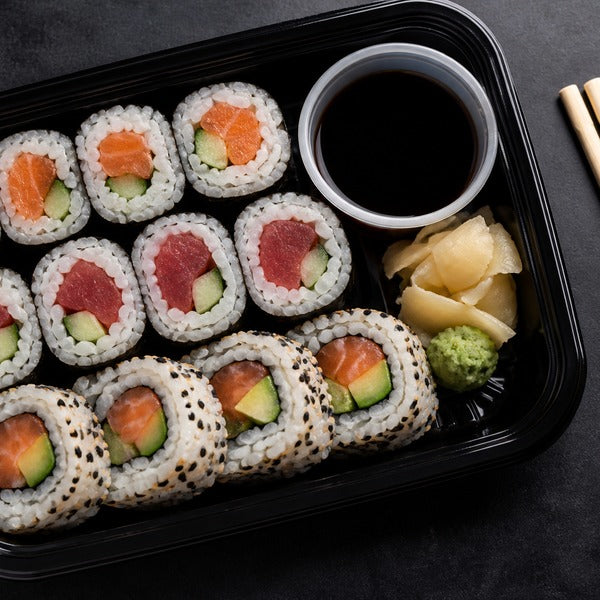
Sushi is bought with the eyes first. In 15+ years supplying 40,000+ foodservice operations, we've seen the same pattern across sushi bars, hotels, and grocery programs: identical rolls sell dramatically better when presented on purpose-built trays with fitted lids, clean compartments for wasabi and ginger, and quality chopsticks — because packaging is the freshness signal a customer reads before tasting anything.
Here's how we'd outfit each service style:
- Takeout and delivery: A fitted, leak-resistant container keeps rolls upright and condensation off the nori. Our Roku black plastic long take-out sushi container with clear lid frames an 8-piece roll like a display case, while the medium Roku take-out sushi tray suits 6-piece hosomaki and combo boxes.
- Grab-and-go and retail kiosks: Sustainability reads as freshness in the grocery aisle. The Matsuri Vision kraft paper large sushi container and the Pulp Tek sugarcane bagasse large sushi tray give programs a plastic-reduced package that still stacks and merchandises cleanly.
- Catering platters: For assorted sushi spreads, the Roku extra-large sushi tray with clear lid carries 20+ pieces without crowding the presentation.
- In-house prep: Every roll on this list starts on a Bento Tek natural bamboo sushi mat — the one tool no sushi station can skip.
- The finishing touch: Pair every order with wrapped disposable bamboo chopsticks; handing a guest quality chopsticks costs pennies and upgrades the entire experience.
Our foodservice customers consistently tell us that upgrading from generic clamshells to presentation-grade sushi containers is what makes takeout sushi look worth its price point — several grocery partners reported that better packaging alone justified moving their combo boxes up a full price tier without customer pushback.
Frequently Asked Questions About Sushi Rolls
What are the top 10 sushi rolls?
The top 10 sushi rolls in the U.S. are: (1) California roll, (2) spicy tuna roll, (3) shrimp tempura roll, (4) Philadelphia roll, (5) dragon roll, (6) rainbow roll, (7) spider roll, (8) caterpillar roll, (9) tekka maki (tuna roll), and (10) Boston roll. Cooked and inside-out rolls dominate because they are the most approachable for new sushi eaters.
What are all the different types of sushi rolls?
Sushi rolls come in five structural types: hosomaki (thin rolls with one filling), futomaki (thick multi-filling rolls), uramaki (inside-out rolls with rice on the outside), temaki (cone-shaped hand rolls), and gunkan (nori-wrapped "battleship" cups for loose toppings). Nearly every named roll — from the California to the dragon — is a variation of one of these five.
Is sushi good for A1C?
Sushi can fit a blood-sugar-conscious diet, but portion and format matter. White sushi rice is a refined, high-glycemic carbohydrate — a single roll can contain a cup or more, plus added sugar in the seasoning — so rice-heavy rolls can raise glucose quickly. Better choices for managing A1C include sashimi, nigiri in moderation, cucumber-wrapped (naruto-style) rolls, and rolls with fatty fish and vegetables that slow digestion. Anyone managing diabetes should confirm an approach with their healthcare provider.
Is sushi good for osteoporosis?
Sushi offers real bone-supporting nutrients: fatty fish like salmon and mackerel supply vitamin D, which supports calcium absorption, and edamame and tofu-based sides add calcium and protein. The caution is sodium — soy sauce, miso, and pickled items add up quickly, and high sodium intake increases calcium excretion. Choose low-sodium soy sauce and dip lightly. As with any condition, dietary questions belong with a physician or dietitian.
What are all the types of sushi?
Beyond rolls, sushi includes nigiri (hand-pressed rice topped with fish), sashimi (sliced fish without rice — technically not sushi), chirashi (a bowl of sushi rice with scattered toppings), inari (rice in sweet fried tofu pouches), oshizushi (pressed box sushi), and temari (ball-shaped sushi). A full-service sushi menu draws on all of these formats, with maki rolls as the volume driver.
What is the most ordered sushi roll?
The California roll is the most ordered sushi roll in the United States. Its cooked ingredients, mild flavor, and low price make it the default entry point for first-time sushi eaters, the top seller in supermarket grab-and-go programs, and the base recipe for dozens of specialty rolls like the rainbow and volcano.
Conclusion: Build a Sushi Program Worth Photographing
Sushi rolls are the growth engine of one of the fastest-expanding categories in American foodservice — a $22 billion industry that now reaches from omakase counters to 12,500+ grocery kiosks. The operators winning that growth get three things right: rice made properly, fish handled to FDA standards, and presentation that signals quality before the first bite.
We can help with the third one. Explore Restaurantware's full collection of sushi containers, trays, and serving supplies — from Roku takeout trays to eco-friendly bagasse and kraft options — and give every roll on your menu the presentation it deserves.