PFAS Free Products: A Guide To Restaurant Supplies With No PFAS Added
PFAS free products are food packaging and supplies made without per- and polyfluoroalkyl substances — synthetic "forever chemicals" historically used as grease-proofing coatings on paper and fiber packaging. Operators must avoid PFAS because bans in California, New York, Washington, and other states prohibit selling fiber-based packaging containing them. The reliable rule: buy only products backed by a manufacturer's certificate of compliance or third-party certification such as BPI.
TL;DR: Sourcing PFAS Free Products for Your Operation
- PFAS grease-proofers are off the U.S. market at the federal level. In February 2024, the FDA announced that grease-proofing agents containing PFAS are no longer sold for U.S. food contact use, and in January 2025 it declared the 35 related food contact notifications no longer effective.
- State bans go further — and apply to you. New York (Dec. 31, 2022), California (Jan. 1, 2023), Washington (Feb. 1, 2023, expanded May 1, 2024), and Minnesota (2024) prohibit distributing or selling plant-fiber food packaging with intentionally added PFAS.
- Highest-risk categories: molded fiber clamshells and bowls, grease-resistant wraps and liners, paper bags and sleeves, pizza boxes, and food boats.
- How to verify: request a certificate of compliance, look for BPI or CMA certification, or ask for total organic fluorine (TOF) test results.
- Where to buy: Restaurantware's eco-friendly disposables and restaurant disposable supplies collections carry fiber and paper lines built for post-ban compliance, with documentation available on request.
| Quick check | PFAS risk signal | PFAS-free signal |
|---|---|---|
| Material | Grease-resistant coated paper/fiber with no coating disclosure | Uncoated paper, PLA-lined fiber, bamboo, aluminum, or disclosed water-based coatings |
| Documentation | "Eco" or "green" label with no paperwork | Certificate of compliance; BPI or CMA certification |
| Testing | No fluorine data available | Total organic fluorine (TOF) results below regulatory thresholds |
| Claims | Vague "chemical-free" marketing | Explicit "no intentionally added PFAS" statement in writing |
Searches for pfas free products have surged as "forever chemicals" moved from environmental journals to state law books — and nowhere is the pressure more direct than in foodservice. If you buy clamshells, cups, bowls, wraps, or paper bags for a restaurant, ghost kitchen, or catering operation, PFAS-free sourcing is no longer a marketing preference. It is a compliance requirement in a growing list of states, and choosing wrong can mean unsellable inventory or fines. This guide consolidates everything operators need: what PFAS are, exactly what the FDA and state legislatures have done, whether bagasse supplies are safe, what distributors must document, and how to verify that the products you buy contain no PFAS added.
What Are PFAS and Why Are They in Food Packaging?
PFAS (per- and polyfluoroalkyl substances) are a class of thousands of man-made chemicals used in industry and consumer products since the 1940s, according to the CDC's Agency for Toxic Substances and Disease Registry. In food packaging, PFAS served one job extremely well: repelling grease, water, and oil. A thin fluorinated coating is what kept a burger wrapper from soaking through and a molded fiber bowl from wilting under a hot, oily entrée.
The problem is persistence. Most PFAS — including the most studied compounds, PFOA and PFOS — do not break down in the environment. ATSDR notes that PFAS are now found in the blood of people and animals worldwide, are present at low levels in a variety of foods, and can build up in the body with repeated exposure. Scientific studies suggest exposure to some PFAS may be linked to harmful health effects, which is why federal and state regulators have moved against them in food contact applications.
For foodservice buyers, the key insight is that PFAS in packaging were almost always intentionally added — applied as grease-proofing agents to paper, paperboard, and molded fiber. That is exactly what the laws below target, and it is why "no PFAS added" is the phrase to look for on supplier documentation.
What Has the FDA Done About PFAS in Food Packaging?
The FDA has ended the U.S. market for PFAS grease-proofing agents in food packaging. In February 2024, the agency announced that all grease-proofing agents containing PFAS are no longer being sold for food contact use in the United States — the result of voluntary market phase-outs the FDA negotiated with manufacturers. In January 2025, the FDA followed up with a Federal Register notice determining that the 35 food contact notifications (FCNs) covering PFAS-based grease-proofers for paper and paperboard packaging are no longer effective, based on abandonment of those uses.
The phase-out grew out of FDA science. In 2020, FDA researchers published findings on 6:2 fluorotelomer alcohol (6:2 FTOH), a component of "short-chain" PFAS coatings that had been marketed as the safer successor to older long-chain PFAS. The FDA's review found that 6:2 FTOH biopersists in rodents and is more toxic than comparison compounds, which led the agency to seek — and get — a market phase-out of these short-chain grease-proofing substances.
Two practical takeaways for buyers:
- New domestic supply should be PFAS-free. U.S.-compliant paper and fiber packaging manufactured today should not use PFAS grease-proofers, because those substances are no longer authorized or sold for that use.
- Old stock and gray-market imports are the risk. The phase-out did not vaporize warehouse inventory, and imported packaging may not follow U.S. practice. Documentation — not the manufacture date alone — is your protection.
Beyond packaging, the EPA regulates PFAS in the water your operation uses. In April 2024, the EPA finalized the first national drinking water standards for PFAS, setting enforceable limits of 4.0 parts per trillion for PFOA and PFOS. The agency has since proposed implementation changes — including a compliance extension option to 2031 for water systems and a proposed rescission of limits on certain other PFAS compounds — but the PFOA/PFOS limits stand as of mid-2026. Water rules don't change your packaging order, but they signal where regulation is headed: toward less PFAS everywhere food is made and served.
Which States Ban PFAS in Food Packaging?
Multiple states now prohibit selling or distributing plant-fiber food packaging that contains intentionally added PFAS — and the bans bind restaurants and distributors, not just manufacturers. The four laws below are the ones most operators ask about, verified at their official sources.
| State | Law | Effective | What it prohibits |
|---|---|---|---|
| New York | Hazardous Packaging Act (ECL Art. 37, Title 2) | Dec. 31, 2022 | Distributing, selling, or offering for sale plant-fiber food packaging intended for direct food contact that contains intentionally added PFAS |
| California | AB 1200 (Health & Safety Code §109000) | Jan. 1, 2023 | Distributing, selling, or offering for sale food packaging — including food service ware made substantially of paper, paperboard, or plant fiber — containing regulated PFAS; manufacturers must use the least toxic alternative |
| Washington | RCW 70A.222.070 (Healthy Food Packaging) | Feb. 1, 2023 / May 1, 2024 | First round: wraps, plates, food boats, pizza boxes. Second round: bags and sleeves, bowls, flat serviceware, open-top containers (fry cartons, food cups), and closed containers such as clamshells |
| Minnesota | Food packaging ban (2024) + Amara's Law | 2024; Amara's Law phases 2025–2032 | PFAS prohibited in food packaging as of 2024; Amara's Law extends prohibitions across 11 product categories from Jan. 1, 2025, reaching nearly all intentionally added PFAS by Jan. 1, 2032 |
Additional states have enacted their own PFAS packaging restrictions with varying effective dates, and more are in the pipeline — Minnesota's Amara's Law model, which sweeps far beyond packaging, is being watched closely by other legislatures. If you operate in multiple states, the practical strategy is simple: source to the strictest standard. A product line that satisfies Washington's category-by-category ban and California's AB 1200 will satisfy essentially every other state rule on the books.
California AB 1200: What the Ban Covers and Why It Set the Template
California's AB 1200, signed in October 2021 and effective January 1, 2023, prohibits any person from distributing, selling, or offering for sale in the state any food packaging containing regulated PFAS. The law defines "food packaging" broadly: a nondurable package, packaging component, or food service ware composed in substantial part of paper, paperboard, or other materials originally derived from plant fibers. That definition pulls in most of a restaurant's disposables wall — molded fiber clamshells, paper bowls, bakery boxes, sleeves, wraps, and trays.
AB 1200 also includes two provisions buyers should know beyond the ban itself. First, manufacturers replacing PFAS must use the least toxic alternative — the legislature explicitly did not want PFAS swapped for a different problem chemical. Second, the same bill created cookware chemical-disclosure rules: since January 2024, cookware sold in California containing designated-list chemicals in food-contact surfaces or handles must disclose them on the label, and manufacturers may not claim cookware is "free of" a chemical class unless no chemical from that class was intentionally added. If your operation buys pans as well as packaging, the same documentation discipline applies.

Are Bagasse Restaurant Supplies With No PFAS Added Safe?
Yes — bagasse restaurant supplies with no PFAS added are a safe, compliant, and commercially proven choice for foodservice. Bagasse is the fibrous pulp left over after sugarcane is crushed for juice; molded under heat and pressure, it becomes rigid, microwave-tolerant plates, bowls, and clamshells. Because bagasse is a plant-fiber material, it sits squarely inside every state packaging ban discussed above — which is exactly why "no PFAS added" is the phrase that matters when you buy it.
Are bagasse plates safe?
Bagasse plates are safe for hot and cold food service when they are manufactured without intentionally added PFAS. The historical concern was real: before the state bans and the FDA phase-out, many molded fiber products relied on fluorinated grease-proofing agents to achieve oil resistance, and molded fiber was repeatedly flagged in state guidance as a category where PFAS were used to impart grease-proofing. New York's DEC guidance specifically lists molded fiber and bagasse among the plant-fiber materials covered by its ban. Today's compliant bagasse lines achieve grease and moisture resistance through fiber density, mechanical pressing, and non-fluorinated treatments instead. When evaluating bagasse plates, ask the supplier one direct question: "Can you provide a written statement or certificate that no PFAS are intentionally added?" A reputable manufacturer answers with paperwork, not adjectives.
Do compostable bagasse plates fail in high-volume catering?
Compostable bagasse plates perform reliably in high-volume catering when you match the product weight to the application — most reported "failures" trace to under-specified plates, not the material. Three sourcing rules prevent them:
- Match plate weight to menu weight. Heavy, saucy entrées need heavyweight bagasse (or a two-plate stack policy). Lightweight economy plates are built for pastries and passed appetizers, not carving stations.
- Mind hold time. Bagasse tolerates hot, moist food well, but any uncoated fiber product will soften if plated food sits under heat lamps for extended periods. For long holds, use lidded fiber containers rather than open plates.
- Buy consistent, certified stock. Catering volume magnifies quality variance. Sourcing from a single documented line — like the sugarcane and fiber options in our eco-friendly plates collection — keeps performance predictable across thousands of covers.
In 15+ years supplying more than 40,000 foodservice operations, we've watched bagasse go from a niche "green option" to a default spec for caterers and fast-casual chains — precisely because post-ban, PFAS-free bagasse delivers the grease resistance operators need without the compliance risk fluorinated coatings created.
What Are the PFAS Testing Requirements for Foodservice Packaging Distributors?
Distributors and the operators who buy from them prove PFAS compliance through three mechanisms: certificates of compliance, third-party certifications, and total organic fluorine (TOF) testing. No state requires a restaurant to run its own lab tests — the burden sits upstream — but every state ban makes it illegal for you to sell or distribute non-compliant packaging, so you need the paper trail.
- Certificates of compliance. Washington requires manufacturers of restricted food packaging to keep a certificate of compliance on file (RCW 70A.222.040), retain it for three years after the product's last sale, and provide it on request — and the Department of Ecology explicitly advises purchasing businesses to ask for it. New York's DEC guidance likewise tells retailers and food service establishments they may rely on a certification of compliance from the distributor or manufacturer. Make the certificate a standing line item in every disposables contract.
- Third-party certification. New York's guidance notes that products certified compostable by BPI (Biodegradable Products Institute) or CMA (Compost Manufacturing Alliance), and food service ware that is GreenScreen certified, are likely to comply — because those certifications screen for fluorine. BPI certification, which caps total fluorine, has become the de facto shorthand for "fiber packaging without PFAS added."
- Total organic fluorine (TOF) testing. Because PFAS are a class of thousands of chemicals, regulators and certifiers use total organic fluorine as the screening proxy: if a fiber product shows organic fluorine above threshold levels, intentionally added PFAS are presumed. Serious suppliers can produce recent TOF results for their fiber lines. New York's guidance confirms compliance can be established "either through testing or a signed certificate of compliance."
- Know what "intentionally added" excludes. Trace PFAS from recycled feedstock or processing aids are generally not "intentionally added" under New York's interpretation — so a low-but-nonzero TOF reading is not automatically a violation. The legal question is whether PFAS were added to serve a function, such as grease-proofing.
Our foodservice customers consistently tell us they need supplier documentation, not just "eco" labels, when auditing disposables — a lesson many learned the hard way when a state deadline hit and their broadline distributor couldn't produce a certificate for a house-brand clamshell. Negotiate documentation into supply agreements up front; our guide to negotiating better contracts with food suppliers covers how to write those requirements into terms.
Which Restaurant Supply Categories Carry the Highest PFAS Risk?
The highest-risk categories are exactly the ones state laws enumerated: grease-contact, plant-fiber disposables. Washington's two-round ban is effectively a regulator-built risk list — wraps, plates, food boats, and pizza boxes first; bags, sleeves, bowls, flat serviceware, open-top containers, and clamshells second. Use it as your audit checklist:
- Molded fiber clamshells and bowls — historically the most PFAS-dependent category, because raw molded fiber has poor native grease resistance.
- Grease-resistant wraps, liners, and deli sheets — any paper marketed as "grease-resistant" before 2023 deserves scrutiny; ask what makes it grease-resistant now.
- Paper bags and sleeves — especially bakery and fry bags where oil contact is constant.
- Pizza boxes and food boats — direct hot-grease contact on kraft fiber.
- Paper cups and bowls — lower risk (most use polyethylene or PLA lining rather than PFAS), but confirm the lining type in writing.
Categories largely outside the fiber-packaging bans: rigid plastics, aluminum, foil wraps, and glass. They carry their own sustainability trade-offs, but PFAS grease-proofing was a paper-and-fiber technology. That's also why a plastic zip-top bag is a different regulatory conversation than a kraft fry bag — more on that in the FAQ.
How Do You Buy PFAS Free Restaurant Supplies? A 5-Step Sourcing Framework
Buying pfas free restaurant supplies comes down to a disciplined, repeatable procurement process. Here is the framework we recommend to operators, adapted from how compliance-driven chains actually audit their disposables:
- Inventory your fiber SKUs. List every paper, paperboard, molded fiber, bagasse, and bamboo item that touches food. These are the SKUs the laws cover.
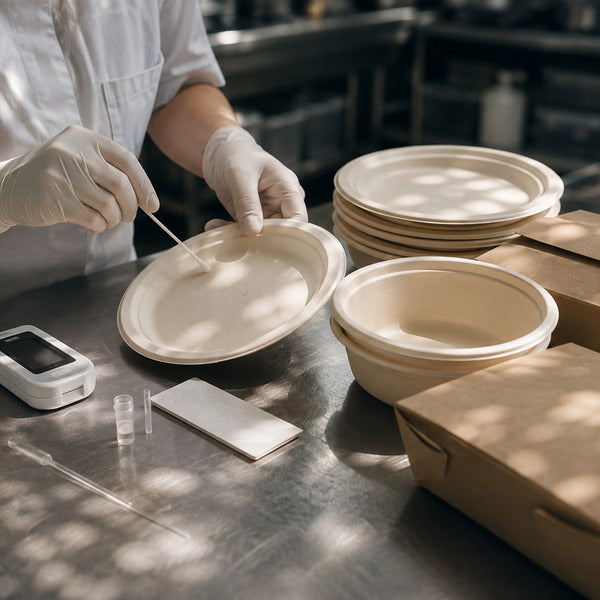
- Demand documentation per SKU. Certificate of compliance, BPI/CMA certification, or TOF test data — one of the three, in writing, filed where your team can find it for three years.
- Replace undocumented items. If a supplier can't or won't document a grease-contact fiber product, swap it. The replacement market is mature; there is no longer a performance excuse for keeping a mystery SKU.
- Write PFAS terms into contracts. Require "no intentionally added PFAS" warranties and documentation delivery in supplier agreements — the same discipline covered in our green procurement strategies guide.
- Re-verify annually. Formulations, mills, and state laws change. Recheck certificates each year and whenever you onboard a new supplier or a state you operate in adds a deadline.
Buying documented lines in volume also keeps unit costs in line — consolidating compliant SKUs into bulk orders is the same math we walk through in why restaurants should buy disposable plates in bulk.
PFAS-Free Alternatives by Material
| Material | How it resists grease without PFAS | Best applications | Watch-outs |
|---|---|---|---|
| Bagasse / molded fiber (no PFAS added) | Dense pressed fiber + non-fluorinated treatments | Plates, bowls, clamshells, catering | Confirm certification; match weight to menu |
| PLA-lined paper | Plant-based bioplastic lining | Hot cups, soup containers, bowls | Commercial composting required for end-of-life claims |
| PE-lined paper | Polyethylene lining | Cups, folded takeout cartons | Not compostable; recyclability varies |
| Uncoated kraft paper | None — relies on short contact time | Dry bakery items, bread sleeves, liners under low-grease food | Not for wet or oily holds |
| Bamboo & palm leaf | Naturally dense plant material | Premium plates, boards, catering presentation | Higher unit cost |
| Aluminum & foil | Metal — inherently grease-proof | Baking, wraps, catering pans | Outside fiber bans, but check municipal foil rules |
PFAS-Free Supplies in Practice: What We Stock and Why
Restaurantware built its disposables catalog around the post-ban reality: operators need fiber and paper products that perform under grease and heat, with documentation to match. Product lines our compliance-driven customers order most:
- Fiber and paper take-out packaging. Our take-out containers and to-go boxes include molded fiber and paper formats built for delivery-era grease loads — the category where clamshell bans bite first.
- Uncoated and eco paper trays. Paper food trays cover concession and QSR service where the old PFAS-treated food boat used to live.
- Compostable plates and bowls. The eco-friendly plates collection spans bagasse, bamboo, and palm leaf for everything from food trucks to plated catering.
- Wraps and liners. Deli wrap and bakery wrap options replace legacy grease-resistant sheets in sandwich and bakery programs.
One concrete pattern from our order data: when Washington's second-round ban took effect May 1, 2024, we saw multi-unit operators in the state switch entire clamshell and bowl programs to documented fiber lines in a single quarter — and most kept the spec chain-wide rather than managing two SKU sets. Compliance sourcing in one state tends to become the national spec, and buying that way simplifies everything downstream. Browse the full restaurant disposable supplies collection to consolidate documented SKUs with one supplier, and ask our team for compliance documentation on any fiber line — that request is normal now, and we're staffed for it.
Frequently Asked Questions About PFAS Free Products
What are PFAS free products?
PFAS free products are goods manufactured without intentionally added per- and polyfluoroalkyl substances. In foodservice, the term means packaging and service ware — plates, clamshells, cups, bags, wraps — made without the fluorinated grease-proofing coatings historically applied to paper and molded fiber, and verifiable through certificates of compliance, BPI/CMA certification, or total organic fluorine testing.
What brands do not have PFAS?
Rather than trusting brand marketing, look for product lines carrying BPI or CMA compostability certification or a GreenScreen certification — New York's DEC guidance identifies these as likely to comply with PFAS bans because they screen for fluorine. Any reputable foodservice brand, Restaurantware included, should provide a written "no intentionally added PFAS" statement or certificate of compliance for its fiber products on request. If a brand won't put it in writing, treat that as your answer.
What products have PFAS to avoid?
The historical PFAS hot spots in foodservice were grease-contact fiber products: molded fiber clamshells and bowls, grease-resistant sandwich wraps and liners, fry and bakery bags, pizza boxes, food boats, and microwave popcorn bags. Since the FDA's February 2024 phase-out announcement and the state bans, new U.S.-market versions of these items should be PFAS-free — the products to avoid are undocumented old stock and imports without compliance paperwork.
Do Ziploc bags have PFAS?
Plastic zipper bags are made of polyethylene film, a material that never needed PFAS grease-proofing — those coatings were a paper-and-fiber technology, and plastic film packaging also falls outside the state plant-fiber packaging bans. For any specific brand's formulation, request the manufacturer's current PFAS statement, since brand-level claims should come from the brand's own documentation rather than third-party assumptions.
How do I know if my product is PFAS free?
Verify through documentation, in this order: (1) a signed certificate of compliance from the manufacturer or distributor — required paperwork under Washington's law and accepted under New York's; (2) third-party certification such as BPI or CMA; (3) total organic fluorine (TOF) lab results below regulatory thresholds. A quick field heuristic: uncoated paper and unlined fiber that quickly absorbs oil was not treated with grease-proofers — but heuristics inform, only paperwork proves.
What is PFAS in food packaging?
PFAS in food packaging refers to fluorinated chemicals that were intentionally applied to paper, paperboard, and molded fiber packaging to impart grease-proofing, waterproofing, leak-proofing, or stain resistance — the definition used in New York's DEC guidance. The FDA announced in February 2024 that PFAS-containing grease-proofing agents are no longer sold for U.S. food contact use, and state laws now prohibit selling fiber packaging that contains them.
Are PFAS regulations for restaurants going to expand?
Yes — the trajectory points one direction. Minnesota's Amara's Law phases toward a near-total prohibition on intentionally added PFAS in products by January 1, 2032, the EPA finalized drinking-water limits for PFOA and PFOS in 2024, and additional states add packaging restrictions in most legislative sessions. Operators who standardize on documented PFAS-free supplies now won't have to re-source every time a new deadline lands. For ongoing updates, bookmark our RW Resources hub.
Conclusion: Make PFAS-Free Your Default Spec
PFAS free products have moved from differentiator to baseline. The FDA has ended U.S. sales of PFAS grease-proofers, four-plus states ban fiber packaging with PFAS added outright, and every trend line — federal, state, and consumer — runs toward stricter scrutiny of what touches food. The operators handling this well aren't testing plates in the walk-in; they're demanding certificates, buying certified lines, and writing PFAS warranties into contracts once, then reordering with confidence.
Start with your highest-risk categories — clamshells, bowls, wraps, and bags — and replace anything undocumented. Restaurantware's restaurant disposable supplies and eco-friendly disposables collections give you documented, PFAS-free-by-design options in every category the state laws cover, and our restaurant tabletop supplies and janitorial supplies round out the rest of the back- and front-of-house order. Ask us for the paperwork — that's what it's there for.