Soup Container Sizes: Choosing the Right Disposable Soup Container for Your To-Go Menu
Disposable soup containers come in four standard sizes: 8 oz for sides, 12 oz for lunch portions, 16 oz for entrées, and 32 oz for family orders. Most restaurants standardize on 12 and 16 oz. Always verify the lid seal and heat rating before adding a container to your to-go program.

Soup travels worse than almost anything else on a to-go menu. It is hot, liquid, and unforgiving — and the single decision that determines whether it arrives intact is the container you ladle it into. Choosing the right size disposable soup containers means matching ounces to menu role: a soup that fills a cup to the brim leaks in transit, and a soup that arrives half-full in an oversized tub looks like a shorted portion. This guide breaks down standard soup container sizes, the materials behind them, and how to build a to-go soup program that survives a 30-minute delivery run.
The stakes keep rising. Nearly 75% of all restaurant traffic now happens off-premises — almost 3 out of 4 orders are taken to go, according to the National Restaurant Association's 2025 Off-Premises Restaurant Trends report. If soup is on your menu, it is riding in a car more often than it is landing on a table. (Stat current as of July 2026.)
TL;DR — Soup Container Sizing in 30 Seconds
- 8 oz: side portions, kids' cups, sauce-heavy add-ons, tasting portions.
- 12 oz: the standard "cup of soup" — lunch combos, appetizers.
- 16 oz: the standard "bowl" — entrée portions, hearty soups, ramen and pho bases.
- 32 oz: family-size, quart takeaway, catering, and retail-style grab-and-go.
- Headspace rule: fill to about 80–90% of capacity — never to the brim — so the lid seals clean and thermal expansion doesn't force a leak.
- Standardize on 2–3 sizes to simplify portioning, lids, and inventory.
Soup Container Sizes at a Glance
| Size | Menu Role | Practical Fill (80–90%) | Typical Use Cases |
|---|---|---|---|
| 8 oz | Side / kids / add-on | ~6.5–7 oz | Cup of soup with a combo, miso side, dipping broth, sauces |
| 12 oz | Standard cup | ~10–11 oz | Lunch specials, appetizer soup, soup-and-half-sandwich pairings |
| 16 oz | Standard bowl / entrée | ~13–14 oz | Entrée chili, chowder, stew, noodle soup bases |
| 32 oz | Family / quart | ~27–29 oz | Family meals, catering, "soup by the quart" retail programs |
What Sizes Do Disposable Soup Containers Come In?
Disposable soup containers come in four core sizes — 8, 12, 16, and 32 oz — with the industry treating 12 oz as a "cup" and 16 oz as a "bowl." Some manufacturers also produce 6 oz tasters, 24 oz large bowls, and 64 oz half-gallon tubs, but the four core sizes cover the vast majority of foodservice to-go programs, and stocking beyond them usually adds inventory complexity without adding sales.
Capacity is measured brim-full. That matters more than most operators realize: a "12 oz" container holds 12 fluid ounces only when filled to the rim, which you should never do with hot liquid. Your real working capacity is 80–90% of the label — so a 12 oz cup realistically carries a 10–11 oz portion. Build your recipe costing and portion specs around the practical fill, not the printed capacity.
What Size Soup Container Do Restaurants Use?
Most restaurants use 12 oz containers for cup portions and 16 oz containers for bowl or entrée portions — these two sizes anchor nearly every to-go soup program. Delis and fast-casual concepts often add 32 oz quarts for family-size sales, while 8 oz cups serve combo sides and kids' portions. In 15+ years supplying 40,000+ foodservice operations, our customers consistently tell us that standardizing on 2–3 soup container sizes simplifies both portioning and inventory: fewer SKUs, fewer lid mismatches at the pack station, and portion sizes servers can eyeball at speed.
How Do You Match Soup Container Sizes to Your To-Go Menu?
Match the container to the menu role, not the other way around. A useful decision framework:
- Is it a side or an entrée? Sides and combo add-ons go in 8 or 12 oz; anything sold as a meal belongs in 16 oz.
- How dense is the soup? Broth-forward soups (pho, miso, consommé) look generous in smaller containers; chunky chowders, chilis, and stews need the 16 oz bowl to read as a full entrée once solids settle.
- Do you sell soup as a take-home product? If soup is a signature item, a 32 oz quart program ("family chili by the quart") turns one recipe into a second revenue stream with the same batch.
- What does the perceived value look like on arrival? A 12 oz portion in a 16 oz container arrives looking half-empty and drives "shorted portion" complaints — even when the ounces are exactly right. Size down before you underfill.
In our experience at Restaurantware, wrong-sized soup containers drive more delivery complaints than any recipe issue — headspace and lid fit decide whether the order arrives intact, and fill-level perception decides whether the customer reorders. Both are sizing decisions, not cooking decisions.
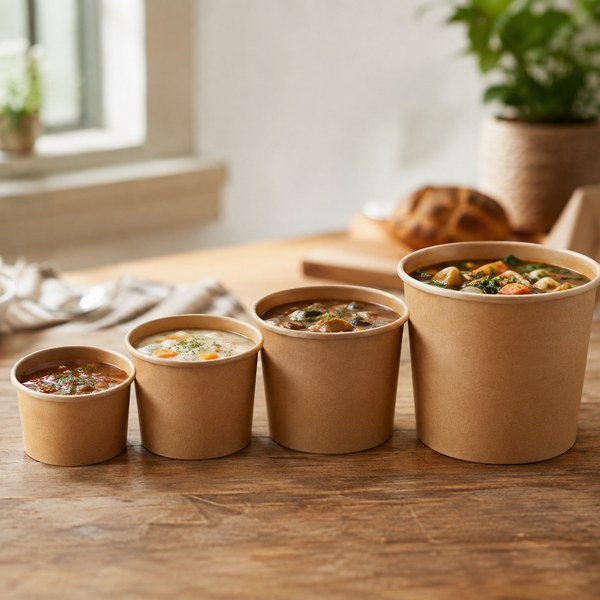
What Are the Most Common Soup Container Sizing Mistakes?
The five sizing mistakes we see most often in real to-go programs:
- Costing recipes at brim capacity. A "16 oz bowl" priced around 16 ladled ounces gets filled to the rim on busy shifts — and leaks. Cost at practical fill (~13–14 oz).
- One size for every soup. A brothy pho and a dense chili have different perceived-value curves; running both in the same 16 oz container underprices one and overexposes the other.
- Stocking five sizes "to be flexible." More sizes mean more lids, more pack-station errors, and more dead inventory. Two or three sizes cover nearly every menu.
- Ignoring the lid SKU when switching cups. Rim diameters vary by manufacturer even at identical capacities — a new cup with your old lids is a leak program, not a cost saving.
- Sizing for dine-in, packing for delivery. A portion that looks right in ceramic reads differently in a tall disposable cup. Spec to-go portions in the actual to-go container.
Which Disposable Soup Containers Are the Best Options for Hot Liquids?
The best disposable soup containers for hot liquids are double-poly-coated or PP-lined paper cups with tight-fitting vented lids, and microwavable polypropylene (PP) containers — both are engineered to hold liquids at serving temperature without softening, delaminating, or leaking at the seam. Hot soup packaging fails at three points: the sidewall (heat softening), the base seam (seepage), and the lid (pressure pop-off). Rate every candidate container on all three before it touches your line.
Temperature is also a food-safety requirement, not just a comfort preference. The FDA Food Code requires hot time/temperature-control-for-safety foods to be held at 135°F (57°C) or above, and the 41–135°F range is the danger zone where pathogens grow fastest. Your hot soup to-go containers must tolerate 135°F+ contents for the full delivery window without deforming. For a material-by-material breakdown of exactly how much heat each packaging substrate tolerates, see our guide to the temperature limits of food packaging materials — the short version for soup: PP handles ~230°F, poly-coated paper handles serving-temperature liquids comfortably, and PET or PLA cold cups should never touch hot broth. (FDA figures current as of July 2026.)
What About Paper Soup Containers with Lids for Takeout?
Paper soup containers with lids are the takeout default for a reason: the paperboard sidewall insulates better than thin plastic, so customers can carry them comfortably, and kraft paper reads as premium and eco-conscious on camera — which matters when your soup gets photographed. Look for double poly-coated or PP-lined interiors (single-coat cups can wick moisture at the rim over a long delivery) and buy the matching vented lid from the same manufacturer. Mixed-brand cup-and-lid pairings are the most common source of leaks we see in real takeout programs.
The same construction logic applies to hot drink cups — insulated sidewalls, poly lining, vented lids — but soup containers use a wider mouth and a heavier board because spoons, solids, and reheating demand more of the package than coffee does. Don't run soup in beverage cups; the narrow mouth makes them awkward to eat from and prone to overflow when filled with chunky soups.
What Should You Use for Catering Soup Containers?
For catering, move up to 32 oz quart containers for transport and let the venue portion into cups or bowls on site. Quarts hold heat longer than individual cups (more thermal mass, less surface area per ounce), stack securely in transport racks, and cut your packaging cost per served ounce roughly in half versus individually packed 12 oz cups. For drop-off catering where guests serve themselves, pair quarts with a stack of 8 oz portion cups and lids — guests take what they want and leftovers reseal.
Paper vs. Plastic vs. Compostable: Which Soup Container Material Should You Choose?
Material choice determines microwavability, heat retention, lid seal quality, and cost per unit. The three families that matter for disposable soup containers:
Soup Container Materials Compared
| Material | Heat Retention | Microwavable? | Lid Seal | Relative Cost | Best For |
|---|---|---|---|---|---|
| Poly-coated / PP-lined paper | Good — insulating sidewall | Only PP-lined grades (check rating) | Good with matched vented lid | $–$$ | Takeout cups, branded programs, camera-friendly presentation |
| Polypropylene (PP) plastic | Moderate — thin wall, but retains seal | Yes (~230°F rating) | Excellent — tamper-evident and gasket options | $ | Delivery-heavy programs, reheat-at-home soups, clear-lid merchandising |
| Bagasse / eco-fiber (sugarcane) | Good — thick molded wall | Yes, short cycles | Good with matched fiber or PP lid | $$ | Compost-mandate markets, eco-branded concepts |
If your city or state has single-use packaging rules — or your brand leans green — commercially compostable fiber soup containers are the growth category, and our eco-friendly soup containers collection covers bagasse and PLA-lined paper options across the standard sizes. For the bigger strategic picture on materials, certifications, and cost planning, we've covered that ground in two dedicated guides: eco-friendly takeout packaging solutions for modern restaurants and how to transition your restaurant to sustainable packaging — this article stays focused on sizing and soup-specific performance. If compostables will extend beyond soup to your full service line, see how to choose the right compostable tableware for your menu.
Are Paper Soup Cups Microwave Safe?
Paper soup cups are microwave safe only when the manufacturer rates them microwavable — which generally means a polypropylene (PP) lining rather than a standard polyethylene (PE) coating. PE-coated paper can soften and delaminate in the microwave; PP-lined grades are engineered for reheating. Check the base stamp or spec sheet, and if your customers reheat at home (most soup customers do), make "microwavable" a hard requirement and say so on the label. Always tell customers to remove or vent the lid before microwaving.
How Do You Transport Soup in a Disposable Container Without Leaks?
Transporting soup safely comes down to five controls: correct fill level, a matched vented lid, an upright carrier, a stable bag, and a time limit. Applied in order:
- Fill to 80–90%, never the brim. Headspace absorbs sloshing and thermal expansion; brim-filling is the #1 cause of leaked orders.
- Use the matched lid — vented for hot soup. Steam pressure in a sealed container pops lids in transit; a vented lid releases pressure while keeping liquid in. Press the full circumference and check the seal by lifting gently by the lid rim (over the counter, not over the bag).
- Keep containers upright and immobilized. Cup carriers, snug boxes, or crumpled kraft paper around the base — soup containers fail sideways, not upward.
- Bag soup separately from dry items. One condensation-damp bag bottom can drop an entire order. Purpose-sized to-go bags and take-out bags with flat bottoms keep containers vertical; tape the lid seam for long delivery runs.
- Cap the transit window. Insulated bags buy time, but quality and safety both degrade past 30–40 minutes — design your delivery radius around the soup, not the pizza.
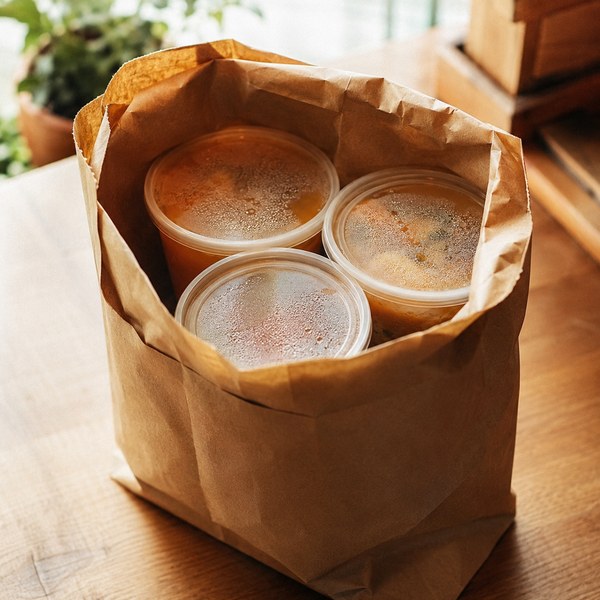
What Is a Good Alternative to a Cup for a Soup Order?
The best alternatives to a soup cup are wide-mouth disposable bowls for hot soup and heavy-wall deli containers. Disposable bowls — paper, PP, or molded fiber — suit chunky soups, ramen, and grain bowls where a spoon needs room to work, and many pair with clear dome or flat lids for merchandising. Round deli containers are the workhorse crossover: microwavable PP versions seal exceptionally well, stack tightly in delivery bags, and let customers see the product. If an order includes soup as one component of a larger meal, a deli container often rides more securely than a tall cup.
What Do Operators Look for When Comparing Soup Cups?
When operators review soup cups, four criteria separate winners from returns: lid-seal reliability (the lid should audibly click and survive an inversion test with water), sidewall rigidity when full and hot (squeeze test at 180°F), stackability with lids on (delivery bags are vertical real estate), and consistent sizing across reorder lots (a 1 mm rim variance breaks lid fit). Run a one-case pilot of any new container through your actual delivery loop — packed, driven, and opened — before committing to a pallet. It's the cheapest quality insurance in foodservice packaging.
One question that comes up in this comparison: can I use a soup thermos for takeout? A thermos is a reusable product, not a disposable — it's great for personal meal transport, but it doesn't belong in a single-use to-go program; if reusables interest you, look at returnable-container programs instead.
Which Restaurantware Soup Containers Fit Each Size?
Restaurantware stocks disposable soup containers across all four core sizes in paper, plastic, and eco-fiber lines, each with matched lids:
- 8 oz and 12 oz kraft paper soup cups with poly-lined interiors and vented paper or PP lids — the takeout standard for sides and lunch cups.
- 16 oz paper and PP soup containers — the entrée bowl workhorse; PP versions are microwavable for reheat-at-home programs.
- 32 oz quart containers — family meals, catering transport, and soup-by-the-quart retail.
- Bagasse and eco-fiber soup containers — commercially compostable options for regulated markets and green-branded concepts.
Every size is stocked with its matching lid so cup-lid mismatch never becomes your leak point. Browse the full range of disposable soup containers to spec a program across sizes and materials.
Soup's to-go economics keep improving, too: comfort food led consumers' meal priorities across every generation — cited by 55% of those surveyed by FMI, The Food Industry Association, per IFT's Food Technology trend report — and soup is the definitive comfort category that travels profitably when packaged right. (Stat current as of July 2026.)
Frequently Asked Questions
What is the best container to give soup in?
The best container for to-go soup is a poly-lined paper soup cup or microwavable PP container with a matched, vented lid, sized so the portion fills 80–90% of capacity. Paper wins on insulation and presentation; PP wins on lid seal and reheatability.
What type of disposable bowl is best for soup?
Wide-mouth PP or heavy poly-coated paper bowls with secure-fitting lids are best for soup — they resist heat softening, seal reliably, and give spoons room to work. Bagasse fiber bowls are the best compostable option for hot soup.
Is there a disposable soup container?
Yes — disposable soup containers are a standard foodservice packaging category, available in 8, 12, 16, and 32 oz sizes in paper, polypropylene plastic, and compostable fiber, each with matching vented or sealing lids designed for hot liquids.
How do you transport soup in a disposable container?
Fill to 80–90% of capacity, seal a matched vented lid around the full circumference, keep the container upright in a flat-bottom bag or carrier, bag it separately from dry items, and keep total transit under 30–40 minutes.
What size soup container do restaurants use?
Restaurants standardize on 12 oz containers for cup portions and 16 oz for bowls or entrées, adding 8 oz for sides and 32 oz quarts for family or catering orders. Two to three sizes cover nearly every menu.
Are paper soup cups microwave safe?
Only PP-lined paper soup cups rated microwavable by the manufacturer are microwave safe. Standard PE-coated cups can delaminate when microwaved — check the spec sheet, and always remove or vent the lid before reheating.
Can I use a soup thermos for takeout?
A soup thermos is a reusable product rather than takeout packaging — for single-use to-go programs, use disposable soup containers, and explore returnable-container systems if reusables fit your concept.
Conclusion: Size First, Material Second, Lid Always
Choosing the right size disposable soup container is a three-step call: match ounces to menu role (8/12/16/32), pick the material your program demands (paper for presentation, PP for reheating, fiber for compost mandates), and never separate a container from its matched vented lid. Standardize on two or three sizes, fill to 80–90%, and test every new container through a real delivery run before you commit.
Ready to build or upgrade your soup program? Shop the full lineup of disposable soup containers in every standard size and material — matched lids included — with same-day shipping on in-stock items.