Coffee Dispenser Buying Guide: How to Choose Airpots, Urns & Satellite Dispensers
A coffee dispenser is an insulated container that holds and serves brewed coffee — most commonly a pump-style airpot, a gravity-fed satellite dispenser, or a large-capacity coffee urn. Cafes, caterers, and hotels choose between them based on batch size, heat retention, and serving speed. This guide compares every commercial dispenser type.
Picking the right coffee dispenser is one of those decisions that looks trivial until a breakfast rush proves otherwise. Coffee is the single most consumed beverage in the United States — 66% of American adults drink it every day, averaging about three cups each, according to the National Coffee Association's Spring 2025 National Coffee Data Trends report. When that demand hits your counter, the difference between a 2.2-liter airpot and a 5-gallon urn is the difference between smooth self-service and a line out the door.
In 15+ years supplying 40,000+ foodservice operations, we've watched cafes, caterers, and hotel breakfast bars make (and fix) every dispenser mistake there is. This guide distills that experience into a practical framework: what each dispenser type does best, how airpots compare to urns, which stirrers and syrup pumps belong beside them, and the exact products our customers rely on.
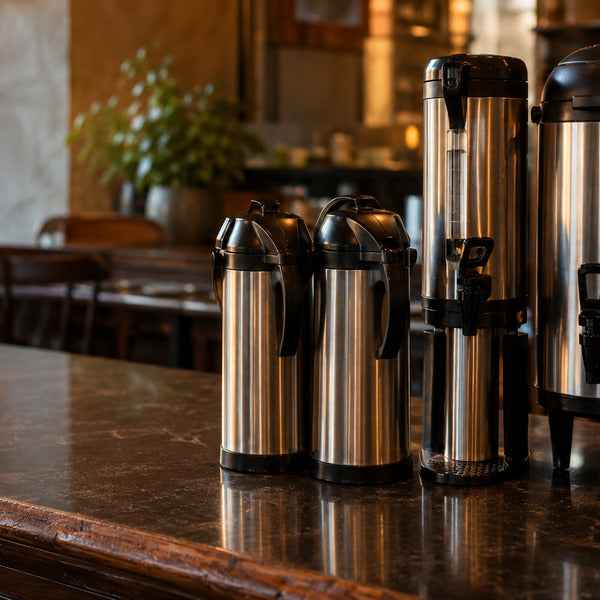
TL;DR — Which Coffee Dispenser Should You Buy?
- Airpot (pump coffee dispenser): best for self-service counters, office coffee, and catering drop-offs. 2–3 liter capacity, 12–24 hour heat retention, no power needed.
- Satellite coffee dispenser: best for high-volume cafes brewing into 1–1.5 gallon shuttles that move from brewer to service station. Fast gravity-fed faucet pour.
- Coffee urn: best for banquets, buffets, and events serving 50+ guests. Brews and holds 55–128 cups in one vessel; electric models keep coffee hot all service.
- Syrup & creamer dispensers: pump bottles and chilled cream dispensers keep the condiment station fast, portioned, and clean.
- Stirrers: birch wood for eco-minded cafes, plastic keyhole stirrers for events — a sub-dollar detail that shapes guest experience.
| Dispenser Type | Typical Capacity | Heat Retention | Serving Method | Best For |
|---|---|---|---|---|
| Airpot | 2.2–3 L (about 10–16 cups) | 12–24 hours (vacuum insulated) | Pump lever, one cup at a time | Self-service counters, offices, catering |
| Satellite dispenser | 1–1.5 gal (about 16–24 cups) | 2–4 hours typical (insulated shuttle) | Gravity-fed faucet | High-volume cafes, batch brewing programs |
| Coffee urn | 3–5 gal (55–128 cups) | Continuous (electric heating element) | Spigot | Banquets, buffets, churches, large events |
| Thermal carafe | 1–2 L (about 4–8 cups) | 1–4 hours | Hand pour | Tableside service, small meetings |
What Is a Coffee Dispenser?
A coffee dispenser is defined as any commercial vessel that stores brewed coffee at serving temperature and dispenses it on demand — by pump, faucet, or spigot — without a direct pour from the brewer. The category breaks down into four families: airpots (insulated pump pots), satellite dispensers (gravity-fed shuttles that pair with satellite brewers), coffee urns (large-capacity vessels that brew and hold), and thermal carafes (small hand-pour servers). Coffee-station adjacents — syrup dispensers, creamer dispensers, and stirrer organizers — complete the setup.
Every model is judged on the same three metrics: capacity (how many cups between refills), heat retention (how long coffee stays at temperature without scorching), and serving speed (how fast a guest or server can fill a cup). The right answer depends on your volume, not your budget — an oversized urn wastes coffee in a slow cafe, and an undersized airpot strands a catering client mid-event.
What Are the Different Types of Coffee Dispensers?
There are four main types of coffee dispensers: airpots, satellite dispensers, coffee urns, and thermal carafes. Each solves a different volume-and-service problem, and most multi-daypart operations end up running two of them side by side.
Airpot Coffee Dispensers (Pump Dispensers)
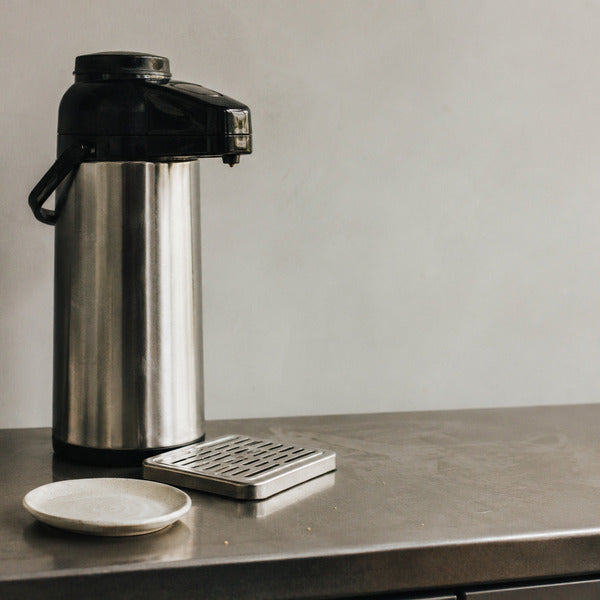
An airpot is a vacuum-insulated pump coffee dispenser: pressing the lever forces air into the chamber and pushes coffee up a siphon tube and out the spout. Because the pump is the only moving part and the vacuum wall does the insulating, airpots need no electricity and hold heat far longer than glass-lined carafes.
Airpots are the workhorse of self-service coffee. Our foodservice customers consistently tell us the pump format wins on three counts: guests serve themselves without lifting anything heavy, the sealed chamber prevents burns and spills in transit, and vacuum insulation preserves temperature for a full service day. The Met Lux 3-liter stainless steel airpot is rated for 24-hour heat retention, while the Restpresso 3-liter black airpot holds heat for 12 hours — plenty for a catering drop-off that has to survive from morning setup through afternoon service.
For coffee shops running regular and decaf side by side, a smaller vessel like the Restpresso 2.2-liter airpot with hanging tag and decals keeps the slower-moving decaf fresh instead of stale — the labeling tags end the "which one is decaf?" question at the condiment bar. When shopping, note that "coffee pump dispenser" listings and airpot listings describe the same product family; compare liner material (stainless steel outlasts glass liners in commercial use), rated heat retention hours, and whether the coffee dispenser pump assembly disassembles for cleaning.
Satellite Coffee Dispensers
A satellite coffee dispenser is an insulated 1–1.5 gallon shuttle that a commercial batch brewer fills directly, then moves to wherever service happens. Instead of a pump, it dispenses through a gravity-fed faucet — faster per pour than an airpot, which matters when a barista is filling twenty cups during a rush.
Satellite systems shine in operations that brew in volume on a schedule: bakery-cafes, drive-thru coffee chains, corporate dining. The shuttle format separates brewing from serving, so the brewer never sits idle waiting for a vessel to empty. The trade-off is heat retention — most satellite shuttles are insulated but not vacuum-sealed, so coffee quality degrades faster than in an airpot. Batch discipline (brew smaller, more often) matters more with satellites than with any other dispenser type.
Coffee Urns — the Large Coffee Dispenser for Events
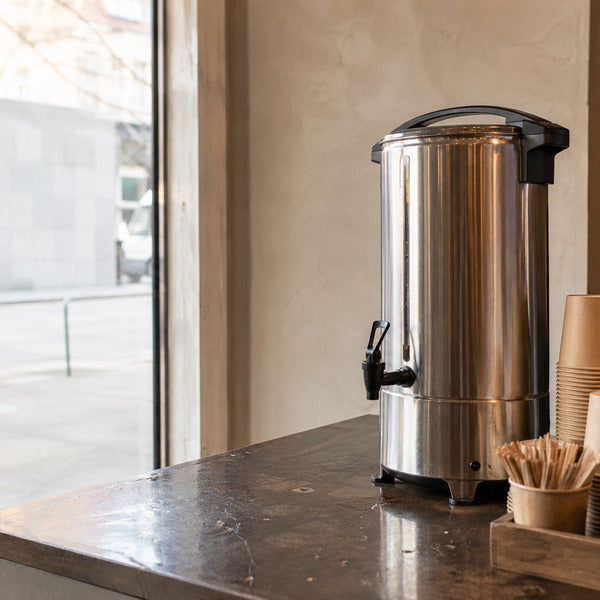
A coffee urn is a large coffee dispenser that both brews and holds coffee in one electric vessel, serving through a spigot at the base. Urns are measured in cups, and the jump in scale is dramatic: the Restpresso 950-watt stainless steel urn brews 55 cups, while the Restpresso 5-gallon, 128-cup urn covers a full banquet room from a single station.
Urns are the default for banquets, buffet lines, church halls, and conference breaks — any setting where 50 or more guests serve themselves over a defined window. Because the heating element holds temperature continuously, an urn never "runs cold," but coffee held on heat for hours will taste flat; brew as close to service as the event schedule allows. Browse the full coffee urns collection to match cup count to your typical guest list.
Airpot vs Coffee Urn: Which Should You Choose?
Choose an airpot when you serve under roughly 25 guests per batch and need portability; choose a coffee urn when you serve 50 or more from a fixed station. The decision comes down to four factors:
- Batch size: an airpot holds 2–3 liters (10–16 cups); urns hold 55–128 cups. Between those ranges, run multiple airpots or a satellite system.
- Power: airpots are vacuum-insulated and need no outlet — critical for off-site catering. Urns need a dedicated circuit for the heating element.
- Heat method: vacuum insulation preserves flavor; a constant heating element holds temperature longer but cooks the coffee over time.
- Serving speed: an urn spigot and a satellite faucet pour faster than a pump — relevant when one line of guests must move quickly.
Hotel breakfast bars are the classic hybrid case we see across our 40,000+ customer operations: urns handle the 7–9 a.m. peak, and airpots take over for the low-volume lobby coffee that runs the rest of the day.
How Do You Choose the Right Coffee Dispenser? (Capacity, Heat & Safety)
Choose a coffee dispenser by working through four questions in order: how many cups per hour at peak, how long coffee must hold, who pours (guest or staff), and what safety certifications your health inspector expects.
1. Peak cups per hour. Count your busiest 60 minutes, not your daily average. A cafe pouring 40 cups at peak needs either two 3-liter airpots on rotation or a satellite shuttle — a single airpot will run dry mid-rush.
2. Holding time and temperature. Brewed coffee is not a food-safety hazard the way dairy is, but the same equipment often holds hot water, cocoa, or cream-based beverages. The FDA Food Code requires time/temperature-control-for-safety foods to be hot-held at 135°F (57°C) or above, and defines 41–135°F as the danger zone where pathogens multiply. A quality vacuum airpot keeps coffee well above that threshold for a working shift; a cheap glass-lined carafe will not.
3. Guest-facing or staff-facing. Self-service counters favor pump airpots (no open spigot to leave dripping); staffed stations favor faucet-pour satellites for speed.
4. Certification. For commercial dispensing equipment, look for compliance with NSF/ANSI 18, the standard for manual food and beverage dispensing equipment, which sets minimum sanitation requirements for materials, design, and cleanability. Health inspectors in most U.S. jurisdictions evaluate beverage equipment against FDA Food Code and NSF criteria, so certified stainless steel construction pays for itself at inspection time.
What Are the Best Coffee Stirrers for Cafes?
The best coffee stirrers for most cafes are 6-inch birch wood stirrers — biodegradable, splinter-free, and neutral in flavor — with plastic keyhole stirrers as the upgrade pick for catered events. Stirrers cost pennies, but they are the last thing a guest touches before the first sip, so the choice deserves more thought than it usually gets.
Wood coffee stirrers (best overall). The Restpresso natural wood coffee stirrer is cut from birch with a smooth, flat surface that won't splinter or break mid-stir, plus a rounded top for grip. Birch is biodegradable, which matters to the growing eco-minded segment of cafe guests, and the natural grain reads as intentional rather than institutional next to a kraft cup sleeve.
Plastic keyhole stirrers (best for events). The Restpresso white plastic keyhole coffee stirrer uses a decorative paddle that moves cream and sugar faster than a flat stick and stays rigid in hot liquid. Caterers we supply favor keyhole stirrers for weddings and corporate events where the coffee station is part of the presentation.
What to avoid: thin "straw-style" stirrers that collapse in hot coffee, and any wood stirrer without a smooth-sanded finish — splinters are a guest-experience failure you only make once. Whichever coffee stirrer you choose, station it upright in an organizer rather than loose on the counter; it keeps hands off the sticks guests don't take.
Syrup & Creamer Dispensers for the Coffee Station
Syrup and creamer dispensers are the throughput multipliers of a coffee station: a pump-top coffee syrup dispenser portions exactly one serving per press, and a dedicated creamer dispenser keeps dairy covered, chilled, and pourable instead of sweating in an open carton.
Coffee syrup dispensers. Pump dispensers portion vanilla, caramel, and seasonal syrups at a consistent 8–10 ml per stroke, which protects both drink consistency and food cost — free-pouring syrup is one of the quietest margin leaks in a cafe. Restaurantware's syrup and sauce dispensers collection covers pump bottles and squeeze formats sized for back-bar rails and guest-facing stations alike.
Coffee creamer dispensers. For self-service, small covered pitchers or pump creamer dispensers beat open cartons on every axis: temperature, hygiene, and waste. Remember that dairy is a time/temperature-control food under the FDA Food Code — cream left out must be time-tracked or kept at 41°F or below, so choose a creamer dispenser sized to what your station actually uses in a service window, not the whole quart.
Tie the station together. A coffee condiment organizer corrals sugars, stirrers, and lids into one footprint, cutting counter clutter and refill trips. For operations dispensing iced tea, lemonade, or infused water alongside coffee, the broader beverage dispensers collection uses the same capacity-and-serving-speed logic covered above.
Choosing Coffee Cups? See Our Coffee Cups Buying Guide
Dispensers are only half the station — cup sizing, materials, and lid pairing are their own decision tree. For coffee cup sizes, types of coffee cups, and to-go cup recommendations, see our dedicated Coffee Cups Buying Guide, which covers everything cup-side so this guide can stay focused on dispensing equipment.
How Do Real Foodservice Operations Set Up Their Coffee Dispensers?
The best dispensing setups we see across 40,000+ foodservice operations share one trait: the equipment mix matches the service pattern, not the other way around. Coffee demand keeps climbing — the NCA reports past-day specialty coffee consumption grew nearly 18% between 2020 and 2025, and coffee alone accounts for 8% of the entire U.S. foodservice sector — so the operations that scale smoothly are the ones that planned their dispensing hardware around peak load. Three real-world patterns:
- The cafe counter: two 3-liter airpots (regular + decaf) on rotation with a third cycling through the brewer, wood stirrers in a condiment organizer, syrup pumps on a back rail. Guests self-serve drip while baristas focus on espresso.
- The catering kit: 2.2-liter tagged airpots for off-site drops — no outlet required, labeled by roast, 12-hour retention outlasting any event window. Keyhole stirrers and pump creamers travel in the same crate.
- The hotel breakfast bar: a 55-cup urn for the morning peak, swapping to a single airpot at 9 a.m. A countertop cup sleeve dispenser keeps sleeves stacked and reachable instead of scattered around the urn.
Our foodservice customers consistently tell us the refill cadence is what surprises them: a vacuum airpot rated for 12–24 hours means morning-brewed coffee is still service-hot at close, while non-vacuum shuttles need a fresh batch every 2–4 hours to taste right. Build your par levels around that difference. Everything above — airpots, urns, organizers, and stirrers — lives in Restaurantware's coffee service collection.
Frequently Asked Questions
What is a coffee dispenser called?
A coffee dispenser is called an airpot when it uses a pump lever, a satellite dispenser or shuttle when it uses a gravity-fed faucet, and a coffee urn when it brews and holds large batches with a spigot. "Coffee dispenser" is the umbrella term for all three.
What is a coffee pourer called?
A coffee pourer is called a carafe or decanter when hand-held, and an airpot when it dispenses through a pump. Thermal carafes are vacuum-insulated hand pourers used for tableside service; airpots are their larger, self-service counterparts.
What is a coffee urn called?
A coffee urn is also called a coffee percolator urn or banquet urn. It is a large electric coffee dispenser — typically 55 to 128 cups — that brews and holds coffee in one vessel and serves through a spigot at its base.
What are the different types of coffee dispensers?
The four types of coffee dispensers are airpots (vacuum-insulated pump dispensers, 2–3 liters), satellite dispensers (gravity-fed 1–1.5 gallon shuttles), coffee urns (electric 55–128 cup vessels), and thermal carafes (small hand-pour servers). Syrup and creamer dispensers round out the coffee station.
How long does coffee stay hot in an airpot?
Coffee stays hot in a vacuum-insulated airpot for 12 to 24 hours depending on build quality — the Met Lux 3-liter airpot is rated for 24-hour heat retention, and Restpresso airpots for 12 hours. Flavor peaks well before that, so most cafes still rotate batches every 1–2 hours.
Do commercial coffee dispensers need to be NSF certified?
Commercial coffee dispensers are evaluated in most U.S. jurisdictions against NSF/ANSI 18, the sanitation standard for manual food and beverage dispensing equipment. Certification is not federal law, but health inspectors commonly expect commercial-grade, easily cleanable construction consistent with FDA Food Code requirements.
Conclusion: Match the Dispenser to the Rush
A coffee dispenser is a capacity decision disguised as an equipment purchase. Count your peak-hour cups, decide who pours, and the right hardware picks itself: airpots for self-service and catering, satellites for batch-brewing cafes, urns for events, with stirrers and syrup pumps sized to match. Get the mix right once and your coffee station runs itself through every rush.
Ready to build your station? Shop coffee airpots and accessories, coffee urns, and the complete coffee service collection at Restaurantware — trusted by 40,000+ foodservice operations for 15+ years.