The Benefits of Buying Local Produce for Your Restaurant
Buying local produce means sourcing fruits and vegetables from farms near your restaurant — typically within 400 miles or inside your state. Key benefits include fresher, longer-lasting ingredients, seasonal menu flexibility, shorter supply chains, stronger community ties, and marketable farm-to-table appeal that raises perceived quality and supports premium menu pricing.
Ask any chef who has cut into a tomato picked 24 hours ago versus one that spent two weeks in cold storage, and you will get the same answer: there is no comparison. Buying local produce is one of the few sourcing decisions that improves your food, your margins on featured dishes, and your marketing story at the same time — and diners have noticed. The National Restaurant Association named local sourcing one of the defining macro trends in its 2026 What's Hot Culinary Forecast, with operators deepening community ties by featuring ingredients from nearby farms. This operator guide covers what "local" actually means, the benefits of buying local produce, how to find and vet farms, what it costs, and how to turn local sourcing into menu sales.
TL;DR: Local produce is fresher (often harvested 24–48 hours before delivery), holds up longer in your walk-in, lets you build seasonal menus that command premium prices, and gives you a farm-to-table story diners actively seek out. Trade-offs are seasonal availability, more supplier relationships to manage, and variable pricing — all manageable with the planning framework below.
Local vs. Broadline Produce Sourcing at a Glance
| Factor | Local Produce (farms, food hubs, farmers markets) | Broadline Distributor Produce |
|---|---|---|
| Time from harvest to kitchen | Often 1–3 days | Frequently 5–14+ days including transit and warehousing |
| Flavor & ripeness | Picked at or near peak ripeness | Often picked early to survive shipping |
| Usable shelf life in your kitchen | Longer — less transit time already burned | Shorter — days of freshness lost in the supply chain |
| Availability | Seasonal; varies by region | Year-round, consistent specs |
| Pricing | Variable; competitive in peak season, often cheaper on gluts | Stable contract pricing |
| Marketing value | High — farm names, farm-to-table story, community goodwill | Low — generic origin |
| Ordering logistics | Multiple relationships, or one food hub | One order, one truck, one invoice |
What Does Buying Local Produce Mean?
Buying local produce is defined as purchasing fruits and vegetables grown close enough to your restaurant that they reach your kitchen with minimal transit time — under the definition adopted by the U.S. Congress in the 2008 Food, Conservation, and Energy Act, a "locally or regionally produced agricultural food product" travels less than 400 miles from its origin or stays within the state where it was produced, per the USDA Economic Research Service. In practice, most restaurants define "local" more tightly — often a 100–150 mile radius — because a shorter distance is what delivers the freshness, relationships, and story that make the effort worthwhile.
Local sourcing is not a niche. USDA data show producers sold $17.5 billion in food through direct marketing channels in 2022 — including sales to restaurants, retailers, institutions, and food hubs — and the 2022 Census of Agriculture counted 116,617 farms selling directly to consumers, with direct sales up 16% from 2017. The supply side of farm to table sourcing is growing, which means more options for operators in nearly every region.
For a deeper look at how local sourcing fits into a broader supply strategy — including the challenges — see our guide to sourcing local: benefits and challenges for foodservice. This article focuses on the produce side specifically: why buy local produce, how to find local produce for restaurants of any size, and how to sell it.
What Are the Benefits of Buying Local Produce?
The benefits of buying local produce fall into five categories: superior freshness and shelf life, seasonal menu flexibility, supply chain resilience, community and economic goodwill, and marketing power. Here is how each one shows up on your P&L and your plates.
1. Fresher Ingredients With Longer Usable Shelf Life
Freshness is the benefit chefs feel first. Local produce is often harvested 24–48 hours before it reaches your kitchen, while produce moving through national distribution can spend a week or more in transit and warehousing. Every day of transit is a day of shelf life your kitchen never gets back. When your greens arrive two days off the field instead of ten, you gain usable days in the walk-in, tighter yields, and less spoilage waste — and the flavor difference is immediately visible on the plate. Varieties matter too: local growers can plant for flavor rather than for shipping durability, which is why a local heirloom tomato tastes nothing like a gassed shipping tomato.
2. Seasonal Menu Flexibility That Sells
Seasonality is a feature, not a bug. Menus built around what is at peak right now give regulars a reason to return — spring asparagus, summer stone fruit, fall squash, winter root vegetables. Rotating seasonal specials also lets you feature ingredients at their cheapest and best simultaneously, which is a rare alignment in food cost management. If you want ready-made frameworks, our winter menu ideas and pumpkin-inspired menu ideas guides show how seasonal produce becomes limited-time items that sell.
3. Shorter, More Resilient Supply Chains
A farm 40 miles away is not affected by a port slowdown, a cross-country trucking shortage, or a freeze two time zones away. Operators who diversified into buying local food from nearby farmers during recent national supply disruptions kept produce on their menus while competitors posted apology signs. Local sourcing will not replace your broadline distributor for staples, but it gives you a second, independent supply line — and negotiating leverage on both sides.
4. Community Goodwill and Local Economic Impact
Dollars spent with nearby growers circulate in your local economy, and farmers talk. In 15+ years supplying 40,000+ foodservice operations, we've seen a consistent pattern at Restaurantware: restaurants that source from local farms get named — by the farms themselves, at markets, in community media — and that word-of-mouth reaches exactly the diners who care most about where their food comes from. The relationship also runs in reverse: growers give their restaurant accounts first call on limited harvests and honest guidance on what is coming into season.
5. Farm-to-Table Marketing Power
"Locally sourced" is one of the few menu phrases that measurably shifts perception of quality and justifies premium pricing — which is why local sourcing keeps appearing in the National Restaurant Association's annual culinary forecasts. Naming the farm ("Miller Family Farms heirloom tomatoes") is stronger than a generic "local" claim because it is specific, verifiable, and tells a story. If farm-to-table positioning is new to you, start with our explainer on what is farm to table? — the short version is that buying local produce is the supply-side foundation the entire concept stands on.
How Do You Find Local Farms and Produce Suppliers?
Finding local produce suppliers starts with four channels: USDA directories, food hubs, farmers markets, and direct farm relationships. Most operators end up using two or more in combination.
- USDA Local Food Directories. The USDA Local Food Portal lists thousands of farmers markets, on-farm markets, CSAs, and food hubs nationwide, searchable by location. It is the fastest free starting point for mapping what exists within your delivery radius.
- Food hubs. A food hub aggregates product from multiple local farms and handles ordering, delivery, and invoicing like a distributor — one order sheet, one truck, dozens of farms. For operators who want local produce without managing ten farm relationships, a food hub is usually the best first move.
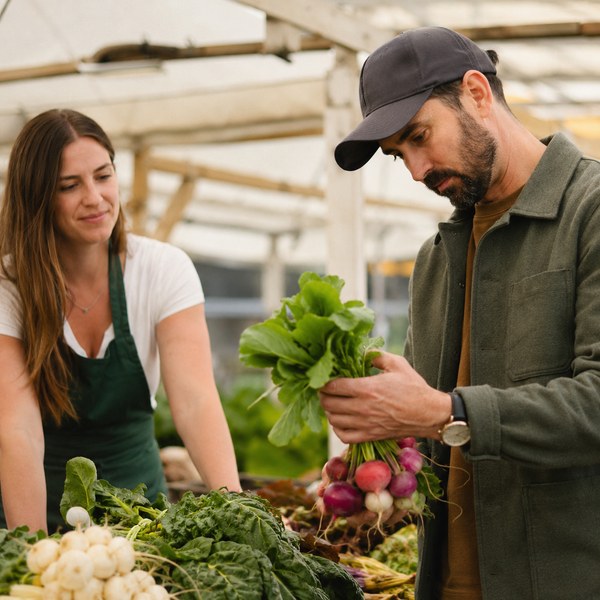
- Farmers markets. Markets are less a place to do volume buying and more a place to meet growers, taste product, and negotiate standing wholesale orders delivered to your door. Our guide should restaurants buy from farmers markets? covers the economics in detail.
- Direct farm accounts and CSAs. Once you know your volume, set up direct accounts with two or three anchor farms. Many farms offer restaurant-scale CSA-style shares — a weekly box of whatever is at peak — which pairs perfectly with a rotating specials board.
- Grow a portion yourself. Herbs, microgreens, and edible flowers are realistic to produce on-site. See how restaurants can grow their own food for setups that work in commercial operations.
Vetting for food safety: ask prospective farms about their food safety practices and whether they hold a USDA Good Agricultural Practices (GAP) audit — a voluntary verification that produce is grown, packed, and stored to minimize microbial food safety risks. Not every excellent small farm is GAP-audited, but every farm you buy from should be able to walk you through how they handle water, harvest hygiene, and post-harvest cooling. Keep supplier records the same way you would for any vendor.
Is Buying Local Produce More Expensive? Cost and Planning Considerations
Local produce is not automatically more expensive — pricing depends on the item, the season, and the channel. In peak season, local product frequently beats distributor pricing because you are not paying for long-haul freight, brokers, and warehousing; during a harvest glut, farms will discount heavily to move volume, which is prime time for specials and preservation projects. Out of season, local options shrink or disappear, and greenhouse-grown local product usually carries a premium. The honest math for most operators is a hybrid model: local produce for featured, high-visibility items and seasonal specials; broadline for year-round staples.
| Planning factor | What operators should do |
|---|---|
| Menu design | Build 20–30% of the menu as rotating seasonal items; keep core dishes on stable supply lines |
| Price volatility | Use market-price language on specials; lock seasonal pricing agreements with anchor farms before the season starts |
| Volume gaps | Keep a distributor backup for every local item; farms have crop failures |
| Delivery windows | Consolidate through a food hub, or align farm deliveries to 1–2 receiving days per week |
| Gluts & surplus | Pickle, ferment, freeze, and preserve peak-season buys to extend value into the shoulder seasons |
| Storage & rotation | Label and date on arrival, FIFO strictly — local produce's shelf-life advantage only pays off with disciplined storage |
Storage discipline deserves emphasis. The freshness edge you paid for disappears if product sits warm at receiving or gets buried in the walk-in. Our produce storage guide for restaurants covers temperatures, humidity, and ethylene separation item by item.
How Do You Market Local Produce on Your Menu?
Marketing local produce works best when it is specific, visible, and consistent. Diners reward proof, not adjectives.
- Name the farm on the menu. "Sunrise Acres rainbow carrots" outperforms "local carrots." Specificity signals authenticity and gives diners something to repeat.
- Use a rotating "from our farms this week" section. A short, changing block trains guests to look for what is new — and gives servers a built-in talking point.
- Show it in the dining room. Crates of squash by the host stand, a chalkboard listing this week's farms, produce displayed at the counter — visible abundance sells. Display pieces from our food display baskets collection turn deliveries into merchandising.
- Tell the story on social. Farm visit photos and delivery-day posts are the highest-engagement, lowest-cost content a restaurant can make. Tag the farm; they will reshare.
- Train servers with two sentences per item. Where it is from and why it is on the menu this week. That is all a table needs to feel the difference.
Putting Local Produce to Work in a Commercial Kitchen
Buying well is half the job; handling and presenting local produce properly is the other half. This is where the operational details separate restaurants that profit from local sourcing from those that just pay more for it. Our foodservice customers consistently tell us the same thing: the restaurants that succeed with local programs are the ones that upgraded their receiving, storage, and prep workflow at the same time they upgraded their sourcing.
- Receiving and storage. Field-fresh produce often arrives with field heat, dirt, and irregular pack sizes. Get it cooled, cleaned, and transferred into airtight, labeled food storage containers fast — clear, date-labeled containers make FIFO rotation automatic and protect the shelf-life advantage you paid for.
- Prep workflow. Local produce is less uniform than spec-graded distributor product, so knife work and prep organization matter more. Stock your line from our food preparation collection — cutting boards, prep bowls, and organization tools that keep high-volume vegetable prep moving.
- Front-of-house display. Woven and metal display baskets turn seasonal abundance into décor and merchandising at the counter, on buffet lines, and in grab-and-go zones.
- Plating that honors the ingredient. Peak-season produce needs less manipulation and more presentation. Simple preparations on the right serveware let the ingredient — and your sourcing story — carry the dish.
In 15+ years supplying 40,000+ foodservice operations, we've watched farm-to-table go from a fine-dining niche to a mainstream operating strategy, and the pattern holds at every price point: the local-sourcing programs that last are the ones treated as an operations system — sourcing, storage, prep, and presentation together — not just a line on the menu.
Frequently Asked Questions
Is buying local produce better?
Yes — local produce is better on freshness, flavor, shelf life, and marketing value: it typically reaches your kitchen within days of harvest instead of a week or more, and it supports a farm-to-table story diners pay a premium for. Broadline produce still wins on year-round consistency and one-truck logistics, which is why most successful restaurants run a hybrid sourcing model.
Is it better to buy local produce in season or year-round?
In season is when buying from local farmers delivers its full advantage — peak flavor and the lowest pricing arrive at the same time. Out of season, local availability shrinks and premiums rise, so build your menu with rotating seasonal items backed by stable distributor staples rather than forcing a 100% local commitment year-round.
Where is it cheaper to buy produce?
For year-round staples in consistent volume, broadline distributors are usually cheaper per case. For in-season items, local farms, food hubs, and wholesale arrangements with farmers market growers are often cheaper because you skip long-haul freight and middlemen — especially during harvest gluts, when farms discount to move volume. Compare per-usable-pound cost, not per-case price: less spoilage changes the math in local produce's favor.
Which country feeds the world the most?
The United States is among the world's largest agricultural producers and the leading food exporter by value, alongside major producers like China, India, and Brazil. That scale is exactly why the U.S. local food economy is so deep for restaurant buyers — USDA counted 116,617 farms selling direct to consumers in the 2022 Census of Agriculture, so nearly every American operator has local growers within sourcing range.
Conclusion: Start Small, Source Close, Sell the Story
Local sourcing pays restaurants back three ways at once: better ingredients in the kitchen, a resilient second supply line, and a marketing story no distributor invoice can provide. You do not need to overhaul your entire supply chain to start — pick one season, two or three anchor farms or a food hub, and a rotating specials section, then build from what works. Handle the product with the respect it deserves from receiving to plate, and your menu will do the selling for you.
Ready to set your kitchen up for a local program? Outfit your walk-in and prep line with commercial-grade food storage containers and everything else in our food preparation collection — built for the operators who take sourcing seriously.