4 Types of Robots in the Food Industry: A Foodservice Operator's Guide
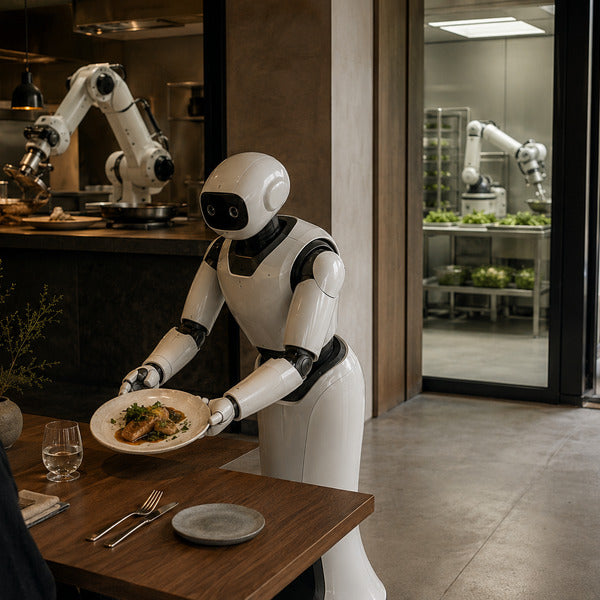
Robots in the food industry fall into four types: kitchen robots that cook and assemble food, delivery robots that transport orders, service robots that carry food to tables, and processing robots that handle production and packaging. Foodservice operators use them to offset labor shortages, boost throughput, and improve consistency.
TL;DR — The 4 Types of Food Industry Robots at a Glance
The global food robotics market is projected to reach $6.81 billion by 2030, growing at a 20.6% CAGR from 2024, according to Grand View Research. Meanwhile, the National Restaurant Association projects restaurant and foodservice employment will reach 15.8 million jobs in 2026, with nearly three-quarters of operators planning to hire but expecting difficulty finding experienced staff (NRA, 2026 State of the Restaurant Industry). That labor gap is exactly why food robots have moved from novelty to necessity.
| Robot Type | What It Does | Real Examples | Best For |
|---|---|---|---|
| 1. Kitchen & cooking robots | Fry, grill, assemble bowls, portion ingredients | Miso Robotics Flippy Fry Station; Infinite Kitchen (now owned by Wonder) | QSRs and fast casual with high-volume, repetitive stations |
| 2. Food delivery robots | Carry orders curbside-to-door on sidewalks or roads | Starship, Coco, Serve Robotics, Kiwibot | Campuses, dense urban delivery zones, off-premise programs |
| 3. Food service robots | Run food and bus tables in the dining room | Pudu BellaBot, Bear Robotics Servi | Full-service restaurants, sushi chains, casinos, senior living |
| 4. Food processing robots | Pick, pack, palletize, and portion at production scale | FANUC, KUKA, Stäubli, ABB, Chef Robotics | Food manufacturers, commissaries, ghost-kitchen production |
What Are Robots in the Food Industry?
Robots in the food industry are automated machines that perform cooking, delivery, service, or processing tasks that were traditionally done by human workers. The category spans everything from a $15,900 tray-carrying server robot to multi-million-dollar robotic production lines — but for restaurant operators, the practical landscape breaks down into the four types above.
Here's the distinction that matters when you research this topic: most of what ranks for "robots food industry" is written for food manufacturers — industrial arms from FANUC, KUKA, Stäubli, and ABB picking and packing on production lines. That is real and covered below, but it is not what a restaurant, hotel, or caterer actually shops for. This guide focuses on foodservice operations: the robots that cook, deliver, and serve food in and around restaurants, plus the AI systems increasingly wired into all of them.
In 15+ years supplying 40,000+ foodservice operations at Restaurantware, we've watched automation move from publicity stunt to staffing strategy. A decade ago a robot in a restaurant was a marketing gimmick. Today, when 26% of restaurant operators already use AI-related tools in their operations (NRA 2026 State of the Restaurant Industry), a fry robot or delivery bot is simply the next line item in a labor plan.
Type 1: Kitchen Robots and Cooking Robots for Restaurants
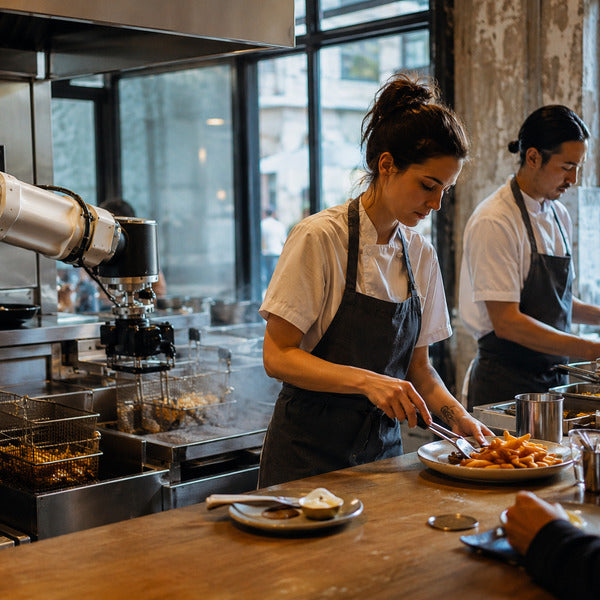
Kitchen robots are automated systems that cook, assemble, or portion food inside commercial kitchens. They are the fastest-maturing category of food robots because they attack the industry's most persistent pain point: back-of-house labor. Commercial kitchen robots today handle four main jobs:
Frying and grilling robots
The best-known cooking robot for restaurants is Flippy, the AI-powered fry station from Miso Robotics. The newest Flippy Fry Station, redesigned in early 2026 after five years of deployments and millions of baskets fried, installs in as little as 9.5 feet of wall space under a kitchen's existing hood and fire-suppression system — no major layout changes required (Miso Robotics). Flippy has run fry stations at White Castle and has been scheduled into Jack in the Box and other large-brand locations. It identifies baskets, monitors cook times, and shakes and hangs fries with more consistency than a rushed line cook at hour seven of a shift.
Automated makelines and bowl assembly
The Infinite Kitchen — the automated makeline developed by Sweetgreen — is the highest-profile proof that robots can run the heart of a fast-casual line. The system dispenses and portions ingredients into bowls automatically, and Sweetgreen reported faster throughput, better order accuracy, tighter portion consistency, and meaningfully lower team-member turnover at Infinite Kitchen locations. In November 2025, food-hall operator Wonder acquired the Infinite Kitchen technology from Sweetgreen to scale it further (Food On Demand, Nov 2025) — a strong signal that automated makelines are becoming platform technology rather than a single chain's experiment.
Specialized single-task cooking robots
Beyond the headline systems, a wave of specialized machines automate one station at a time: automated soup and broth stations (sold under names like "Soup Plus" by robotics vendors), robotic wok and noodle cookers common in Asian fast-casual concepts, automated pizza lines, and robotic coffee baristas. These single-task kitchen robotics units are typically cheaper and easier to permit than full robotic kitchens, which is why they are often an operator's first automation purchase.
What automated kitchens still need from humans
Here's the part vendors under-sell: automated kitchens are only as good as the prep operation feeding them. A robotic makeline doesn't wash, chop, or stage ingredients — humans do, using the same food preparation tools, containers, and organization any high-volume kitchen depends on. Our foodservice customers consistently tell us automation succeeds when it pairs with a well-organized prep line, not instead of one. Budget for the mise en place infrastructure around the robot, or the robot starves.
Type 2: Food Delivery Robots — How Robots Deliver Food
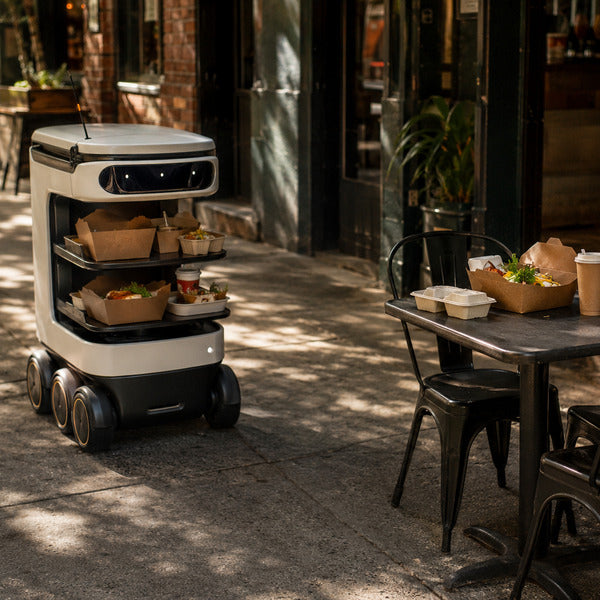
Food delivery robots are autonomous vehicles — mostly cooler-sized sidewalk rovers — that carry orders from a restaurant to a customer's door. Of the four types, robots delivering food have scaled the fastest, because the last mile is the most expensive, lowest-margin leg of off-premise dining.
Delivery robot names and companies to know
- Starship Technologies — the volume leader. Starship has completed more than 9 million autonomous deliveries across seven countries, covering over 12 million miles, and closed a $50M Series C in October 2025 with plans to grow its fleet from 2,700+ robots to over 12,000 by 2027 (Starship Technologies). Its robots dominate U.S. college campuses.
- Coco Robotics — the urban specialist. Coco has operated in Los Angeles since 2020 with a fleet that surpassed 1,000 robots, and launched in Miami in 2025, where its robots now deliver restaurant orders, groceries, and everyday essentials. In November 2025 Coco and DoorDash expanded their partnership to Miami via DashMart (DoorDash, Nov 2025), and in February 2026 Coco unveiled its next-gen Coco 2 platform for city-wide goods movement. If you've seen a delivery robot rolling through Wynwood or Brickell, it was almost certainly a Coco.
- Serve Robotics — spun out of Uber, running sidewalk delivery for Uber Eats in Los Angeles and other metros.
- Kiwibot and Avride — campus- and city-focused fleets rounding out the U.S. sidewalk-robot market.
Benefits of automated food delivery systems
For operators, the benefits of automated food delivery systems come down to five measurable wins:
- Lower per-delivery cost on short-radius orders, since a robot doesn't earn hourly wages or tips.
- Predictable capacity — fleets don't call in sick on a rainy Friday night.
- Tamper-evident, locked compartments that reduce order theft and food-safety complaints in transit.
- Zero-emission last mile, which matters for brands with sustainability commitments.
- Marketing visibility — a branded robot on the sidewalk is a rolling billboard; Coco now sells ad campaigns on its Miami fleet.
The operational catch: robot delivery still depends on packaging that survives a ride in an unattended compartment. Sturdy, sealed, insulated containers stop being nice-to-haves and become the interface between your kitchen and the customer.
Type 3: Food Service Robots — Robots Serving Food in Dining Rooms
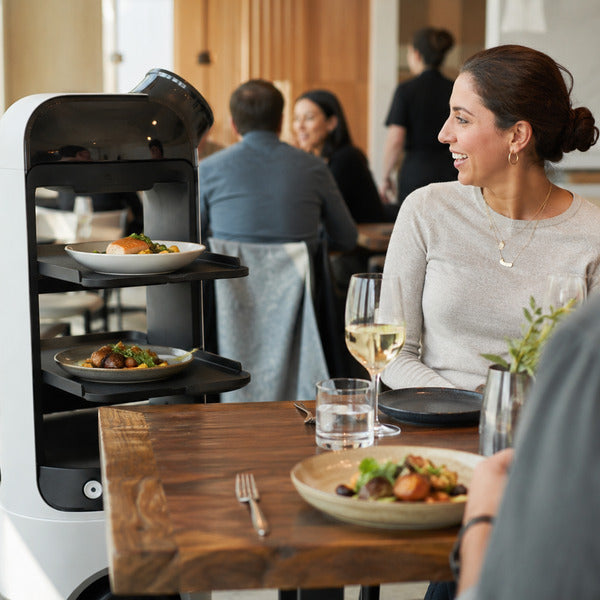
Food service robots are autonomous carts that carry plates, drinks, and bus tubs between the kitchen and the dining room. Robots serving food do not replace servers; they replace the walking. A runner robot handles the 50-foot round trips so human staff spend their time at the table, where hospitality actually happens.
The two names that dominate this category:
- Pudu Robotics BellaBot — the cat-faced tray robot used by chains including IHOP and Kura Sushi and in Disney properties. Units sell for around $15,900, or lease under robots-as-a-service (RaaS) plans from roughly $2,430/month through resellers like RobotLab (current as of July 2026).
- Bear Robotics Servi — a food-running and table-bussing robot widely deployed in full-service restaurants, casinos, and senior-living dining.
Food serving robots earn their keep in three settings: high-footage dining rooms where servers log miles per shift, concepts with heavy tray volume like sushi and hot pot, and labor markets where a $2,400 monthly lease undercuts a hard-to-fill runner position. They struggle with stairs, tight aisles, and outdoor patios — walk your floor plan before you sign a lease.
One presentation note from our side of the business: when robots serve food, the plate arrives without a human hand to steady it. Operators running server robots gravitate toward stable, well-balanced dinnerware and drinkware that travels flat — worth factoring into your restaurant equipment choices if a Servi or BellaBot is in your plans.
Type 4: Food Processing and Production Robots
Food processing robots are industrial robotic arms and systems that handle food at manufacturing scale — picking, packing, portioning, palletizing, and increasingly plating. This is the B2B side of the robots food industry conversation, dominated by industrial vendors: FANUC food-grade arms on beverage and bakery lines, KUKA and Stäubli hygienic-design robots built for washdown environments, ABB delta robots doing high-speed pick-and-place, and newer entrants like Chef Robotics, whose AI-enabled arms portion ingredients for prepared-meal manufacturers.
For restaurant operators, processing robots matter in two ways. First, they already touch most of your supply chain — the portioned proteins, pre-cut produce, and packaged sauces you buy were likely handled by robots upstream. Second, as commissary kitchens and ghost-kitchen networks consolidate production, mid-size operators increasingly buy from robot-run facilities, which tightens spec consistency and traceability.
Food safety standards for automated food equipment
Every robot that touches food in the U.S. plays by the same sanitation rulebook as any other piece of equipment. NSF/ANSI 4 establishes the food protection and sanitation requirements for the materials, design, construction, and performance of commercial cooking, rethermalization, and hot-food holding and transport equipment (NSF), and the FDA Food Code deems equipment certified to ANSI-accredited standards compliant with its Chapter 4 equipment sanitation provisions. Translation for operators: when evaluating any cooking or holding robot, ask for the NSF (or equivalent ANSI-accredited) certification mark the same way you would for a fryer or holding cabinet. If a vendor can't produce it, your health inspector will notice even if you don't.
How Is AI Changing the Food Industry?
AI in the food service industry is the software layer that makes all four robot types work — and it now extends far beyond the robots themselves. As of the National Restaurant Association's 2026 State of the Restaurant Industry report, 26% of restaurant operators use AI-related tools in their businesses. The current, real-world AI applications in the food service industry include:
- Demand forecasting and prep planning — AI predicts covers and builds prep lists, shrinking overproduction.
- Dynamic inventory and waste reduction — camera- and scale-based systems flag waste patterns; kitchen automation technologies aimed at reducing waste consistently show some of the fastest paybacks in the category.
- Voice AI ordering — drive-thru and phone ordering handled by conversational AI at major QSR brands.
- Computer vision quality control — cameras verifying order accuracy and cook doneness on the line.
- Menu and concept R&D — generative AI trained on culinary and consumer data (see Mattson, below).
- Robot orchestration — the routing, obstacle avoidance, and fleet management inside every delivery and service robot above.
Mattson's ProtoThink AI and Chef Insights AI
The clearest example of AI moving into food innovation — not just operations — is Mattson, the Silicon Valley food-and-beverage innovation firm with 47+ years in the industry. In April 2025, Mattson launched two AI-driven tools for foodservice professionals: Chef Insights AI, which distills chef and culinary-trend intelligence for menu developers, and ProtoThink Foodservice AI (sometimes written "Proto-Think AI"), a generative concepting tool Mattson has used internally since 2022 to accelerate product and menu prototyping (Prepared Foods, Apr 2025). In May 2026 Mattson extended the suite with MattsonIQ, an AI platform that packages its food-intelligence expertise for global professionals. For operators, the takeaway is practical: the same AI wave powering kitchen robots is now compressing menu R&D cycles from months to weeks.
Future Trends in Foodservice Automation and Robotics
Where is foodservice automation headed? Five trends define the future of foodservice automation through the late 2020s — all grounded in figures current as of July 2026:
- The market keeps compounding. Food robotics is projected to reach $6.81 billion by 2030 at a 20.6% CAGR (Grand View Research). Automation in the food service industry is no longer venture theater; it's an equipment category.
- Labor math drives adoption. With foodservice employment projected at 15.8 million jobs in 2026 and nearly three-quarters of operators expecting hiring difficulty (NRA), robots are being deployed to fill positions that stay vacant — not to eliminate filled ones.
- RaaS replaces capex. Robots-as-a-service leases (like the ~$2,430/month service-robot plans above) let independents adopt automation without six-figure capital budgets, which is pulling robots out of chains-only territory.
- Platforms consolidate. Wonder buying Infinite Kitchen and DoorDash embedding Coco into its network show automation being absorbed into bigger foodservice platforms. Expect fewer standalone robot startups and more automation bundled into delivery, POS, and kitchen ecosystems.
- Waste-reduction automation grows fastest. The best kitchen automation technologies to reduce waste — AI prep forecasting, smart portioning, vision-based waste tracking — deliver ROI without a robot arm, and they're the on-ramp most independents take first.
For a deeper look at whether full robotic restaurants are viable, see our companion piece on are robots the future for restaurants?
Adjacent Tech: Ambient Technology in Automated Kitchens
Ambient technology is computing that fades into the environment — sensors, connected equipment, and automation that respond to conditions without anyone tapping a screen. It is not a robot type, but it is the connective tissue of automated kitchens, so it earns a brief mention here. In foodservice, ambience technologies show up as temperature sensors that log coolers automatically for HACCP compliance, smart hoods and lighting that adjust to cooking activity, and equipment that flags its own maintenance needs. A note on terminology: "ambient" in food retail also describes shelf-stable goods — ambient products and ambient meals are items stored and sold at room temperature, and an "ambient culinary" range simply means no cold chain required. The two usages share a word, not a meaning. For operators, the practical takeaway is that ambient (ambiance) technology is what lets your kitchen robots, sensors, and back-of-house systems talk to each other — quiet infrastructure rather than a machine you can point to.
Equipping a Semi-Automated Kitchen: Where Restaurantware Fits
Most kitchens won't jump straight to a robotic makeline — they'll automate one station and run humans everywhere else. That semi-automated middle is where we live. At Restaurantware, we supply 40,000+ foodservice operations, and the pattern we see from customers adopting automation is consistent: the robot is the easy part; the workflow around it decides whether it pays off.
Three places to invest alongside (or before) a robot:
- Countertop equipment that automates without robotics. Our Kitchen Tek collection covers programmable countertop equipment — the affordable rung of automation that most independents should climb first.
- Prep infrastructure that feeds automated stations. Organized food preparation tools and containers keep an automated line stocked and a prep team efficient.
- Back-of-house essentials that keep pace. From holding to transport, the right restaurant equipment keeps a faster, robot-assisted line from bottlenecking at the pass.
Frequently Asked Questions
What are examples of robots in the food industry?
Robots in the food industry include Flippy (Miso Robotics' fry-station robot), the Infinite Kitchen automated makeline, Starship and Coco sidewalk delivery robots, Pudu BellaBot and Bear Robotics Servi server robots, and industrial arms from FANUC, KUKA, Stäubli, and ABB used in food processing and packaging.
What companies make food industry robots?
Leading robots food industry companies include Miso Robotics and Wonder (kitchen robots), Starship Technologies, Coco Robotics, Serve Robotics, and Kiwibot (delivery robots), Pudu Robotics and Bear Robotics (service robots), and FANUC, KUKA, Stäubli, ABB, and Chef Robotics (food processing and production).
Are robots used in fast food?
Yes. Robots in fast food handle frying (Flippy at White Castle and Jack in the Box locations), bowl assembly (Infinite Kitchen), drink-making, and drive-thru voice AI ordering. QSRs adopt robots faster than any other segment because their menus are standardized and their labor turnover is highest.
What is food robotics?
Food robotics is the field of designing and deploying automated machines that handle food across cooking, service, delivery, processing, and packaging. The global food robotics market is projected to reach $6.81 billion by 2030, growing at a 20.6% CAGR (Grand View Research, current as of July 2026).
How much does a restaurant robot cost?
A food service robot like the Pudu BellaBot sells for around $15,900, with robots-as-a-service leases from roughly $2,430/month (RobotLab pricing, current as of July 2026). Kitchen robots like fry stations typically run on monthly subscription models; sidewalk delivery robots are usually operated by fleet companies rather than purchased by restaurants.
Will robots replace restaurant workers?
No — the evidence points to reallocation, not replacement. The National Restaurant Association projects industry employment will grow to 15.8 million jobs in 2026 even as automation spreads, and operators deploying robots report they primarily fill chronically vacant positions and shift staff toward guest-facing work.
Conclusion: Start with the Station, Not the Robot
The four types of robots in the food industry — kitchen, delivery, service, and processing robots — are all solving the same equation: too few workers, too much repetitive work, and margins too thin to waste either. The winners we see among our 40,000+ customers don't chase the flashiest machine; they identify their most painful station, automate that one thing, and build a disciplined prep and equipment workflow around it.
Whether your next step is a full fry-station robot or simply a smarter countertop line, build the foundation first. Explore the Kitchen Tek collection for programmable countertop automation, and outfit the rest of your back of house from our restaurant equipment range.