Temperature Limits of Food Packaging Materials
Food packaging temperature limits define the safe range each material can hold food without warping, leaching, or failing. Polypropylene withstands up to ~230°F, PET ~140°F, paper and foil handle higher heat, and PTFE coatings work up to 500°F. Match packaging to the USDA's 40–140°F danger-zone rules; this guide covers limits, compliance, and material selection.
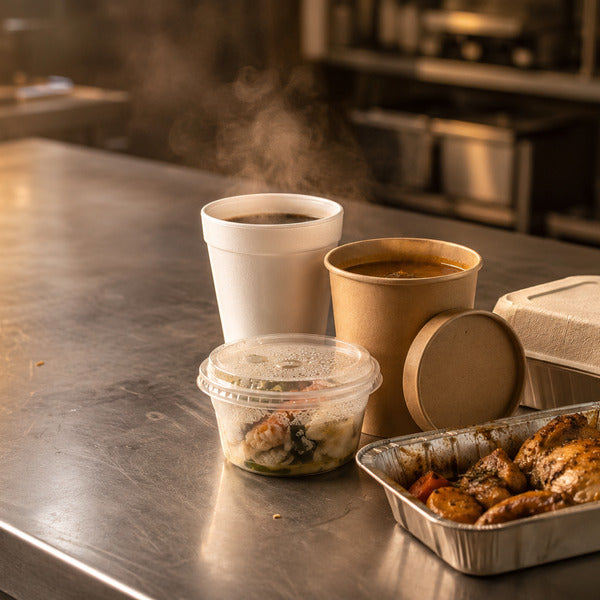
TL;DR — Quick Temperature Reference
- Cold-only: PET (up to ~140°F) and PLA (~110–140°F) — never microwave or hot-hold.
- Hot-hold and microwave: Polypropylene (up to ~230°F continuous), bagasse (~200°F), PP-lined paperboard.
- Oven-capable: CPET trays (up to ~400°F), aluminum foil (~660°F service, melts at ~1,220°F), PTFE-coated mats and liners (up to 500°F).
- Compliance anchor: Keep food out of the USDA danger zone (40–140°F); the FDA Food Code requires hot holding at 135°F+ and cold holding at 41°F or below — your packaging must support both.
Food Packaging Material Temperature Limits at a Glance
| Material | Safe Continuous Temperature | Microwave? | Oven? | Best For |
|---|---|---|---|---|
| Polypropylene (PP, #5) | Up to ~230°F (110°C); melts ~320–340°F | Yes | No | Hot entrées, soups, reheatable takeout |
| PET (#1) | Up to ~140°F (60°C) | No | No | Cold drinks, salads, deli containers |
| CPET (crystallized PET) | -40°F to ~400°F | Yes | Yes (to 400°F) | Freezer-to-oven meal trays |
| HDPE (#2) | Up to ~230°F (110°C) | Generally no (not rated) | No | Milk jugs, condiment bottles, tubs |
| Polystyrene (PS, #6) | Up to ~175°F | No | No | Cold cups, lids, cutlery |
| Paper / paperboard | Depends on liner: PP-lined microwave-safe; PE-lined not | Only PP-lined | No | Takeout boxes, food trays, wraps |
| Aluminum foil | Oven-safe; melts at ~1,220°F (660°C) | No (arcing) | Yes | Hot-hold pans, catering, baking |
| Bagasse (sugarcane fiber) | Up to ~200°F (93°C); some grades oven-rated to ~375°F | Yes (short cycles) | Check grade | Eco-friendly hot and cold takeout |
| PTFE (nonstick coatings, grill mats) | Up to 500°F (260°C) continuous | N/A | Yes (to rating) | Grill mats, oven liners, bakeware coatings |
What Are the Temperature Limits of Food Packaging Materials?
The temperature limit of a food packaging material is the maximum (and minimum) temperature at which it holds food safely without deforming, leaking, or transferring chemicals into the food. Food packaging temperature limits matter because the same container that performs perfectly for a cold salad can warp, blister, or leach when filled with 190°F soup.
Two regulatory benchmarks frame every packaging decision:
- The USDA "Danger Zone" is the 40°F–140°F range where bacteria multiply fastest; the USDA Food Safety and Inspection Service advises never leaving perishable food in this range for more than 2 hours (1 hour above 90°F).
- The FDA Food Code requires operators to hold hot time/temperature-control-for-safety (TCS) foods at 135°F or above and cold TCS foods at 41°F or below, per FDA Food Code sections 3-501.16.
The practical rule: your packaging must comfortably exceed your holding temperature. A container rated to 140°F cannot legally support 135°F+ hot holding with any safety margin — heat from fresh-cooked food routinely spikes past 165°F.
In 15+ years supplying 40,000+ foodservice operations, we've seen the same failure modes repeat: PET deli cups warped by hot grain bowls, PE-lined paper boxes delaminating in microwaves, and foam clamshells softening under fried chicken straight from a 350°F fryer. Nearly every one traces back to a material used past its temperature rating.
How Do Temperature Limits Break Down by Material?
Each packaging material has a distinct thermal profile. Here is the material-by-material breakdown, from everyday plastics to high-heat fluoropolymers.
Polypropylene (PP) — the hot-food workhorse
Polypropylene withstands continuous temperatures up to about 230°F (110°C) and melts between 320°F and 340°F (160–170°C), which is why PP is the default resin for microwave-safe takeout containers. PP tolerates boiling-temperature foods, reheating cycles, and hot-holding without deforming. Its cold limit is around -4°F (-20°C), so it also handles refrigeration, though it can turn brittle in deep-freeze conditions.
PET and CPET — cold clarity vs. oven trays
Standard PET (polyethylene terephthalate) softens at low heat and should stay below roughly 140°F (60°C). It is the crystal-clear resin in cold cups, salad bowls, and deli containers — never microwave it. Crystallized PET (CPET), by contrast, is heat-set and rated from -40°F up to about 400°F, making CPET trays the standard for freezer-to-oven prepared meals.
HDPE and LDPE — storage, not reheating
High-density polyethylene handles up to roughly 230°F before deforming but is rarely rated microwave-safe; it serves in jugs, tubs, and bottles. Low-density polyethylene (LDPE) softens sooner and appears mostly as bags, squeeze bottles, and film liners for cold and ambient use.
Polystyrene — cold-side only
Polystyrene (rigid PS and foam EPS) softens around 175°F and is not microwave-safe. It insulates well for short holds, but hot, oily foods accelerate softening — keep PS on the cold side of the menu.
Paper and paperboard — it's the liner that decides
Uncoated paper itself tolerates significant heat (paper ignites around 451°F), but nearly all food-contact paperboard carries a moisture-barrier liner, and the liner sets the limit. Paper containers with a PP liner are microwave-safe; paper containers with a PE (polyethylene) liner are not, because PE softens at microwave temperatures. Check the liner spec before promising customers a microwavable box, and pair boxes with the right food packaging wrap to hold heat during delivery.
Aluminum foil — the high-heat generalist
Aluminum melts at about 1,220°F (660°C), far beyond any foodservice application, so foil pans and wraps are oven-safe at any realistic cooking temperature. Foil's real limits are practical: it cannot go in microwaves (arcing) and highly acidic or salty foods can pit it during long storage.
Bagasse and molded fiber — compostable heat tolerance
Bagasse (sugarcane fiber) containers withstand food temperatures up to about 200°F (93°C) and are microwave-safe for short reheat cycles; some manufacturer grades are oven-rated to roughly 375°F. Bagasse does not melt like plastic — it gradually loses rigidity when saturated with very hot, wet foods, so vent steam on soups and stews.
What are PTFE temperature limits?
PTFE (polytetrafluoroethylene, best known by the Teflon™ brand) withstands continuous service temperatures up to 500°F (260°C) and intermittent exposure to about 550°F (288°C) — the highest rating of any common food-contact polymer. In foodservice, PTFE appears as nonstick coatings and reusable grill mats and oven liners rather than as containers. FDA regulation 21 CFR 177.1550 (Perfluorocarbon resins) authorizes PTFE for repeated food contact across aqueous, acidic, alcoholic, and fatty foods.
The key operating rule is simple: keep PTFE surfaces under 500°F. Above that threshold the polymer begins to degrade and can release fumes, which is why empty preheating of PTFE-coated pans over high flame is discouraged. Within its rating, PTFE is inert, nonstick, and exceptionally easy to clean — our rectangle black PTFE reusable grill mat is a typical example, built for repeated grill and oven service. (Related high-performance materials follow the same logic: PEEK components are rated to about 480°F continuous, and EPDM gaskets and seals to roughly 300°F — both appear in food equipment, not disposable packaging.)
Which Types of Plastic Are Used in Food Packaging?
Six plastics dominate food packaging, identified by their resin codes. Knowing each resin's temperature ceiling tells you instantly which menu items it can carry:
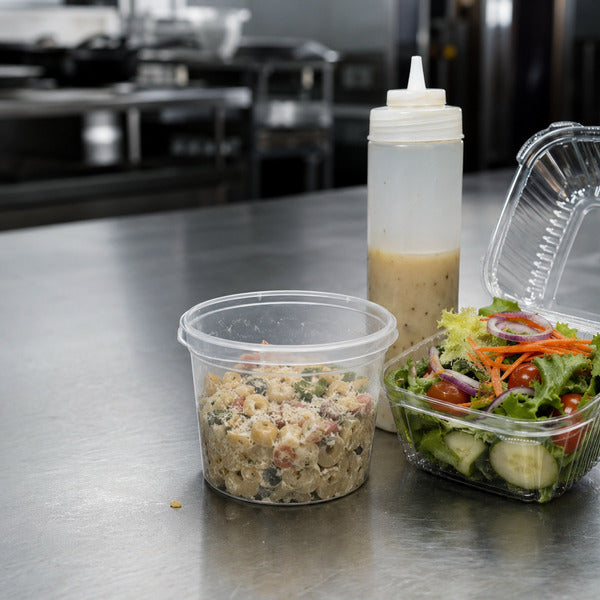
- PET (#1) — clear, lightweight, and strong; the standard for cold beverages, salads, and grab-and-go. Cold-only (~140°F max).
- HDPE (#2) — rigid and chemical-resistant; jugs, tubs, and bottles. Ambient and refrigerated use.
- PVC (#3) — mostly films and blister packs; low heat tolerance and declining use in direct food contact.
- LDPE (#4) — flexible bags, films, and squeeze bottles; ambient/cold use.
- PP (#5) — the microwave-safe hot-food resin; containers, lids, and liners up to ~230°F.
- PS (#6) — rigid cups, lids, and cutlery plus foam clamshells; cold-side use below ~175°F.
All plastic packaging for food products sold in the U.S. must comply with FDA food-contact regulations (21 CFR Parts 174–179), which define which polymers, additives, and coatings may touch food and under what conditions of use. When sourcing plastic for food packaging, ask suppliers for the specific 21 CFR citation or an FDA Declaration of Compliance — reputable manufacturers provide it readily.
What Does the Regulatory Landscape for Food Packaging Look Like?
Food packaging regulation in the United States is anchored by the FDA, which treats packaging as an indirect food additive. The framework operators should know:
- 21 CFR Parts 174–179 list approved food-contact substances — polymers (Part 177), adhesives and coatings (Part 175–176), and production aids — with conditions of use that often include temperature classes (e.g., "hot filled," "high-temperature heat-sterilized").
- Food Contact Notifications (FCNs) are the modern pathway: manufacturers notify FDA of new food-contact substances with safety data before marketing.
- The FDA Food Code (adopted by states) governs how operators use packaging: hot holding at 135°F+, cold holding at 41°F or below, and protection of food from contamination.
- Microwave-safe and condition-of-use testing: FDA clearances tie each material to specific temperature conditions of use — from frozen storage through high-temperature heat sterilization — and "microwave safe" labeling reflects extraction testing under those intended reheating conditions, not a marketing judgment. A container is only microwave-safe if it was cleared and tested for that use.
- State-level action on PFAS and foam: a growing list of states restricts intentionally added PFAS in food packaging and bans EPS foam containers — check your state before committing to a packaging program.
For biodegradable food packaging, regulatory solutions add another layer: compostable claims are policed by the FTC Green Guides, and third-party certification (BPI in the U.S., following ASTM D6400/D6868) is the accepted proof standard. Biodegradable materials must still meet the same FDA food-contact rules as conventional plastics — "compostable" does not exempt a container from 21 CFR compliance. For food and beverage manufacturers, the practical takeaway is to build a compliance file per SKU: resin identity, 21 CFR citation, temperature conditions of use, and any state-specific restrictions.
How Do You Navigate Compliance and Safety Standards in Food Packaging?
Food packaging safety compliance comes down to a repeatable checklist operators can run on every new container, wrap, or lid:
- Verify food-contact status. Request the FDA compliance statement (21 CFR citation or FCN number) from the supplier for every food-contact item.
- Match temperature rating to use. Confirm the material's rated range covers your hottest fill temperature and coldest storage temperature — not just "average" service.
- Confirm condition-of-use class. FDA clearances specify use conditions (frozen storage vs. hot fill vs. microwave reheat); a resin cleared for cold use is not automatically cleared for hot.
- Maintain packaging hygiene. Store packaging off the floor, in original cartons, away from chemicals and splash zones; the Food Code treats single-service articles as food-contact surfaces, so handle them with the same care.
- Document everything. Health inspectors and chain auditors increasingly ask for packaging compliance documentation, not just food temperatures.
Compliant packaging is also an insurance policy: if a customer complaint or recall ever puts your operation under scrutiny, a documented, temperature-appropriate packaging program is your first line of defense.
How do you stay compliant with seasonal food packaging?
Seasonal food packaging — holiday-printed boxes, limited-run cups, summer catering trays — must meet the same FDA food-contact and temperature standards as your core packaging, and U.S. operators should verify each seasonal SKU the same way. Seasonal items carry two extra risks: short-run inks and coatings from unvetted suppliers, and temperature mismatch (a decorative box designed for ambient bakery items pressed into hot-food duty during a rush). Order seasonal packaging from suppliers who provide food-contact documentation, and confirm the temperature rating before it touches a hot menu item. Proper packaging is one of the most direct ways to comply with food safety regulations: it keeps hot food above 135°F and cold food below 41°F between kitchen and customer, seals out contamination, and shows inspectors a documented chain of protection.
How Do Clean Labels and Extended Shelf Life Work Together?
Clean-label shelf life extension means preserving food longer using ingredients and packaging consumers recognize — not synthetic preservatives. Packaging is the quiet hero here: the right material extends shelf life so the label doesn't have to.
- Barrier packaging (high-barrier films, vacuum and modified-atmosphere packaging) slows oxidation and microbial growth physically, letting formulators drop chemical preservatives.
- Clean-label ingredient swaps — rosemary extract, cultured dextrose, vinegar-based antimicrobials, citrus extracts — replace synthetic preservatives like BHA/BHT and sodium benzoate.
- Temperature discipline is the multiplier: even the best barrier package cannot compensate for storage in the 40–140°F danger zone. Cold-chain-appropriate materials (PET for cold display, PP for hot fill) protect both safety and shelf life.
- Honest labeling: "extended life" claims must reflect validated shelf-life testing; clean label means the ingredient statement and the shelf-life mechanism can both survive customer scrutiny.
For operators, the takeaway is that packaging choice is a shelf-life ingredient. Airtight, temperature-appropriate food storage containers routinely add days of usable life to prepped ingredients without touching the recipe.
What Are the Benefits of Custom Food Packaging?
Custom food packaging turns a required cost into a marketing asset. The seven benefits our customers cite most:
- Brand visibility in transit — with nearly 75% of restaurant traffic now off-premises (National Restaurant Association, 2025 Off-Premises Restaurant Trends), your box is seen by more people than your dining room.
- Perceived quality — branded packaging signals intention; unbranded packaging signals commodity.
- Social media amplification — distinctive packaging is photographed and shared; plain packaging is not.
- Functional fit — custom sizing reduces food shift, sog, and spill complaints in delivery.
- Customer trust and repeat orders — tamper-evident, well-branded packaging reassures delivery customers.
- Premium pricing support — presentation justifies price; this holds for U.S. operators and internationally (UK cafés report the same lift from branded drink packaging: branded cups extend the café experience to the commute and act as walking advertising).
- Differentiation at scale — integrated branding packages (cups, boxes, bags, wraps in one visual system) let restaurants and retail brands compare durability and customization options across their whole packaging line instead of piecemeal, keeping quality consistent as they grow.
One constraint custom packaging never escapes: temperature limits are set by the material, not the print. A beautifully branded PET cup still can't hold hot coffee. Choose the substrate for the menu temperature first, then brand it.
How Do You Match Packaging to Your Menu? (Foodservice Applications)
Here is how we guide operators to pair materials with menu temperatures — the framework behind thousands of packaging consultations at Restaurantware:
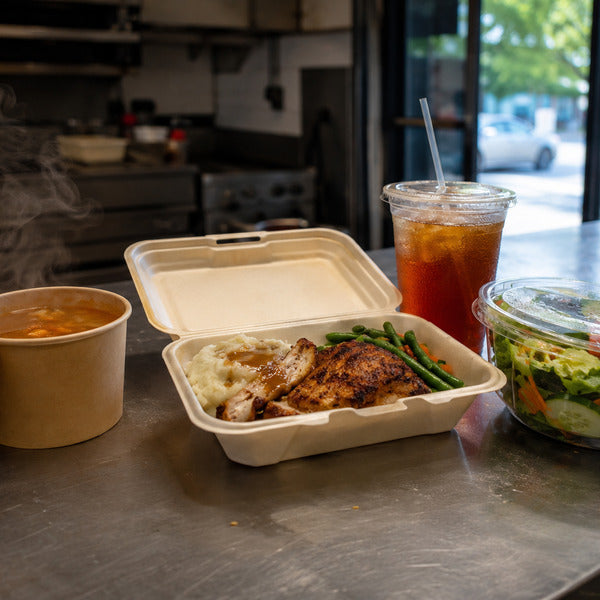
- Hot entrées, fried food, soups (135–200°F): PP containers, bagasse clamshells, or foil pans. Vented lids prevent sog on fried items. Browse heat-rated take out containers & to go boxes by temperature rating.
- Reheat-at-home meals: PP or CPET so the customer can microwave (PP) or oven-finish (CPET) in the original container.
- Cold salads, desserts, beverages (33–41°F): PET for clarity and merchandising; PLA where compostability is required (cold-only).
- Hot-hold wraps and catering: foil sheets and PP-lined paper with insulated food packaging wrap to bridge delivery time without dropping below 135°F.
- Back-of-house prep: microwave-safe PP food storage containers that move from walk-in to microwave without a transfer step.
- Grill and oven lines: PTFE grill mats and liners rated to 500°F for nonstick, easy-clean cooking surfaces.
Our foodservice customers consistently tell us that matching container material to menu temperature is the single biggest driver of delivery-quality complaints they eliminate — ahead of driver speed and even tamper seals. When the container matches the food's temperature, food arrives at safe holding temp, structurally intact, and looking like it did at the pass.
Ready to build a temperature-matched packaging program? Explore our full range of disposable food packaging supplies, organized by material and heat rating.
Frequently Asked Questions
What temperature can plastic food packaging withstand?
It depends on the resin: polypropylene withstands up to about 230°F continuously (melting at 320–340°F), HDPE to about 230°F, polystyrene to about 175°F, and PET only to about 140°F. CPET is the outlier, oven-rated to roughly 400°F. Always check the container's rating against your hottest fill temperature.
Which plastics are microwave safe?
Polypropylene (#5) is the standard microwave-safe plastic for food packaging, and CPET trays are also microwave- and oven-safe. PET, polystyrene, and PE-lined paper containers are not microwave-safe. Look for the microwave-safe symbol — "microwave safe" is a tested condition of use, not a guess based on resin code alone.
What is the temperature danger zone for packaged food?
The danger zone is 40°F to 140°F, the range where bacteria multiply most rapidly according to the USDA. Perishable food — packaged or not — should never sit in this range for more than 2 hours (1 hour above 90°F). Under the FDA Food Code, operators must hold hot TCS food at 135°F or above and cold TCS food at 41°F or below.
Is PTFE as bad as PFAS?
PTFE is technically a member of the PFAS family, but it is a large, inert polymer — not the small, mobile PFAS compounds (like PFOA) that drove health concerns. FDA regulation 21 CFR 177.1550 clears PTFE for repeated food contact, and PFOA has been phased out of U.S. PTFE manufacturing. The practical rule: keep PTFE below its 500°F rating, because overheated PTFE can degrade and release fumes. Used within its rating, PTFE grill mats and coatings are considered safe for food contact.
Can takeout containers go in the oven?
Only if the material is oven-rated: CPET trays (to ~400°F), aluminum foil pans, and some bagasse grades (to ~375°F, per manufacturer) can go in the oven. Standard PP, PET, polystyrene, and lined-paper takeout containers cannot — they will warp, melt, or delaminate. When in doubt, transfer food to oven-safe cookware.
Conclusion: Temperature-Match First, Everything Else Second
Food packaging temperature limits are the foundation of every packaging decision: PP for hot and microwavable, PET for cold, CPET and foil for the oven, bagasse for compostable hot service, and PTFE for high-heat cooking surfaces up to 500°F. Layer FDA food-contact compliance and the 135°F/41°F holding rules on top, and you have a packaging program that protects your food, your customers, and your inspections.
After 15+ years supplying 40,000+ foodservice operations, our advice hasn't changed: pick the material for the temperature, then optimize for cost, sustainability, and branding. Start with our disposable food packaging supplies collection to build a temperature-matched program for your menu.