How to Set a Table for Formal & Casual Dining
To set a table, place the dinner plate at the center of each setting, forks to the left on a folded napkin, knife (blade facing inward) and spoon to the right, and a water glass above the knife. Formal settings add chargers, bread plates, and additional flatware arranged in order of use.
Knowing how to set a table is one of the fastest, cheapest ways to raise the perceived value of a meal — at home or across a 200-cover dining room. The rules are simpler than most people think: everything is arranged in order of use, from the outside in. This guide walks through the basic table setting, the step-by-step casual and formal versions, a labeled place-setting diagram, and the buying and operations details that matter when you're setting tables professionally, not just for Sunday dinner.
TL;DR: Formal vs. Casual Table Setting at a Glance
- Casual table setting uses 5–7 pieces: dinner plate, napkin, fork, knife, spoon, and a water glass (plus an optional wine glass and salad fork).
- Formal table setting adds a charger plate, bread plate with butter knife, dessert flatware above the plate, and a full glassware lineup (water, white wine, red wine).
- Proper table setting order is always outside-in: guests work toward the plate course by course.
- Napkin goes to the left of the forks, under the forks, or centered on the plate — never on the right.
| Element | Casual Setting | Formal Setting |
|---|---|---|
| Plates | Dinner plate only (salad plate optional, on top) | Charger, then dinner plate, salad plate; bread plate at upper left |
| Forks (left) | 1 dinner fork (salad fork optional) | Salad fork + dinner fork (fish fork if served), outside-in |
| Knives & spoons (right) | Knife (blade in) + soup/teaspoon if needed | Dinner knife, salad knife, soup spoon, oyster fork if served |
| Dessert flatware | Brought with dessert | Dessert spoon and fork placed horizontally above the plate |
| Glassware | Water glass above the knife | Water, white wine, red wine — angled 45° from water glass |
| Napkin | Left of or under the forks | On the charger or left of the forks, formally folded |
| Typical piece count | 5–7 | 11–15+ |
What Are the Basics of a Table Setting?
A basic table setting is six items: a dinner plate in the center, a napkin and fork on the left, a knife and spoon on the right, and a water glass at the upper right. Those six pieces cover the "5 basic" and "7 essentials" questions guests ask most, because every larger setting is built from this core.
The five basic pieces of a place setting are the dinner plate, napkin, fork, knife, and spoon. Add a water glass and you have a complete everyday setting; add a wine glass and you have the seven essentials most etiquette guides teach: dinner plate, napkin, fork, knife, spoon, water glass, and wine glass.
Three rules govern every setting, from diner counters to state dinners:
- Order of use, outside-in. The first utensil a guest needs sits farthest from the plate. Proper table setting order means a salad fork sits outside (left of) the dinner fork when salad is served first.
- Forks left, knives and spoons right. Knife blades always face inward, toward the plate. The lone exception: small cocktail/oyster forks may sit on the right, outside the spoons.
- Drinks right, food left. Glassware goes above the knife; bread plates and napkins live on the left. The "b and d" trick works: make circles with both thumbs and forefingers — your left hand forms a "b" (bread) and your right forms a "d" (drinks).
Everything else — chargers, extra stemware, dessert flatware — is layered onto this frame depending on the menu and the level of formality.
How Do You Set a Casual Table?
A casual table setting is the everyday or bistro standard: one plate, one fork, one knife, one spoon, a napkin, and a water glass, set in about 30 seconds per cover. It suits family dinner, cafés, fast-casual concepts, and most full-service restaurants at lunch.
Set a casual table for dinner in six steps:
- Lay the foundation. Start with a placemat or tablecloth to define each setting and protect the table. In commercial dining rooms, wipeable woven vinyl placemats — like the Amalfi basketweave cobblestone vinyl woven placemat — survive hundreds of resets that fabric can't.
- Center the dinner plate on the placemat, about 1–2 inches (2.5–5 cm) from the table edge.
- Place the napkin to the left of the plate, or under the fork. On tight tables, center it on the plate instead.
- Add the fork on the napkin or directly left of the plate. If you're serving salad first, set the salad fork to the outside (far left).
- Add the knife and spoon to the right of the plate — knife closest, blade facing the plate; spoon outside the knife. Skip the spoon if the menu doesn't need it; empty flatware is clutter.
- Set the water glass above the knife, at roughly the 1 o'clock position from the plate. Add a single wine glass to its right if wine is served.
Align flatware bottoms with the plate's bottom edge, and leave at least 24 inches of width per cover so guests aren't bumping elbows. That spacing rule matters most on round dining tables set for eight or more, where settings crowd fast toward the center.
How Do You Set a Formal Table?
A formal table setting arranges a full multi-course lineup — charger, stacked plates, three or more pieces of flatware per side, dessert utensils above the plate, and dedicated stemware for water and each wine. It is standard for fine dining, weddings, banquets, and holiday dinners.
Set a formal table in ten steps:
- Dress the table. A pressed tablecloth (ironed seam-side down) is the formal baseline; crisp linens signal the level of service before a single dish arrives.
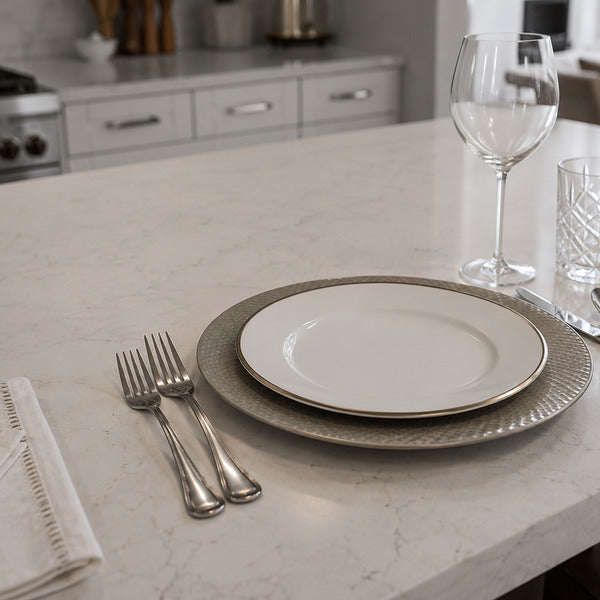
- Place the charger plate at the center of each setting, 1–2 inches from the table edge. The charger (also called a service plate) anchors the setting and stays under the plates through the early courses. If chargers are new to your rotation, our guide to what a charger plate is covers materials and service rules.
- Stack the plates. Dinner plate on the charger; salad plate (and soup bowl, if soup is a course) on top. In plated restaurant service, the dinner plate arrives with the entrée instead.
- Set the forks on the left, outside-in by course: fish fork (if served), then salad fork, then dinner fork closest to the plate.
- Set the knives on the right, blades facing the plate: dinner knife closest, then salad knife.
- Add the spoons to the right of the knives: soup spoon on the outside. A tiny oyster/cocktail fork, if needed, sits outside the soup spoon — the only fork ever placed on the right.
- Place dessert flatware above the plate, horizontally: dessert spoon closest to the plate with its handle pointing right, dessert fork above it with its handle pointing left.
- Set the bread plate at the upper left, above the forks, with the butter knife laid across it, blade down and handle pointing right.
- Arrange the glassware above the knives: water glass directly above the dinner knife, then white wine and red wine glasses angling down and right at roughly 45 degrees, in pouring order. Never preset more than four glasses per cover.
- Finish with the napkin — formally folded on the charger, or to the left of the forks — and a place card above the dessert flatware if seating is assigned.
Formal table setting etiquette also dictates symmetry: measure settings so flatware sits about a half-inch apart, and sight down the table before service — misaligned covers are the first thing a trained eye catches.
Formal vs. Casual Place-Setting Diagram
Use this numbered key with the diagram above. The same numbering applies to both settings; casual settings simply omit items 1, 6–9, and 12–13.
| # | Item | Position | Casual | Formal |
|---|---|---|---|---|
| 1 | Charger plate | Center, 1–2" from table edge | — | ✓ |
| 2 | Dinner plate | Center (on charger if used) | ✓ | ✓ |
| 3 | Napkin | Left of forks, under forks, or on plate | ✓ | ✓ |
| 4 | Dinner fork | Left of plate, innermost fork | ✓ | ✓ |
| 5 | Salad fork | Outside the dinner fork | Optional | ✓ |
| 6 | Fish fork | Outermost left (if fish course) | — | If served |
| 7 | Bread plate + butter knife | Upper left, above forks | — | ✓ |
| 8 | Dessert fork & spoon | Horizontal, above dinner plate | — | ✓ |
| 9 | Salad knife | Right of plate, outside dinner knife | — | ✓ |
| 10 | Dinner knife | Right of plate, blade inward | ✓ | ✓ |
| 11 | Soup spoon / teaspoon | Right of knives | If needed | ✓ |
| 12 | Water glass | Above the dinner knife | ✓ | ✓ |
| 13 | Wine glasses (white, red) | Right of water glass, 45° angle | Optional (1) | ✓ |
What Are the Main Types of Table Settings?
Table settings are categorized into five standard types — basic, casual (informal), formal, five-course (banquet), and buffet — ranked by how many courses the preset covers. Choosing among them is a menu decision first and a labor decision second: every extra preset piece is another item to polish, place, and wash.
- Basic table setting is the minimum functional cover: plate, napkin, fork, knife, and water glass. Diners, cafés, and quick family meals.
- Casual table setting adds a spoon, optional salad fork, and an optional wine glass. The default for most full-service restaurants.
- Formal table setting presets flatware and stemware for three to four courses, with charger and bread plate. Fine dining and holidays.
- Five-course or banquet setting is the formal setting fully loaded — every course's utensils preset, place cards, menu cards — used for weddings, galas, and plated banquets where hundreds of covers must be identical.
- Buffet setting flips the model: flatware rolled in napkins and stacked plates travel with the guest or wait at the table, while serving lines carry the food. Speed and self-service over ceremony.
A useful operator rule from our own catering customers: preset only what 90% of guests will actually use, and hand-deliver the rest. Unused preset flatware still has to be rewashed once it's touched a cleared table.
How Do You Choose Table-Setting Supplies?
Choose table-setting supplies by matching four factors — durability, washability, stackability, and visual consistency — to your service style and turn count. What works for a 12-person dinner party fails at 300 covers a night, and vice versa.
Buying considerations that matter most, from our work supplying commercial dining rooms:
- Dinnerware: Commercial dinnerware should be chip-resistant and stackable; a uniform white or neutral base lets seasonal accent pieces change the look without replacing the whole set.
- Flatware: 18/10 stainless flatware resists corrosion and keeps its polish through commercial dish cycles; buy 20–30% overage because flatware walks off in bus tubs.
- Glassware: Stock glassware in the exact count of your preset plan (water for all, wine by concept) — every extra stem style multiplies polishing time.
- Napkins and linens: Cloth reads upscale and cuts disposable waste; see our napkins buying guide for weights and folds by concept, and cloth napkins for restaurant-grade options.
- Placemats vs. tablecloths: Placemats suit casual, high-turn service (wipe and reset in seconds); tablecloths suit formal rooms. Woven vinyl options like the Geneva frame slate blue vinyl woven placemat (16" x 12") deliver the texture of fabric with a wipeable surface.
- Chargers and accents: Charger plates, candles, and centerpieces from a coordinated table decor program are the cheapest lever for raising perceived formality without touching the menu.
There's a revenue case for getting this right. The National Restaurant Association's 2026 State of the Restaurant Industry report projects total restaurant and foodservice sales of $1.55 trillion in 2026, with operators competing for guests who, per the same report, are hungry for value "not only in price, but in experience" — and more than 7 in 10 consumers say they'd use restaurants more often if they had more disposable income (data current as of July 2026). A well-set table is the first experience cue a guest sees, and it costs pennies per cover to deliver.
Ready to upgrade your tabletop? Browse our full table decor and display collection for chargers, placemats, candles, and centerpiece-ready accents.
How Does Table Setting Work in a Foodservice Operation?
In foodservice, table setting is a standardized, regulated, repeatable process — not a style exercise. Covers are preset to a spec sheet, checked against a diagram, and reset dozens of times a night, which changes both the rules and the tools.
Three differences separate commercial table setting from home entertaining:
- Food-safety rules apply to preset tables. Under the FDA Food Code (2022 edition, §4-904.11), preset tableware must be protected from contamination by being wrapped, covered, or inverted — and any preset items left unused at a seated table must be removed, cleaned, and sanitized before reuse. This is why many casual concepts preset rolled flatware (napkin-wrapped) rather than open settings, and why banquet teams cover preset glassware until doors open. Handle all preset flatware by the handles only.
- Speed is a spec. A trained server should reset a four-top casual cover in under two minutes. Operations hit that number with consolidated flatware rollups, placemats instead of linen changes, and preset diagrams taped inside the server station. On round dining tables set for banquets, teams work in pairs — one placing chargers and glassware, one following with flatware — so every cover lands identical.
- Consistency is the brand. In 15+ years supplying 40,000+ foodservice operations, we've seen the same pattern: dining rooms that photograph their "perfect cover" and post it at the server station keep their settings consistent through staff turnover, and the ones that don't drift within a month. A laminated diagram costs a dollar; retraining a whole front-of-house doesn't.
Our foodservice customers consistently tell us the highest-ROI tabletop change they've made is switching high-turn sections from linens to washable woven placemats — table resets drop from minutes to seconds, linen service invoices shrink, and the table still reads "finished." It's also why our placemats collection spans looks from rustic basketweave to modern metallics: the placemat has quietly become the workhorse of casual table setting.
Frequently Asked Questions
What are the 5 basic pieces of a table setting?
The five basic pieces of a table setting are the dinner plate, napkin, fork, knife, and spoon. The plate sits in the center, the napkin and fork on the left, and the knife (blade inward) and spoon on the right. Most settings add a water glass above the knife as the sixth piece.
Does the napkin go on the left or right?
The napkin goes on the left — placed to the left of the forks, underneath the forks, or centered on the plate. A napkin is never set to the right of the plate in a standard Western table setting; the right side is reserved for knives, spoons, and glassware.
What are the 7 essentials of a table setting?
The seven essentials of a table setting are the dinner plate, napkin, fork, knife, spoon, water glass, and wine glass. Together they form the standard casual dinner setting; formal settings expand this core with a charger, bread plate, additional course flatware, and extra stemware.
What is the correct placement of the dinner plate?
The dinner plate is placed at the exact center of each place setting, about 1 to 2 inches (2.5–5 cm) from the edge of the table. In formal settings, the dinner plate sits on top of a charger plate; flatware aligns with the plate's bottom edge on either side.
In what order do you set flatware on the table?
Flatware is set in order of use, working from the outside in toward the plate. The utensil for the first course sits farthest from the plate — so a salad fork goes outside the dinner fork, and a soup spoon goes outside the knife. Dessert utensils sit horizontally above the plate in formal settings.
How is a formal table setting different from a casual one?
A formal table setting presets every course — adding a charger plate, bread plate with butter knife, salad and dinner flatware pairs, dessert utensils above the plate, and separate water, white wine, and red wine glasses. A casual table setting covers one course with about five to seven pieces per cover.
Conclusion
Learning how to set a table comes down to one memorable system: plate in the center, forks left, knives and spoons right, drinks above the knife, and everything ordered outside-in by course. Master the six-piece casual cover first, then layer on chargers, bread plates, and stemware when the occasion — or the menu — calls for formal. For operators, the same rules become a spec: consistent, food-code-compliant, and fast to reset.
Set the table your menu deserves. Shop table decor and displays — chargers, placemats, candles, and accents trusted by more than 40,000 foodservice operations — and browse placemats and linens and table covers to build covers that survive real service.