How To Run A Successful Bar
Running a successful bar means controlling pour cost (target 18–24%), managing inventory weekly, training staff on consistent service, and marketing to a defined local audience. Profitable bars keep beverage cost near 20% of sales, track every ounce poured, and treat the bar as a retail operation — not a hangout.
Running a bar looks like the best job in the world from the customer's side of the counter. From the operator's side, it is a retail business with perishable inventory, shrinkage measured in ounces, and margins that live or die on discipline. The good news: the levers that separate profitable bars from failed ones are known, measurable, and manageable. In 15+ years supplying 40,000+ foodservice operations — including neighborhood taverns, hotel bars, and high-volume cocktail programs — we've watched the same handful of habits decide who thrives. This guide covers all of them: the candid realities, the core operations, the equipment, and the marketing that builds regulars.
TL;DR — What Successful Bar Operators Get Right
- Pour cost: keep combined beverage cost between 18% and 24% of beverage sales; audit it weekly.
- Inventory: count weekly, order to par levels, and investigate variance over 2–3%.
- Staffing: hire for hospitality, train for consistency, and certify every server in responsible alcohol service.
- Compliance: protect your liquor license like the asset it is — one violation can end the business.
- Equipment: jiggers, speed pourers, quality cocktail glasses, and organized stations directly protect margins.
- Marketing: define one target audience, own your Google Business Profile, and build regulars through consistency.
| Benchmark | Target | Why It Matters |
|---|---|---|
| Combined pour cost | 18–24% of beverage sales | Every point over target is profit poured away |
| Liquor pour cost | ~15–20% | Highest-margin category; tightest control needed |
| Draft beer pour cost | ~20–24% | Foam waste and unrecorded pours add up fast |
| Wine pour cost | ~22–28% | Spoilage after opening drives cost up |
| Inventory count frequency | Weekly | Monthly counts hide shrinkage for 30 days |
| Inventory variance | ≤2–3% | Above that signals over-pouring, waste, or theft |
Pour-cost benchmarks reflect widely used industry guidance; see sources cited below. Current as of August 2026.
How Hard Is It To Run a Bar?
Running a bar is hard: expect 60–80 hour weeks in year one, single-digit net margins on total sales, and a survival curve that punishes sloppy operators. U.S. Bureau of Labor Statistics data shows roughly 1 in 5 new private-sector establishments close within their first year, and only about half survive five years (BLS Business Employment Dynamics, current as of August 2026). Bars aren't exempt from those odds — they earn their reputation as a tough business honestly.
The forum threads are right about the grind and wrong about the hopelessness. What the candid Reddit posts rarely explain is why bars fail: it's almost never the concept, and almost always the controls. A bar that sells $50,000 of beverages a month at a 22% pour cost keeps $11,000 more gross profit per year than the identical bar running at 24% — from a two-point difference nobody notices without weekly counts.
Here is the honest math of bar profit margins:
- Gross margins on beverages are excellent. A well-run bar keeps 76–82 cents of every beverage dollar before labor and overhead. Most industry benchmarks place average liquor cost between 18% and 24% of sales (Sculpture Hospitality, current as of August 2026).
- Net margins are thin. After rent, labor, insurance, licensing, utilities, and shrinkage, typical bar net margins land in the mid-single digits to low teens. High-rent markets compress that further.
- The industry backdrop is growing but cost-pressured. The National Restaurant Association projects total restaurant and foodservice sales to reach $1.55 trillion in 2026, with operators adding more than 100,000 jobs — while flagging persistent cost increases as the defining challenge (National Restaurant Association, 2026 State of the Restaurant Industry, current as of August 2026).
The takeaway: demand for bars is real and growing, but the margin for operational error keeps shrinking. Everything below is about widening it back out.
How To Run a Successful Bar: Core Operations
Successful bar management comes down to four systems: inventory, pour cost, staffing, and compliance. Master these four and most other problems — cash flow, consistency, even reviews — take care of themselves.
How Do You Manage Bar Inventory?
Bar inventory management means counting every bottle, keg, and case on a fixed weekly schedule, setting par levels for each SKU, and ordering to par — not to gut feel. Our foodservice customers consistently tell us the same thing: the week they switched from monthly to weekly counts is the week they found their shrinkage.
- Count weekly, same day, same person(s). Consistency makes variance meaningful. Use tenths-of-a-bottle estimates or a scale for open bottles.
- Set par levels. Par = average weekly usage + safety buffer. Order the difference between par and on-hand. This kills both stockouts and cash tied up in dead stock.
- Track variance. Compare ounces sold (from your POS) against ounces used (from inventory). A variance above 2–3% means over-pouring, unrecorded comps, waste, or theft — find out which.
- FIFO everything. First in, first out — especially wine, beer, juices, and garnishes. Spoiled product is pour cost you can't even serve.
- Organize the backbar and underbar. Counts go faster and errors drop when every bottle has a home. Dedicated underbar equipment and labeled shelving turn a 3-hour count into a 45-minute one.
What Is Pour Cost and How Do You Control It?
Pour cost is the cost of the beverage divided by the price it sells for, expressed as a percentage. If a cocktail costs you $1.90 in ingredients and sells for $10, its pour cost is 19%. Industry guidance places a healthy combined pour cost between 18% and 24%, with liquor at the low end and wine at the high end.
Controlling pour cost is mostly about controlling the pour:
- Jigger every drink. Free-pouring "to speed things up" costs real money: an extra quarter-ounce on every 1.5 oz pour is 16% liquor waste. Measured pours with jiggers keep recipes consistent and costs predictable.
- Cost every recipe. Build drink costs from actual invoice prices, ounce by ounce, and reprice when supplier costs move. Update menus quarterly, not annually.
- Price by category. Spirits are commonly priced at 4–5x bottle cost per pour, with beer and wine at 2–3x. Anchor premium items so mid-tier options look like the smart buy.
- Log waste and comps. Every spilled drink, mis-ring, and buyback goes in a log. Untracked giveaways are the most common source of "mystery" variance we hear about from operators.
- Batch high-volume cocktails. Pre-batching your top sellers cuts pour variance and speeds service — our guide to batching cocktails covers ratios and dilution.
How Do You Staff and Train a Bar Team?
Bar staffing succeeds when you hire for hospitality and train for technique — not the reverse. Drink recipes can be taught in weeks; genuine warmth behind the bar cannot. A great bartender is a salesperson, quality-control inspector, and host in one role, and the position is in demand: BLS projects bartender employment to grow 6% from 2024 to 2034, faster than the average occupation (BLS Occupational Outlook Handbook, current as of August 2026).
- Write a recipe book and enforce it. Same drink, same spec, every shift. Guests notice inconsistency before they notice anything else.
- Structure the support roles. A good barback keeps ice, glassware, and garnishes flowing so bartenders never leave the well — see our breakdown of what a barback does.
- Certify everyone in responsible service. Alcohol-server training (state-approved programs) reduces liability and is mandatory in many states.
- Cross-train and create a path. Barback to bartender to lead is a real career ladder; staff who see it stay longer. If you're building a team from scratch, our guide on how to become a bartender is a useful training baseline.
- Schedule to sales, not habit. Match labor hours to your POS sales curve by hour. Overstaffed slow nights quietly eat the margin your pour-cost discipline earned.
What Compliance Rules Does a Bar Have To Follow?
Bar compliance means protecting your liquor license, serving legally, and keeping your premises safe — and it is the one system where a single failure can end the business.
- Liquor license: know your state alcoholic beverage control (ABC) rules on hours, service limits, and renewals. Calendar every renewal date twice.
- ID checks: 100% carding policy under a set age threshold, no exceptions for regulars. Sting operations target inconsistent bars.
- Over-service: train staff to slow, then stop, service to visibly intoxicated guests. Dram shop laws in most states make the bar liable for what happens after over-service.
- Health and safety: glass-washing sanitation, ice handling (ice is legally a food), pest control, and slip-resistant bar mats in service wells.
- Insurance: general liability plus liquor liability, reviewed annually as revenue grows.
The Bar Operations Checklist
| System | Daily | Weekly | Monthly |
|---|---|---|---|
| Inventory | Restock to par; log waste & comps | Full count; variance report; place orders | Review dead stock; renegotiate top-10 SKUs |
| Pour cost | Jigger enforcement; spot-check pours | Pour cost by category vs. target | Re-cost recipes against invoices; adjust menu |
| Staffing | Pre-shift briefing; station checks | Schedule vs. hourly sales curve | Training session; certification audit |
| Compliance | ID checks; incident log | Sanitation deep-clean | License/insurance calendar review |
| Marketing | Respond to reviews | Post events/specials; email or SMS blast | Review traffic by daypart; plan next promo |
Stocking up or replacing worn tools? Browse our full bartending supplies collection — jiggers, shakers, strainers, and speed pourers that make the systems above stick.
What Equipment Does a Successful Bar Need?
A successful bar needs measured pouring tools, durable mixing equipment, correct glassware, and an organized station — because equipment is not décor, it is margin control. In 15+ years supplying 40,000+ foodservice operations, we've seen the pattern repeatedly: bars that invest in consistent tools run lower pour costs than bars that improvise, simply because every drink comes out the same.
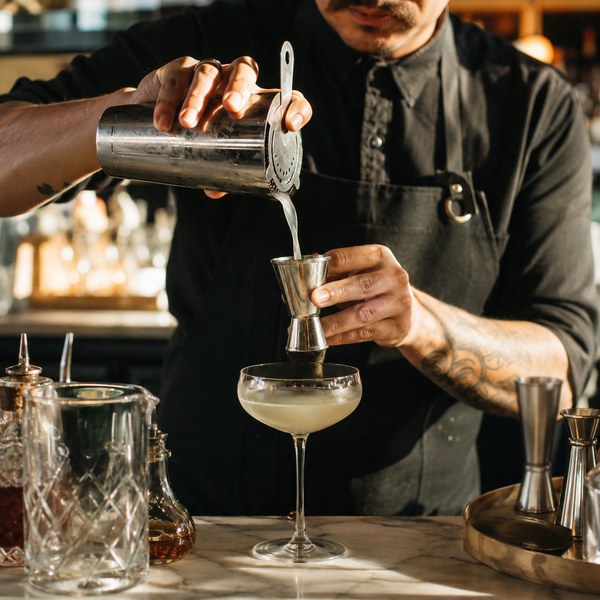
Pouring and Mixing Tools
- Jiggers and speed pourers are the cheapest pour-cost insurance you can buy. Stock one jigger per well, minimum. Our Bar Lux line covers commercial-grade jiggers, strainers, muddlers, and bar spoons built for nightly volume.
- Cocktail shakers in weighted stainless steel — Boston shakers for speed, cobbler shakers for training new staff. Buy multiples; a wet, in-use shaker is the #1 mid-rush bottleneck.
- Bar utensils — muddlers, strainers, mixing spoons, citrus tools — standardized across stations so any bartender can work any well.
Glassware
- Match the glass to the drink. Coupes, rocks glasses, highballs, and martini glasses are portion control in disguise: the right cocktail glasses enforce recipe volumes and elevate perceived value — the same $12 cocktail reads as $15 in the correct glass. Our cocktail glasses buying guide maps styles to drinks.
- Buy commercial-grade glassware rated for thermal shock and commercial washing. Replacement cost on cheap glass exceeds the upfront savings within months at bar volume.
- Stock 2–3x seat count in your top two glass styles so service never waits on the dish pit.
Station Organization
- Bar caddies keep napkins, straws, picks, and garnish tools in fixed positions — seconds saved per drink compound into covers per night.
- Well layout: ice, most-poured bottles, jigger, and shaker within a one-step reach. Mirror the layout at every station so muscle memory transfers.
- Mats and liners under service wells and drying racks protect glassware, reduce breakage, and keep footing safe on wet floors.
How Do You Market a Bar and Build Regulars?
Marketing a bar means picking one clearly defined audience, being findable the moment someone searches "bar near me," and converting first-timers into regulars through consistency. Regulars are the entire economic model: a guest who visits weekly is worth 50x the one who visits once.
- Define the concept in one sentence. "Craft cocktails for date night," "the neighborhood sports bar," "industry hangout after close." Every menu, playlist, and promo decision gets tested against that sentence. Bars that try to be everything to everyone become nothing to anyone.
- Own your Google Business Profile. Accurate hours, current photos, and replies to every review — positive and negative. For most bars this single free channel out-delivers paid ads.
- Program the slow nights. Trivia, industry night, tasting flights, live acoustic sets — recurring weekly programming gives people a reason to form a habit, and habits are what regulars are made of.
- Capture contacts. An email or SMS list you own beats an algorithm you don't. A simple "join for a birthday drink" signup converts steadily.
- Train staff to remember. Names, usual orders, "we got that bourbon you asked about." Recognition is the cheapest loyalty program ever invented — and the one chains can't copy.
- Watch the dayparts. Your POS tells you which hours drag. Fix the specific daypart with a targeted offer instead of discounting the whole week.
Frequently Asked Questions
How hard is it to run a bar?
Running a bar is genuinely hard: long nights, thin net margins, and constant staffing and compliance demands. Per BLS data, about 1 in 5 new establishments close within a year and roughly half within five years. Operators who control pour cost, count inventory weekly, and build regulars consistently beat those odds.
What is the 50% rule in bartending?
The 50% rule in bartending has two common meanings. The service version: offer a guest their next drink when the current one is about half empty, so service stays ahead of demand. The craft version: spend 50% of your effort on making the drink well and 50% on hospitality — the connection with the guest.
What are the 5 P's of bartending?
The 5 P's of bartending are a common training shorthand for what makes a professional bartender: Preparation (a stocked, organized station), Presentation (drink and personal appearance), Professionalism (composure and responsible service), Pace (speed without sloppiness), and Personality (the hospitality that builds regulars).
Can you make $1,000 a night bartending?
Yes, but rarely and only in specific venues — high-volume nightclubs, casinos, or premium cocktail bars on peak nights, where tips drive most of it. It is not typical: BLS reports the 2024 median bartender pay at $33,530 per year ($16.12/hour including tips). Skilled bartenders in busy markets can earn well above the median, but $1,000 nights are the exception, not the schedule.
What type of business has the highest rate of failure?
No single industry "always" fails most, but BLS establishment-survival data shows roughly 20% of new private-sector businesses close within their first year and about half within five years — and hospitality businesses like bars and restaurants consistently track at or below those averages. The differentiator is operational control, not the category itself.
Can you run a bar with no experience?
You can, but stack the deck first: work behind a bar (even part-time) before you own one, hire an experienced bar manager, and adopt the systems in this guide — weekly inventory, costed recipes, and certified staff — from day one rather than after the first bad quarter.
Final Thoughts: Run the Bar Like a Business, Enjoy It Like a Bar
Running a bar rewards discipline disguised as hospitality. Count weekly, jigger every pour, protect the license, and give one specific crowd a reason to come back every week — that is the whole playbook, executed nightly. The operators we've supplied for over a decade who follow it don't just survive the industry's odds; they quietly compound single-digit margins into durable businesses.
When you're ready to tighten the tools behind the bar, explore our bartending supplies, Bar Lux cocktail tools, and cocktail glasses collections — commercial-grade equipment, in stock and ready to ship.