How To Open An Automat Restaurant: 9 Steps
An automat restaurant is a self-service eatery that sells fresh, ready-to-eat meals from coin- or app-operated vending compartments instead of counter staff. Opening one takes nine steps: concept and business plan, permits, location, automat machinery, kitchen equipment, menu engineering, payment technology, back-of-house staffing, and launch marketing.
The automat restaurant is back — and this time it runs on QR codes and smart food lockers instead of nickels and chrome knobs. For operators, the model is compelling: a full hot-food menu served through temperature-controlled compartments, with labor concentrated in the kitchen where it counts. In 15+ years supplying 40,000+ foodservice operations, we've watched self-service formats move from novelty to necessity, and the automat is the most guest-friendly version of that shift. This guide walks through how to open an automat, step by step, from an operator's point of view.
TL;DR — Automat Restaurant At A Glance
- An automat sells fresh, kitchen-made food through self-service vending compartments — no counter staff, full back-of-house kitchen.
- The first U.S. automat opened in Philadelphia in 1902 (Horn & Hardart); the last one closed in New York City in 1991. Modern versions like Automat Kitchen in Jersey City and The Edison Automat in California revived the format with app-driven smart lockers.
- Startup essentials: business entity + health permits, high-foot-traffic location, automat machinery (heated/chilled locker banks), a commercial kitchen, a hold-well menu, cashless payment tech, kitchen staff, and a launch plan.
- Food safety is non-negotiable: the FDA Food Code requires hot food held at 135°F or above and cold food at 41°F or below — your compartments must do both, all day.
- The self-service economics are proven: U.S. convenience services (vending, micro markets, unattended retail) generate more than $41 billion annually, per NAMA.
How does an automat compare to other formats?
An automat combines a ghost kitchen's labor efficiency with a dine-in storefront's guest experience. Here is how the three formats stack up for operators:
| Factor | Automat | Traditional quick-service | Ghost kitchen |
|---|---|---|---|
| Front-of-house labor | Minimal — no cashiers or servers | Cashiers, expo, dining room staff | None — delivery only |
| Guest experience | In-person, self-service novelty | In-person, counter service | App-only, no storefront |
| Core equipment spend | Heated/chilled locker banks + kitchen | Kitchen + POS + dining room | Kitchen + packaging + delivery tech |
| Menu constraint | Items must hold at safe temps in compartments | Cooked to order | Items must survive delivery transit |
| Revenue channels | Walk-up, grab-and-go, pickup | Dine-in, drive-thru, delivery | Delivery, pickup |
What Is an Automat Restaurant?
An automat restaurant is a waiter-less, cashier-less eatery where guests buy hot meals, sandwiches, and desserts from glass-fronted, temperature-controlled compartments. A full kitchen behind the wall restocks each compartment as items sell. The guest pays at the machine — historically with coins, today with a card, phone, or app — and the door unlocks.
The format has deep American roots. Horn & Hardart opened the first U.S. automat in Philadelphia in 1902 and brought it to New York in 1912, where it became a Depression-era icon before the last location closed in 1991, according to HISTORY. The modern revival — led by concepts like Automat Kitchen in Jersey City and The Edison Automat in California — swaps coin slots for smart lockers, mobile ordering, and real-time kitchen software. For the full story of the format's comeback, read our companion piece on the return of automat restaurants in the United States; this guide stays focused on how to open one.
How do automats work today?
Modern automats work through a simple loop: the kitchen cooks in small batches, loads finished items into heated or chilled lockers, and the system lists each item on a touchscreen or app in real time. A guest orders and pays digitally, a specific locker door lights up and unlocks, and the guest grabs the food — often in under a minute. Kitchen display software tells cooks what to replenish, so compartments never sit empty during a rush. It is grab-and-go speed with fresh-cooked quality, which is exactly why the format is winning a second life.
The 9 Steps To Setting Up An Automat
These are the nine steps to opening an automat restaurant, in the order most operators should tackle them. Steps in setting up a small business — entity, permits, financing — come first; machinery and menu decisions follow.
1. Define your automat concept and business plan
Your concept decides everything downstream: menu, machinery, and location. Decide whether you're building a hot-meal automat (comfort food in heated compartments), a chilled grab-and-go automat (salads, bowls, bento), or a hybrid with both locker temperatures. Write a business plan that covers startup costs, projected daily transactions, average ticket, and labor savings versus a counter-service model. Be honest about the automat's core math: you're trading front-of-house payroll for higher upfront equipment spend. The demand backdrop is favorable — the National Restaurant Association projected industry sales to reach $1.5 trillion in 2025 with 15.9 million employed — but automats win or lose on throughput, so plan around a location's realistic foot traffic, not industry averages. Foodservice note: if you have never operated a food business, consider validating your menu at a lower-cost format first — our guide to how to start a pop-up restaurant shows how operators test concepts before committing to buildout.
2. Form your business entity and secure licenses and permits
Register a legal entity — most independent automat operators choose an LLC for liability protection — then open a dedicated business bank account, get an EIN, and start the permit stack. An automat needs the same core paperwork as any restaurant: a business license, food service establishment permit, food handler/manager certifications, and a health department inspection. Because the automat model stores ready-to-eat food in unattended compartments, expect your health inspector to scrutinize holding temperatures, restock logs, and labeling more closely than they would a made-to-order line. Some jurisdictions also classify food-dispensing machinery under vending regulations, which can mean a separate vending license per machine bank. Call your county health department early — permitting timelines, not construction, are what most often delay openings. Foodservice note: build your HACCP-style temperature log system before the inspection, not after; it is the single most common gap we hear about from operators launching self-service concepts.
3. Choose a high-traffic location
Automats live and die on walk-by volume. The original Horn & Hardart automats thrived next to transit hubs and office districts, and the modern math is identical: target lunch-heavy corridors, transit stations, hospitals, universities, and mixed-use developments where guests value a 60-second transaction. Because there's no dining-room labor, you can profitably run a smaller footprint than a typical quick-service restaurant — many modern automats operate in 800–1,500 square feet. Check zoning for food service use, confirm the space supports commercial kitchen ventilation, and verify electrical capacity: a wall of heated and refrigerated lockers plus a cookline draws significantly more power than a retail tenant. If you're evaluating shared or non-traditional spaces, our explainer on what a food hall is covers how self-service concepts slot into multi-vendor venues.
4. Purchase your automat machinery
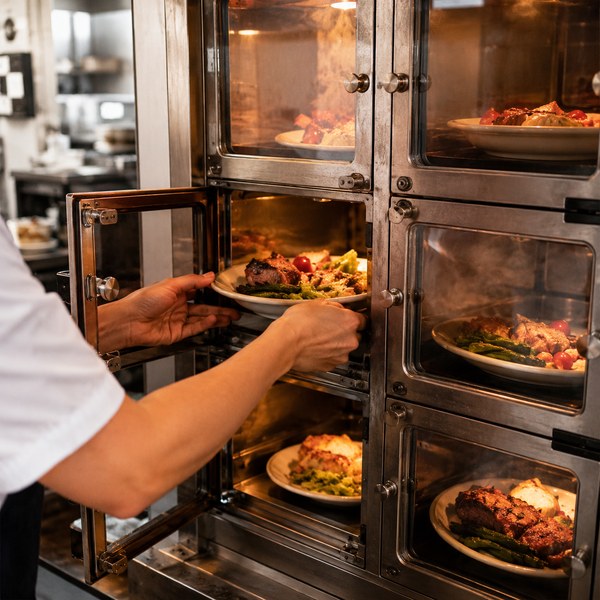
The locker wall is the heart of an automat vending restaurant, and it's where you should spend your research hours. Modern automat machinery falls into three buckets: heated food lockers (hot holding at 135°F+), refrigerated lockers (41°F or below), and ambient compartments for shelf-stable items and packaged desserts. Spec each bank for your menu mix — a comfort-food automat might run 70% heated compartments, while a salad-forward concept flips that ratio. Prioritize units with individually controlled, monitored compartments and API access so your ordering software can assign lockers automatically. Ask vendors hard questions about door-cycle durability (a busy automat can cycle each door 50+ times a day), NSF certification, and remote temperature alerts. Plan for redundancy: one failed locker bank at lunch is a revenue outage, not an inconvenience.
5. Outfit the back-of-house kitchen
Behind every automat wall is a working commercial kitchen — the guest never sees it, but it does all the work. You'll need the standard cookline for your menu (ovens, ranges, fryers, or combi units), refrigeration, prep tables, and smallwares, plus the automat-specific layer: staging racks and holding cabinets that keep batches at safe temperatures between cooking and locker loading. Browse our restaurant equipment collection for the core buildout, and treat food holding & warming equipment as mission-critical rather than optional — in an automat, holding equipment is the bridge between cook time and sell time. Our foodservice customers consistently tell us the same thing after opening self-service concepts: they underestimated holding capacity, and it capped their lunch throughput. Size your holding line for your peak hour, not your average one.
6. Engineer a menu that holds well
Automat food has one non-negotiable requirement: it must taste as good at minute 40 in a compartment as it did at minute one. That rules out fried items that steam themselves soggy and rewards braises, baked pastas, sandwiches, grain bowls, soups, and pies — not coincidentally, the classic Horn & Hardart lineup. Engineer every item around FDA Food Code holding rules: hot foods held at 135°F or above and cold foods at 41°F or below, with anything between those temperatures in the danger zone. Set a maximum compartment dwell time per item — many operators use 60–90 minutes for hot food, well inside safety limits but tight enough to protect quality — and build your batch-cooking cadence backward from it. Package for the format: vented lids for crisp items, clear windows so guests can see the food, and tamper-evident seals if you'll offer takeout. Keep the menu tight at launch; 12–18 well-engineered items outperform 40 mediocre ones in both food cost and compartment turnover.
7. Set up payment and ordering technology
The coin slot is gone; today's automat runs on a cashless stack. You'll need four connected pieces: a kiosk or mobile app for ordering, a payment processor for tap-to-pay and digital wallets, locker-control software that assigns and unlocks compartments, and a kitchen display system that tells cooks what to replenish. Choose a platform where these talk to each other natively — bolting a generic POS onto proprietary locker software is where most tech headaches start. Our comparison of the best POS systems for restaurants covers the evaluation criteria that matter: hardware reliability, integration openness, and per-transaction fees. Add loyalty from day one — automats skew toward repeat weekday lunch customers, exactly the audience loyalty programs move. And build for data: compartment-level sales tracking tells you which items to cut with a precision counter-service operators rarely get.
8. Hire and train your back-of-house team
An automat concentrates nearly all labor in the kitchen, which changes who you hire and how you train. A typical independent automat runs with 3–6 kitchen staff per shift and zero front-of-house employees — but those kitchen roles carry more responsibility than a standard line position. Every cook is also a stocker, a quality checker, and a food-safety monitor. Train the team on three automat-specific disciplines: batch timing (cooking to the replenishment forecast, not to order), locker loading with first-in-first-out labeling and time stamps, and temperature verification at every load. Assign one person per shift to own the guest-facing floor — wiping locker glass, helping first-timers, and clearing jams — because "unattended" retail still needs a human safety net. Cross-training matters more here than in most formats; a called-out shift in a six-person kitchen has nowhere to hide.
9. Launch with marketing that shows the experience
The automat's biggest marketing asset is that it is inherently filmable. A wall of glowing compartments, a door popping open, a hot chicken pot pie behind glass — this is short-form video material, and successful modern automats lean into it. Seed local food creators before opening day, run a soft launch for the immediate neighborhood, and put your ordering app's QR code on every surface. Lead your messaging with the two things guests actually care about: real kitchen-cooked food (fight the "vending machine" perception head-on) and speed (under a minute from tap to tray). Nostalgia is your amplifier — the automat NYC story earns press coverage that a generic fast-casual opening never will — but novelty gets the first visit only; food quality gets the second. Track week-one item sellouts obsessively and adjust batch plans daily.
What Should Operators Consider When Buying Automat Equipment?
Buying for an automat means scoring every purchase on four criteria: temperature integrity, cycle durability, software openness, and serviceability. Use this checklist before signing any equipment order:
- Temperature integrity: Every hot compartment must hold 135°F+ and every cold compartment 41°F or below — continuously, with remote monitoring and alerts. Ask for third-party performance data, not brochure claims.
- Certification: Look for NSF/ANSI-certified food equipment and UL-listed electrical components; your health inspector will.
- Cycle durability: Doors, hinges, and locks are the failure points. Ask for rated door cycles and warranty terms specific to high-traffic use.
- Software openness: Locker systems with open APIs integrate with your ordering and KDS stack; closed systems lock you into one vendor's roadmap.
- Serviceability: Confirm local technician coverage and parts lead times. A locker wall you can't repair in 48 hours is a liability.
- Back-of-house match: Size holding cabinets, transport racks, and staging space to your locker capacity so the kitchen can actually feed the wall at peak.
The broader self-service economy validates the investment: U.S. convenience services — vending, micro markets, and unattended retail — generate more than $41 billion annually and support over 171,000 jobs, per the National Automatic Merchandising Association (NAMA). Micro markets, the automat's closest unattended cousin, grew from $2.4 billion in 2019 to an estimated $5.4 billion in 2023, according to NAMA's industry census. Guests have already voted for self-service; the automat simply serves them better food. (Figures current as of August 2026.)
How Restaurantware Supports Automat Operations
Restaurantware supplies the back-of-house layer that makes an automat wall work. In 15+ years supplying 40,000+ foodservice operations, we've seen self-service concepts succeed or stall based on unglamorous details: whether the holding cabinet keeps a braise at temp through the lunch rush, whether the container lid vents steam without leaking, whether the kitchen can stage the next batch while the current one sells.
Three categories do the heavy lifting for automat operators:
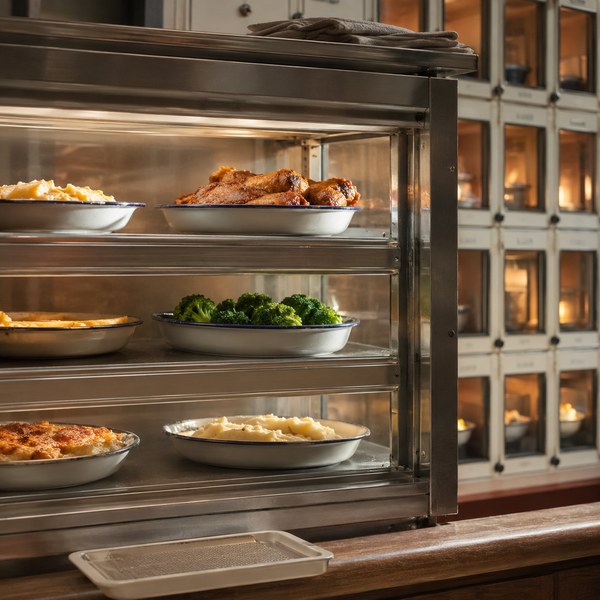
- Food holding & warming equipment — countertop warmers, holding cabinets, and heated displays that bridge cook time and compartment loading while keeping food above 135°F.
- Restaurant equipment — the cookline, refrigeration, and prep gear behind the wall.
- Delivery Tek — insulated bags and transport solutions if your automat adds a pickup-and-delivery channel, which most modern operators do within the first year.
Pair the equipment with smart workflow: our piece on the impact of technology on kitchen efficiency covers how kitchen display systems and batch-cooking software cut the replenishment lag that empties compartments during a rush.
Frequently Asked Questions
Are there any remaining automats?
Yes. While the original Horn & Hardart chain is gone, modern automats operate today — Automat Kitchen opened in Jersey City in 2021 with app-driven hot-food lockers, and The Edison Automat serves the format in California. Automat-style smart-locker service also appears inside airports, hospitals, and college dining programs across the U.S.
Is there still an automat in NYC?
New York City's original automats are gone — the last Horn & Hardart in Manhattan closed in 1991. The automat NYC revival has appeared in waves since, including locker-based concepts in Brooklyn and Manhattan food halls, and the format's transit-hub economics still fit the city well, so new entrants keep testing it.
Why did automats go away?
Automats declined because their economics broke, not because guests stopped liking them. Coin-operated machines couldn't keep pace with inflation, suburban car culture pulled lunch traffic away from downtown walk-up locations, and fast-food chains out-competed them on price and speed. The last Horn & Hardart automat closed in New York City in 1991, per HISTORY.
Is the automat coming back?
Yes — cashless payments and smart-locker technology solved the two problems that killed the original format. Modern automats pair a real kitchen with app ordering and temperature-monitored compartments, and the surrounding self-service economy is expanding, with U.S. convenience services generating over $41 billion annually per NAMA. Our post on the return of automat restaurants tracks the revival in detail.
Do I need an LLC and a business bank account to open an automat?
An LLC is not legally required, but most independent automat operators form one for liability protection — food service carries real risk exposure. If you form an LLC, open a separate business bank account; it preserves the liability shield by keeping personal and business finances separate, and your lender, payment processor, and accountant will all require it anyway.
Conclusion
Opening an automat restaurant comes down to nine disciplined steps: a clear concept, clean permits, a high-traffic location, reliable locker machinery, a properly equipped kitchen, a menu engineered to hold, integrated payment tech, a well-trained back-of-house team, and a launch that shows off the experience. The format rewards operators who obsess over temperature integrity and replenishment speed — the wall is only as good as the kitchen behind it. Ready to build that kitchen? Start with our food holding & warming equipment collection — the automat's true workhorse category — and browse the full restaurant equipment lineup to outfit the rest of the line.